The tradition & historical record
6 min read · 2 sourcesTang dynasty art (simplified Chinese: 唐朝艺术; traditional Chinese: 唐朝藝術) refers to Chinese art created during the Tang dynasty (618–907). The period saw significant advancements in arts such as painting, sculpture, calligraphy, music, dance, and literature. During the Tang dynasty, the capital city Chang'an (today's Xi'an), was the most populous city in the known world, and the era is generally regarded by historians as a high point in Chinese civilization and a golden age of Chinese literature and art. In several areas developments during the Tang set the direction for many centuries to come. This was especially so in pottery, with glazed plain wares in celadon green and whitish porcelaineous types brought to a high level, and exported on a considerable scale. In painting, the period saw the peak level of Buddhist painting, and the emergence of the landscape painting tradition known as shanshui (mountain-water) painting. Trading along the Silk Road of various products increased cultural diversity in small China cities. Stimulated by contact with India and the Middle East, the empire saw a flowering of creativity in many fields. Buddhism, originating in what is modern day India around the time of Confucius, continued to flourish during the Tang period and was adopted by the imperial family, becoming thoroughly sinicized and a permanent part of Chinese traditional culture. 1
Painting
A considerable amount of literary and documentary information about Tang painting has survived, but very few works, especially of the highest quality. There is a good deal of biographical information and art criticism, mostly from later periods such as the Ming dynasty, several centuries after the Tang; the accuracy of this needs to be considered, and much of it was probably already based on seeing copies of the art, not originals. With a very few exceptions, traditional attributions of particular scroll paintings to Tang masters are now regarded with suspicion by art historians. A walled-up cave in the Dunhuang (Mogao Caves) complex was discovered by Aurel Stein, which contained a vast haul, mostly of Buddhist writings, but also some banners and paintings, making much the largest group of paintings on silk to survive. These are now in the British Museum and elsewhere. They are not of court quality, but show a variety of styles, including those with influences from further west. As with sculpture, other survivals showing Tang style are in Japan, though the most important, at Nara, was very largely destroyed in a fire in 1949. The rock-cut cave complexes and royal tombs also contain many wall-paintings; the paintings in the Qianling Mausoleum are the most important group of the latter, mostly now removed to a museum. Not all the royal tombs have yet been opened. Court painting mostly survives in what are certainly or arguably copies from much later, such as Emperor Taizong Receiving the Tibetan Envoy, probably a later copy of the 7th century original by Yan Liben, though the front section of the famous portrait of the Emperor Xuanzong's horse Night-Shining White is probably an original by Han Gan of 740–760. 1
Pottery
Chinese ceramics saw many significant developments, including the first Chinese porcelain meeting both Western and Chinese definitions of porcelain, in Ding ware and related types. The earthenware Tang dynasty tomb figures are better known in the West today, but were only made to placed in elite tombs close to the capital in the north, between about 680 and 760. They were perhaps the last significant fine earthenwares to be produced in China. Many are lead-glazed sancai (three-color) wares; others are unpainted or were painted over a slip; the paint has now often fallen off. Sancai was also used for vessels for burial, and perhaps for use; the glaze was less toxic than in the Han, but perhaps still to be avoided for use at the dining table. The typical shape is the "offering tray", a round or circular and lobed shape with geometrically regular floral-type decoration in the centre. In the south the wares from the Changsha Tongguan Kiln Site in Tongguan are significant as the first regular use of underglaze painting; examples have been found in many places in the Islamic world. However the production tailed off and underglaze painting remained a minor technique for several centuries. 1
Yue ware was the leading high-fired, lime-glazed celadon of the period, and was of very sophisticated design, patronized by the court. This was also the case with the northern porcelains of kilns in the provinces of Henan and Hebei, which for the first time met the Western as well as the Eastern definition of porcelain, being a pure white and translucent. 1
Sculpture
Most sculpture before the official rejection of Buddhism in 845 was religious, and a vast amount was destroyed during the Tang period itself, with most of the rest lost in later periods. There were many bronze and wooden sculptures, whose style is best seen in the survivals in Japanese temples. Monumental sculpture in stone, and also terracotta, has survived at several complexes of rock-cut temples, of which the largest and most famous are the Longmen Grottoes and the Mogao Caves (at Dunhuang), both of which were at their peak of expansion during the Tang. The best combined "the Indian feeling for solid, swelling form and the Chinese genius for expression in terms of linear rhythm ... to produce a style which was to become the basis of all later Buddhist sculpture in China." The tomb-figures are discussed above; though probably not treated very seriously as art by their producers, and sometimes rather sloppily made, and especially painted, they remain vigorous and effective as sculpture, especially when animals and foreigners are depicted, the latter with an element of caricature. A rather different class and type of tomb sculpture is seen in the reliefs of the six favourite horses at the mausoleum of Emperor Taizong (d. 649). By tradition these were designed by the court painter Yan Liben, and the relief is so flat and linear that it seems likely they were carved after drawings or paintings. 1
Metalwork and decorative arts
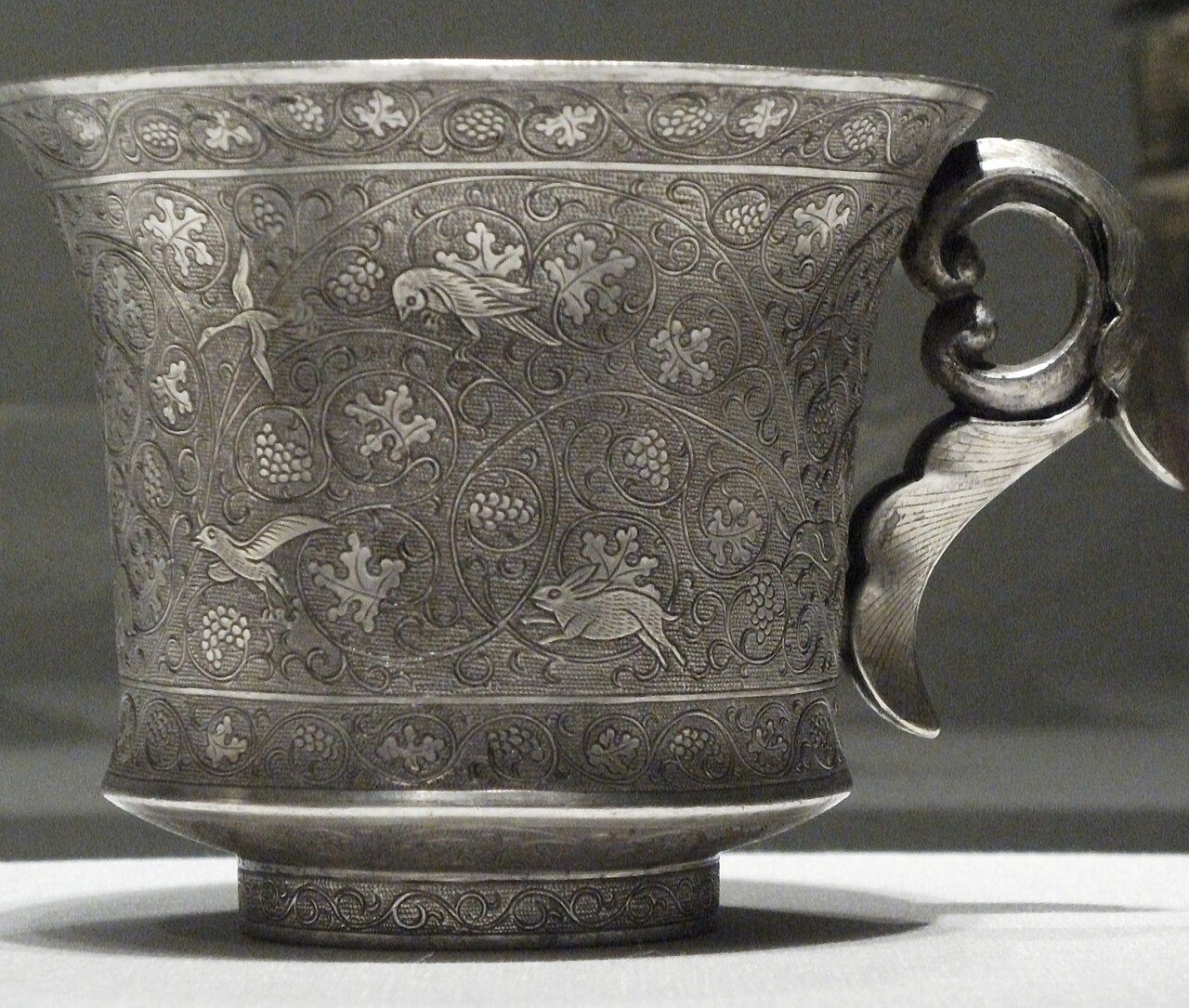
Tang elite metalwork, surviving mostly in bronze or silver cups and mirrors, is often of superb quality, decorated using a variety of techniques, and often inlaid with gold and other metals. An exceptionally fine deposit is the collection in the Tōdai-ji in Nara in Japan of the personal goods of Emperor Shōmu, given to the Buddhist shrine by his daughter Empress Kōmyō after her father's death in 756. As well as metalwork, paintings and calligraphy, this includes furniture, glass, lacquer and wood pieces such as musical instruments and board games. Most is probably made in China, though some is Japanese and some from the Middle East. Another important deposit was discovered in 1970 at Xi'an when the Hejia Village hoard was uncovered by construction. 1
Architecture
There had been an enormous amount of building of Buddhist temples and monasteries, but in 845 these were all confiscated by… 1
The text above is adapted from the Wikipedia article “Tang dynasty art”, available under the Creative Commons Attribution-ShareAlike 4.0 licence. 1
Tang dynasty art is art of the Tang dynasty, according to the structured record cited below. This entry was generated automatically from that record and has not yet been reviewed by a person familiar with the tradition. 2
The source record links this tradition to 4 external registers, which can be verified through the citation. 2