The tradition & historical record
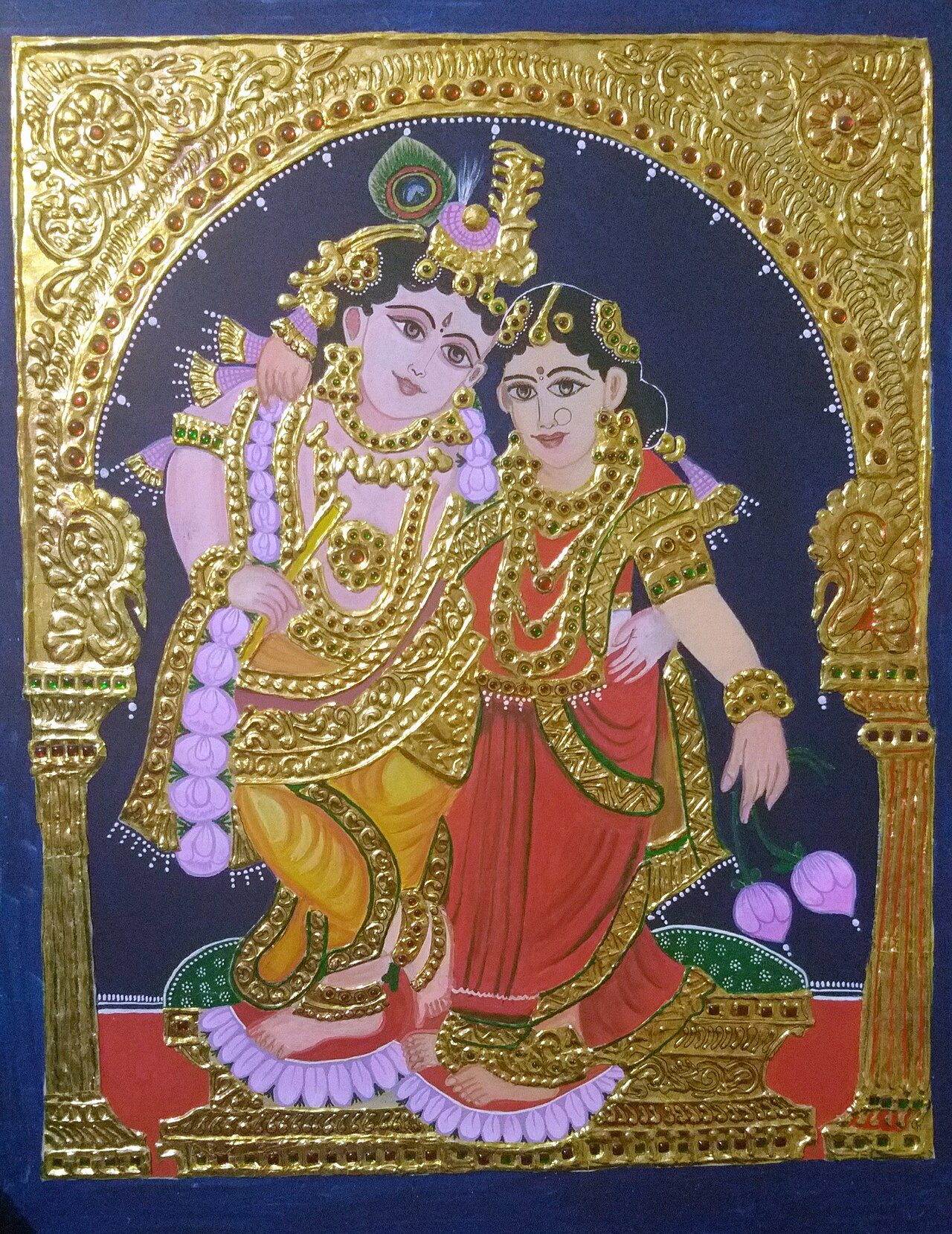
6 min read · 2 sourcesThanjavur painting is a classical South Indian painting style, originating from the town of Thanjavur (anglicized as Tanjore) in Tamil Nadu. The art form draws its immediate resources and inspiration from way back about 1600 AD, a period when the Nayakas of Thanjavur under the suzerainty of the Vijayanagara Rayas encouraged art—chiefly, classical dance and music—as well as literature, both in Telugu and Tamil and painting of chiefly Hindu religious subjects in temples. However, it can safely be surmised that Thanjavur painting, as we know it now, originated in the Maratha court of Thanjavur (1676–1855). It has been recognized as a Geographical indication by the Government of India in 2007–08. Thanjavur paintings are characterised by rich and vivid colours, simple iconic composition, glittering gold foils overlaid on delicate but extensive gesso work, and inlay of glass beads and pieces or very rarely precious and semi-precious gems. In Thanjavur paintings one can see the influence of Deccani, Vijayanagara, Maratha, and even European or Company styles of painting. Essentially serving as devotional icons, the subjects of most paintings are Hindu gods, goddesses, and saints. 1
Style and technique
Thanjavur paintings were made in various sizes depending upon the function, the subject and the choice of the patron. Large paintings of deities and the Maratha rulers, their courtiers and nobility, were painted and installed to serve as architectural accents in the Maratha palaces and buildings. To quote Dallapiccola – "The works, executed on canvas pasted on a wooden support, were framed – a major departure from the pan-Indian tradition, in which paintings are of small size – and designed to be hung on the walls of domestic puja rooms or in bhajan halls. The themes, as in painted albums, (made for European patrons) were usually gods and goddesses, holy places, religious personalities and occasionally portraits. Their dazzling palette consisted generally of vivid reds, deep greens, chalk white, turquoise blues and the lavish use of gold (foil) and inset glass beads. Sometimes precious stones were also used in the paintings. The large format of the majority of such works and the relatively simple composition are the hallmark of the style. This school was greatly inspired by European techniques and was the most popular in Tamil Nadu until the early twentieth century." Paintings in addition to being done on canvas, were also done on walls, wooden panel, glass, paper, mica and exotic media such as ivory. Small Ivory portraits were typically worn as cameo pendants called rajaharam and were quite popular. Thanjavur glass paintings following the techniques of Chinese reverse glass paintings were popularised during Serfoji II's reign as a cheaper and faster craft. The paintings were done on the reverse surface of a glass sheet with strips of metal beaten into transparent gaps to simulate the effect of jewellery and precious stones. 1
Influences
Thanjavur houses the 11th century Chola wall paintings in the Brihadeeswarar temple as also paintings from the Nayak period (many times superimposed on the earlier Chola paintings) dating to the 16th century. In 1521–22, Krishnadevaraya travelled to the Tamil country visiting holy places and as was his wont, made munificent donations to temples and other religious establishments. It can be surmised that some of this munificence was also channeled into art and artists. The fall of the Vijayanagara Empire and the sack of Hampi in the Battle of Talikota in 1565 CE resulted in the migration of painters who had been dependent on the patronage of the empire. Some of them migrated to Thanjavur and worked under the patronage of the Thanjavur Nayakas. The Thanjavur Nayaka line commenced with Sevappa Nayaka (1532–72). Sevappa ruled for several years, ably supported by his son Achyutappa (1564–1614), who later succeeded him. It was during Achyutappa's reign that the Vijayanagara empire fell, leading to the exodus of numerous litterateurs, philosophers, musicians and artists who migrated to several other neighbouring kingdoms like Mysore and Thanjavur. Achyutappa was succeeded by his son Raghunatha Nayaka who in turn was succeeded by Vijayaraghava Nayaka. Raghunatha, who was possibly the most successful Thanjavur Nayaka ruler, was also a great patron of art and artists and helped establish the unique school of Thanjavur artists who later evolved the Thanjavur style of paintings under the Marathas. Subsequently, the Maratha rulers who defeated the Thanjavur Nayakas began to nurture the Thanjavur atelier. The artists absorbed the local influences and the individual tastes of their Maratha patrons which helped evolve the unique Thanjavur style of painting. 1
Artists
Tanjore paintings were painted by 'Moochys or Artists of India' according to the British chronicler Charles Gold in his book Oriental Drawings published in 1806. Traditionally, it is well known that the Raju community of Thanjavur and Tiruchi, also called as Jinigara or Chitragara and the Nayudu community of Madurai were the artists who executed paintings in the Thanjavur style. The artists (Rajus & Naidus) were originally Telugu speaking people from the artistically vibrant Rayalaseema region of Andhra, who moved to Tamil Nadu in the wake of the fall of the Vijayanagara empire and the establishment of Nayak rule in Madurai and Thanjavur. The artists turned out a wide repertoire of paintings on different subjects and of varied quality depending upon the patron's interest, urgency and most importantly influence and financial capacity. However, the art was by and large a sacred task to be performed with a reasonable degree of ritual purity and humility by the master craftsmen, many of whom chose to remain anonymous and never signed their paintings, true to the Indian artistic tradition. However a few works signed by the Thanjavur artists are also known. C. Kondiah Raju, the famous calendar artist from Kovilpatti, was one of the illustrious descendants to make a name as an artist during modern times from the Raju community. 1
Tanjore and Mysore paintings
Tanjore and Mysore paintings, both spring from the same source – Vijayanagara paintings to begin with and Nayaka paintings subsequently. The very same artists, Chitragars and Naidus migrated to various places including Thanjavur and Mysore. This is the reason for the remarkable degree of similarity between the two styles. However, there are many differences that can be made out by the discerning viewer. The differences are largely in the techniques used to create these artworks and in their distinct iconography. The techniques adopted by the Mysore artists are slightly different from those of the Tanjore School. While Tanjore School used white lime powder and powdered tamarind seeds with gum arabic on cloth stretched on wooden panels, Mysore artists used white lead powder (Makhisafeda) or Makhi Gamboge (yellow) drawn from the juice of the indigenous tree (Revana Chinni halu) on paper. 1
Tanjore paintings in Company style
Many of the traditional Indian artists were al… 1
The text above is adapted from the Wikipedia article “Thanjavur painting”, available under the Creative Commons Attribution-ShareAlike 4.0 licence. 1
Tanjore painting is classical South Indian painting style, according to the structured record cited below. This entry was generated automatically from that record and has not yet been reviewed by a person familiar with the tradition. 2
The source record links this tradition to 2 external registers, which can be verified through the citation. 2