The tradition & historical record
5 min read · 2 sourcesA tenor drum is a membranophone without a snare. There are several types of tenor drums. 1
Early music
Early music tenor drums, or long drums, are cylindrical membranophones without snare used in Medieval, Renaissance and Baroque music. They consist of a cylinder of wood, covered with skin heads on both ends, that are tensioned by ropes. Played with two sticks, this type of drum varies in pitch, according to its size. 1
Orchestral music
In a symphony orchestra's percussion section, a tenor drum is a low-pitched drum, similar in size to a field snare, but without snares and played with soft mallets or hard sticks. It is larger in diameter than depth, and tonally is midway between the bass drum and an unsnared snare drum. Berlioz scored for 2 tenor drums in the "Grande messe des morts". His "Te Deum" requires 6 tenor drums. Wagner wrote for this drum in "Rienzi", "Lohengrin", "Die Walküre", “Götterdämmerung”, and "Parsifal". Strauss used it in "Ein Heldenleben", and Elgar in his 3rd "Pomp and Circumstance" march. It is noticeable in scores by 20th-century composers such as Stravinsky, Honegger, Milhaud, Benjamin Britten, William Walton, Aaron Copland and Samuel Barber. Witold Lutoslawski calls for a tenor drum in his Concerto for Orchestra and Arnold Schoenberg writes for it in his Gurrelieder. 1
Multi tenor drums (United States and Latin America)
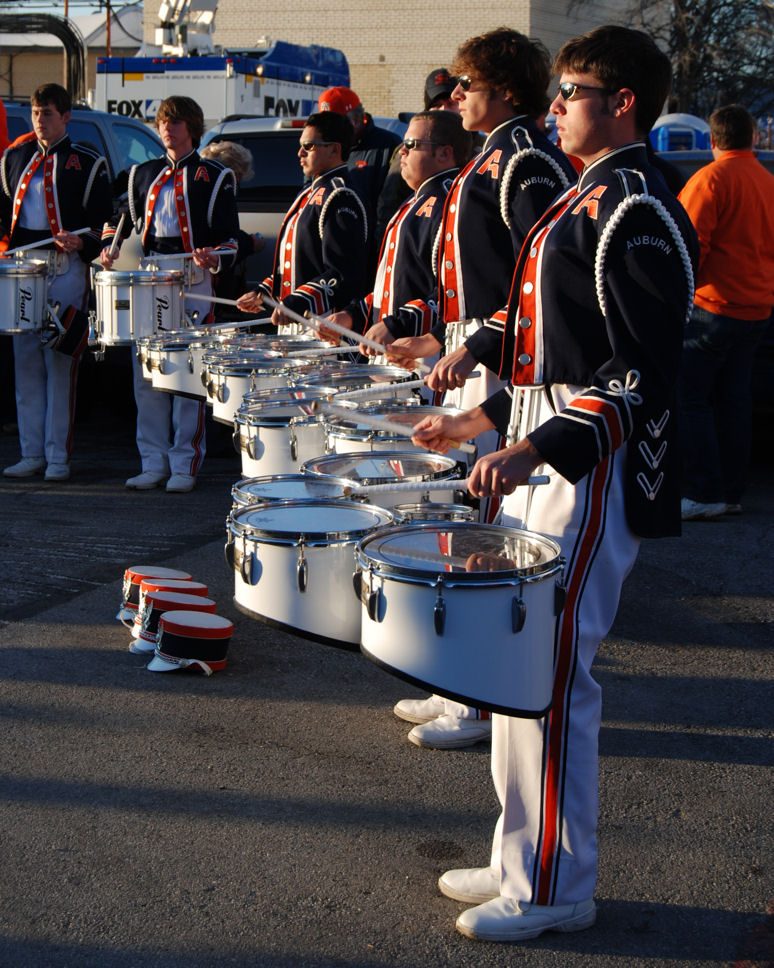
Tenor drums are used as a marching percussion instrument, commonly as mounted sets of 4-6 drums allowing one person to carry and play multiple drums simultaneously. Other names for these drums include names specific to configurations by number of drums: "duos" (2 drums), "tris", "trios", "trips", or "triples" (3 drums), "quads" (4 drums), "quints" (5 drums), and "squints," "hexes," "six-packs," "tenors" or "sextets" (6 drums). The number-specific term "quads" is often used as a generic term for configurations with more than four drums due to it being the original and most common configuration. Typically there are four main drums, usually either 8, 10, 12, and 13 inches in diameter (which is referred to as a high school configuration or small block tenors) or 10, 12, 13, and 14 inches in diameter (referred to as a Corps configuration or big block tenors), plus one or two accent drums (typically 6 or 8 inches in diameter). The accent drums are also known as shot, gock, spock, or spike drums; They are usually tightened as high as they can go to achieve maximum effect. Other percussion instruments, such as cowbells or cymbals mounted to the rim, are sometimes also added. 1
The purpose of the tenors in the marching band is to add more color to the music. In big lines, there can be as many as 6 tenor players. Many high school marching bands will have one to three tenors, while it is typical for World Class drum corps to contain as many as four or five. They tend to supplement the snare part, and often the tenor parts are rudimentally identical to the snare parts. 1
Pipe band tenor drum (United Kingdom)
Originally a rope-tensioned drum, giving way to modern rod tension, the single tenor drum occupied a unique position in the drum corps of military and civilian pipe bands, being used as both timekeepers, accents to the musical ensemble, as well as spectacle. Three types of tenor drum are played in modern pipe bands : 1
Flourishing tenor: Flourishing tenor drummers use beaters on the end of long sticks, which are then tied to the fingers. The beaters are flourished in coordinated movements, while striking the drum; to add "spectacle". Modern pipe bands of average size usually field two to six flourishing tenor drummers. Alto tenor: played in tandem with the bass drum to add sound and keep time. Not all bands use alto tenor drums. Rhythm tenor: played to accent the snare drum part. It usually is played constantly. This type of drum is often used in pipe bands around the world, along with individual solo competitions. It is mainly used in the "flourishing tenor" style, as a part of the bass section (or midsection). 1
Marching band single-head tenor drums
In most countries under the Commonwealth of Nations, as well as in the United States, the Philippines, Taiwan, the Netherlands, Indonesia, Italy, Colombia, Panama, Nicaragua, Guatemala, Bolivia, Peru, Brazil, Germany, Spain and France, the tradition of the single tenor drum is maintained by a few military bands, several police bands and many civil marching bands, corps of drums, classic style drum and bugle corps and fanfare bands. The form of the single tenor drum used in these countries is that of a marching drum similar to a snare drum but is without snares, these drums can also be tuned to have a high pitch so that a line of tenor percussionists can run split parts amongst them, in France, Spain, Italy and Germany the form is that of a cylindric drum similar to those used in the field snare drums and the aforementioned early music drum but without the snares. It can also be referred to as a Flub drum. In the US, single-head tenor drums are popular amongst the ranks of HBCU (historically Black colleges and universities) drumlines, especially in the southern states, where they are used on either the basis of being knee tenors (how snare drums are played) or upright tenors (how bass drums are played). For example, the University of Arkansas at Pine Bluff (UAPB) Marching Musical Machine of the Mid-South's 2 Kold Krank tenor section uses the upright style single-head tenor drums while their rivals, The Alabama State University (ASU) Mighty Marching Hornets' TTB tenor section incorporates the knee single head tenor drums. 1
The text above is adapted from the Wikipedia article “Tenor drum”, available under the Creative Commons Attribution-ShareAlike 4.0 licence. 1
tenor drum is type of drum, according to the structured record cited below. This entry was generated automatically from that record and has not yet been reviewed by a person familiar with the tradition. 2
The source record links this tradition to 4 external registers, which can be verified through the citation. 2