The tradition & historical record
6 min read · 2 sourcesThe Allegory of Good and Bad Government, known in Italian as Allegoria ed effetti del Buono e del cattivo governo, is a series of three fresco panels painted by Ambrogio Lorenzetti between February 1338 and May 1339. The work is located in the Palazzo Pubblico of Siena, specifically in the Sala dei Nove, which translates to the 'salon of the nine'. This room served as the council hall for the nine executive magistrates of the Republic of Siena. An interpretation of the paintings suggests they were "designed to remind the Nine [magistrates] of just how much was at stake as they made their decisions". Considered Lorenzetti's "undisputed masterpiece", the series consists of six different scenes. It is noted that the titles assigned to these scenes are all modern conveniences. These scenes are known as the Allegory of Good Government, the Allegory of Bad Government, the Effects of Bad Government in the City, the Effects of Bad Government in the Country, the Effects of Good Government in the City, and the Effects of Good Government in the Country. 1
Historical context
The Allegory and Effects of Good and Bad Government series was commissioned by the "Council of Nine", a civic group that constituted the city council. Unlike most art of the period, the subject matter is civic rather than religious. The Republic of Siena was one of the most powerful of the fourteenth-century Italian city-states. This century was a turbulent time for politics in Italian cities due to violent party struggles, the overthrow of governments, and the Black Death epidemic. 1
Layout
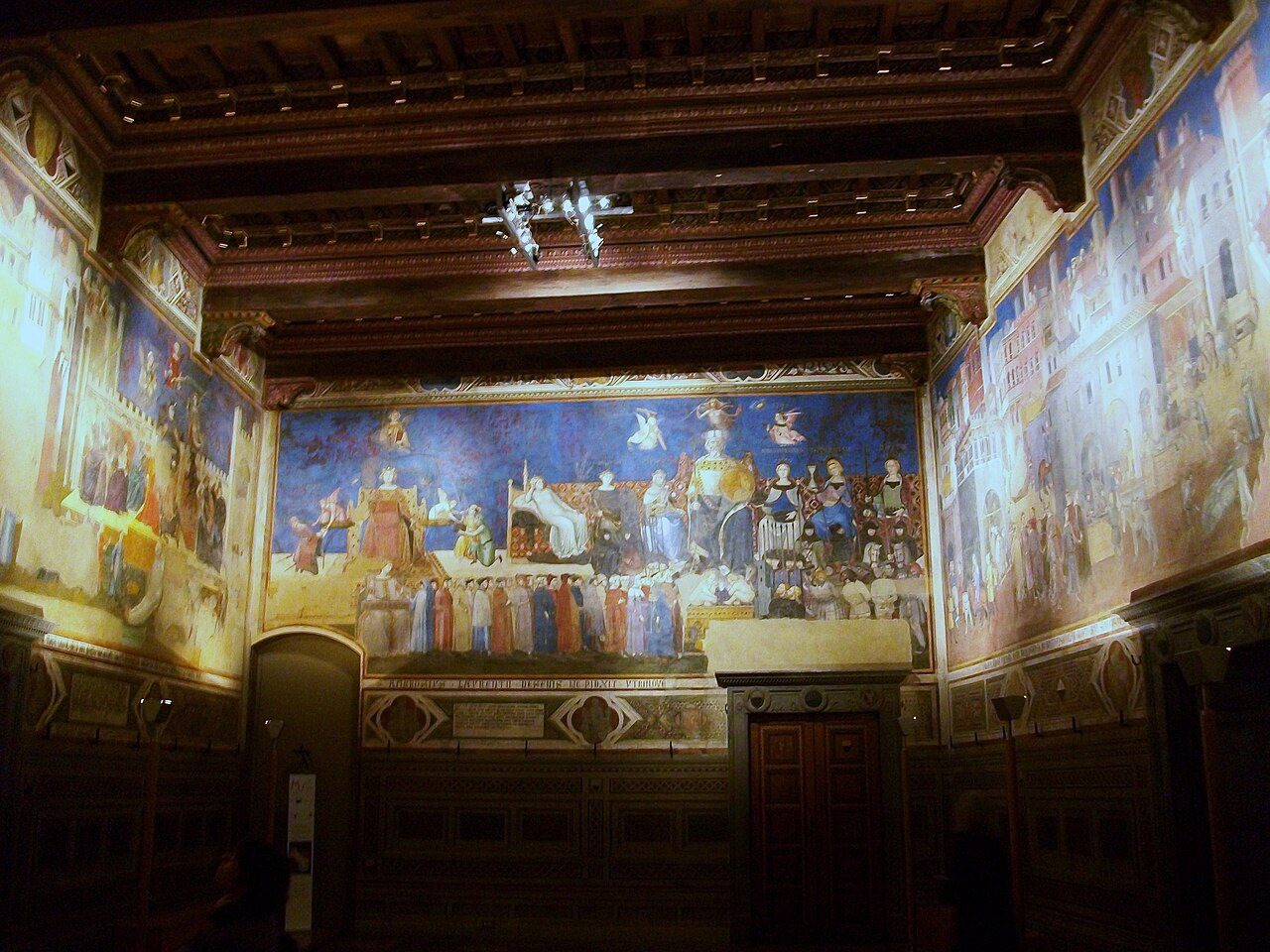
The murals occupy a substantial area, covering three of the four walls within the Council Room. The southern wall remains without a mural. It contains the sole window for the room. The door used by the council for entry is located on the opposite northern wall. On the eastern wall, Lorenzetti depicted scenes of the "Effects of Good Government", while on the opposing western wall he rendered "The Allegory and Effects of Bad Government". Overlooking both of these murals on the northern wall are the personifications of the allegorical depictions of the virtues of good government. 1
Allegory of Good Government
In the Allegory of Good Government, the composition is built up from three horizontal bands. In the foreground, the figures of contemporary Siena are represented. The citizens act as symbolic representations of the various civic officers and magistrates. They are linked by two woven cords, or concords. The concords gather from under the scales of Lady Justice. Behind them, on a stage, there are allegorical figures in two groups, representing the Good Government. The two groups are connected by the procession of the councilors. The upper band indicates the heavenly sphere with the floating bodiless ghosts of the virtues. Wisdom sits above the head of the personification of the Commune of Siena. He sits upon a throne and holds an orb and scepter, symbolizing temporal power. He is dressed in the colors of the Balzana, the black-and-white Sienese coat of arms. Around his head are the letters "C S C V", which stand for "Commune Saenorum Civitatis Virginis", which explains his identity as the embodiment of the Siena Council. That character is guided by the women representing the virtues of Faith, Hope, and Charity. He confers with the proper Virtues necessary for a proper and just ruler. The virtues of Good Government are represented by six crowned, stately female figures: Peace, Fortitude, and Prudence on the left, and Magnanimity, Temperance, and Justice on the right. On the far left of the fresco, the figure of Justice is repeated, as she is balancing the scales held by Wisdom. The figures are naturalistic, and the figures of the women represented the ideal of female beauty in Siena. At the feet of the ruler, two children are depicted playing. They could be the sons of Remus, Ascius and Senius, who, according to Roman legend, are the founders of Siena. 1
Peaceful City
On the longer wall of the room in the Sala is the fresco The Effects of Good Government in the City and in the Country. Part of that fresco is Peaceful City. This panoramic fresco represents several scenes indicating the life of Siena and its environment in the fourteenth century. This painting provides the first accurate panoramic view of the city and the first landscape of countryside since antiquity; viewers may identify some characteristics of the city of Siena, as opposed to ambiguous settings found in other works of the time. The city is filled with clustered palaces, markets, towers, churches, streets, and walls. All of these aspects are reminiscent of town scenes found on ancient Roman murals. There are many shops, indicating good commerce and economic conditions. The traffic moves peacefully, guild members work at their trades, a wedding procession takes place, and maidens may be seen dancing gracefully. Dancers were common for springtime rituals; they also act as a metaphor for a peaceful commonwealth in this painting. The young women might also represent the Nine Muses of the arts and sciences from Greek mythology. This fresco reflects the belief that if government is virtuous and rules justly, the city thrives. There is text along the lower edge of the wall that reads: "Turn your eyes to behold her, you who are governing, who is portrayed here [Justice], crowned on account of her excellence, who always renders to everyone his due. Look how many goods derive from her and how sweet and peaceful is that life of the city where this virtue is preserved that outshines any other. She guards and defends those who honor her, and nourishes and feeds them. From her light come both requiting those who do good and giving due punishment to the wicked." 1
Peaceful Country
The fresco then blends into Peaceful Country. The transition is made by an entourage passing through the city gate and out to the countryside beyond the city walls. The new scene shows a bird's-eye view of the Tuscan countryside, with villas, castles, plowed farmlands, and peasants and farmers leisurely going about their responsibilities. The landscape is particularized, with characteristics that indicate a specific place and environment. The winged allegorical figure of Security hovers above the landscape holding an unfurled scroll promising safety to all who live under the rule of law. Written on her scroll is the text: "Without fear every man may travel freely and each may till and sow, so long as this commune shall maintain this lady [Justice] sovereign, for she has stripped the wicked of all power." 1
The text above is adapted from the Wikipedia article “The Allegory of Good and Bad Government”, available under the Creative Commons Attribution-ShareAlike 4.0 licence. 1
The Allegory of Good and Bad Government is painting by Ambrogio Lorenzetti, according to the structured record cited below. This entry was generated automatically from that record and has not yet been reviewed by a person familiar with the tradition. 2
The source record links this tradition to 3 external registers, which can be verified through the citation. 2