The tradition & historical record
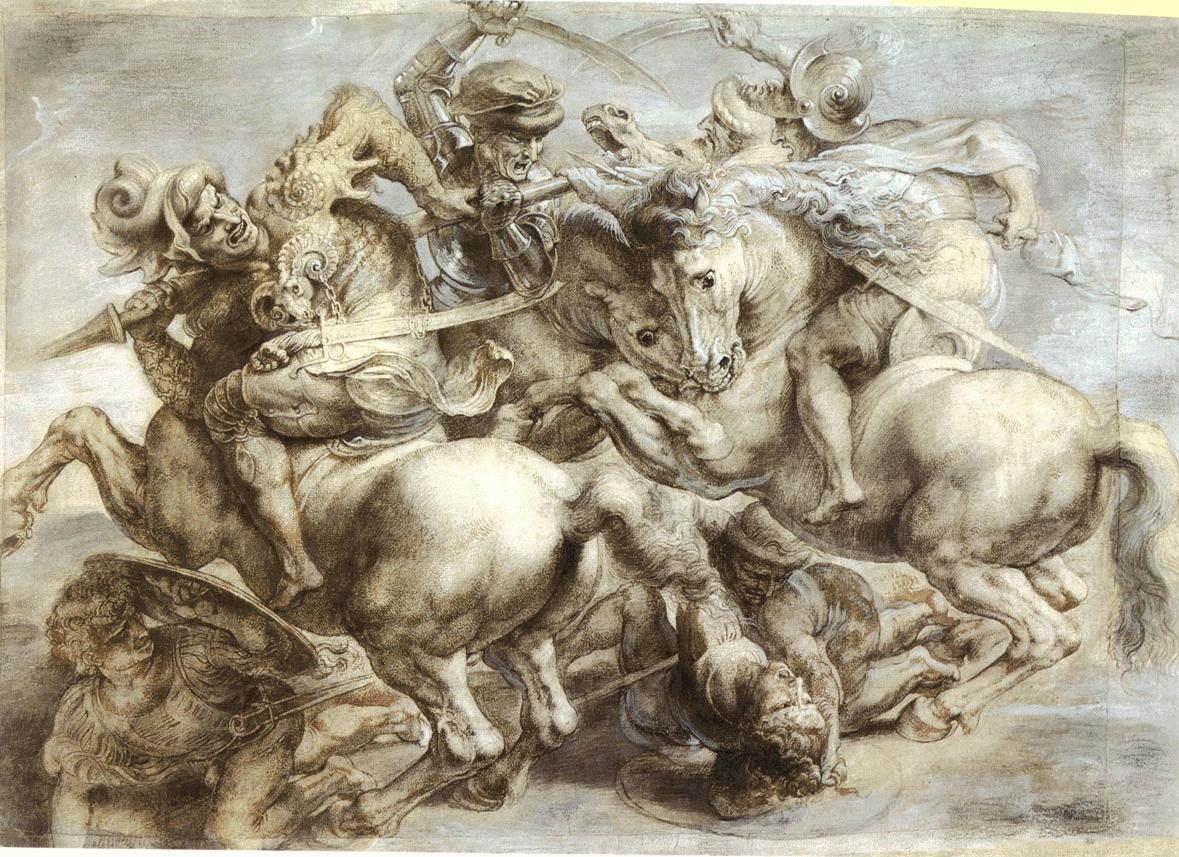
5 min read · 2 sourcesThe Battle of Anghiari (Italian: La Battaglia di Anghiari, 1505) is a lost fresco painting by Leonardo da Vinci in the Salone dei Cinquecento (Hall of the Five Hundred) in the Palazzo Vecchio, Florence. Its central scene would have depicted four men riding raging war horses engaged in a struggle for possession of a standard at the Battle of Anghiari in 1440. Leonardo never completed the commission and left the work unfinished in 1505. According to an early biographer, Leonardo had experimented working in a different fresco technique involving walnut oil but the colors were too unstable, leading the master to abandon the project. Leonardo's unfinished work remained on site for a while and was admired by many visitors and artists; it was ultimately destroyed and replaced by a new work (today, Giorgio Vasari's frescoes from 1563-65 can be seen in its place). Many preparatory studies by Leonardo still exist. The composition of the central section is best known through a drawing which was made in the 16th century and later acquired by Peter Paul Rubens who extended the edges of the drawing. The drawing is in the collection of the Louvre in Paris, where it is referred to as The Battle of the Standard. This drawing succeeds in portraying the fury, the intense emotions and the sense of power that were presumably present in the original painting. 1
History
In 1504 Leonardo da Vinci was given the commission by gonfaloniere Piero Soderini, a contract signed by Niccolò Machiavelli, to decorate the Palazzo Vecchio's Salone dei Cinquecento (Hall of the Five Hundred). At the same time his rival Michelangelo, who had just finished his David, was assigned the opposite wall. This was the only time that Leonardo da Vinci and Michelangelo worked together on the same project; the proximity of their respective works intensified their rivalry. The painting of Michelangelo depicted an episode from the Battle of Cascina, when a group of bathing soldiers was surprised by the enemy. However Michelangelo did not stay in Florence long enough to complete the project. He was able to finish his cartoon, but only began the painting. He was invited back to Rome in 1505 by the newly appointed Pope Julius II and was commissioned to build the Pope's tomb. 1
Leonardo da Vinci drew his large cartoon in the Basilica of Santa Maria Novella, on the east wall, depicting a scene from the life of Niccolò Piccinino, a condottiere in the service of Duke Filippo Maria Visconti of Milan. He drew a scene of a violent clash of horses and a furious battle of men fighting for the flag in the Battle of Anghiari. 1
Reconstruction of room
During the mid-16th century (1555–1572), the hall was enlarged and restructured by Vasari and his helpers on the instructions of Cosimo I, in order that the Duke could hold court in this important chamber of the palace. In the course of the renovations, the remnants of famous (but unfinished) artworks from the previous plan of decoration for the hall, were lost; including The Battle of Cascina by Michelangelo and The Battle of Anghiari by Leonardo da Vinci. Vasari himself painted new frescoes on the now-extended walls. On the walls are large and expansive frescoes that depict battles and military victories by Florence over Pisa and Siena : 1
The Taking of Siena The Conquest of Porto Ercole The Victory of Cosimo I at Marciano in Val di Chiana Defeat of the Pisans at the Tower of San Vincenzo Maximillian of Austria Attempts the Conquest of Leghorn Pisa Attacked by the Florentine Troops 1
Possible rediscovery
Maurizio Seracini, an Italian expert in high-technology art analysis, believes that Leonardo's Anghiari is hidden behind Vasari's Battle of Marciano in Val di Chiana (1572). In the upper part of Vasari's fresco, 12 meters above the ground, a Florentine soldier waves a green flag with the words "Cerca trova" ('He who seeks, finds'). These enigmatic words are suggested to be a hint from Vasari, who had praised The Battle of Anghiari highly in his writings, incomplete and damaged as it was. Seracini believes it is unlikely that Vasari would have willingly destroyed Leonardo's work. Vasari's concealment and preservation of another painting, Masaccio's Holy Trinity, during a subsequent renovation project also assigned to him by Cosimo I, is cited as precedent. Using non-invasive techniques, such as a high-frequency, surface-penetrating radar and a thermographic camera, Seracini made a survey of the hall. Among other findings, he discovered that Vasari had built a curtain wall in front of the original east wall, and painted his fresco on the new wall. Seracini believes the original fresco of Leonardo da Vinci to be located on the older wall, beneath it. Sensors found a gap of 1 to 3 centimeters between the two walls, large enough for the older fresco to be preserved. 1
In early 2007, the city council of Florence and the Italian Minister of Culture approved further investigation. After unsuccessful attempts to fund the development of a more advanced non-invasive scanning system, in December 2011 Seracini and his associates drilled small holes through areas of the Vasari fresco believed to have been previously damaged and restored, hence no longer comprising "original paint" from Vasari's work. 1
The text above is adapted from the Wikipedia article “The Battle of Anghiari (Leonardo)”, available under the Creative Commons Attribution-ShareAlike 4.0 licence. 1
The Battle of Anghiari is lost wall painting by Leonardo da Vinci, according to the structured record cited below. This entry was generated automatically from that record and has not yet been reviewed by a person familiar with the tradition. 2
The source record links this tradition to 4 external registers, which can be verified through the citation. 2