The tradition & historical record
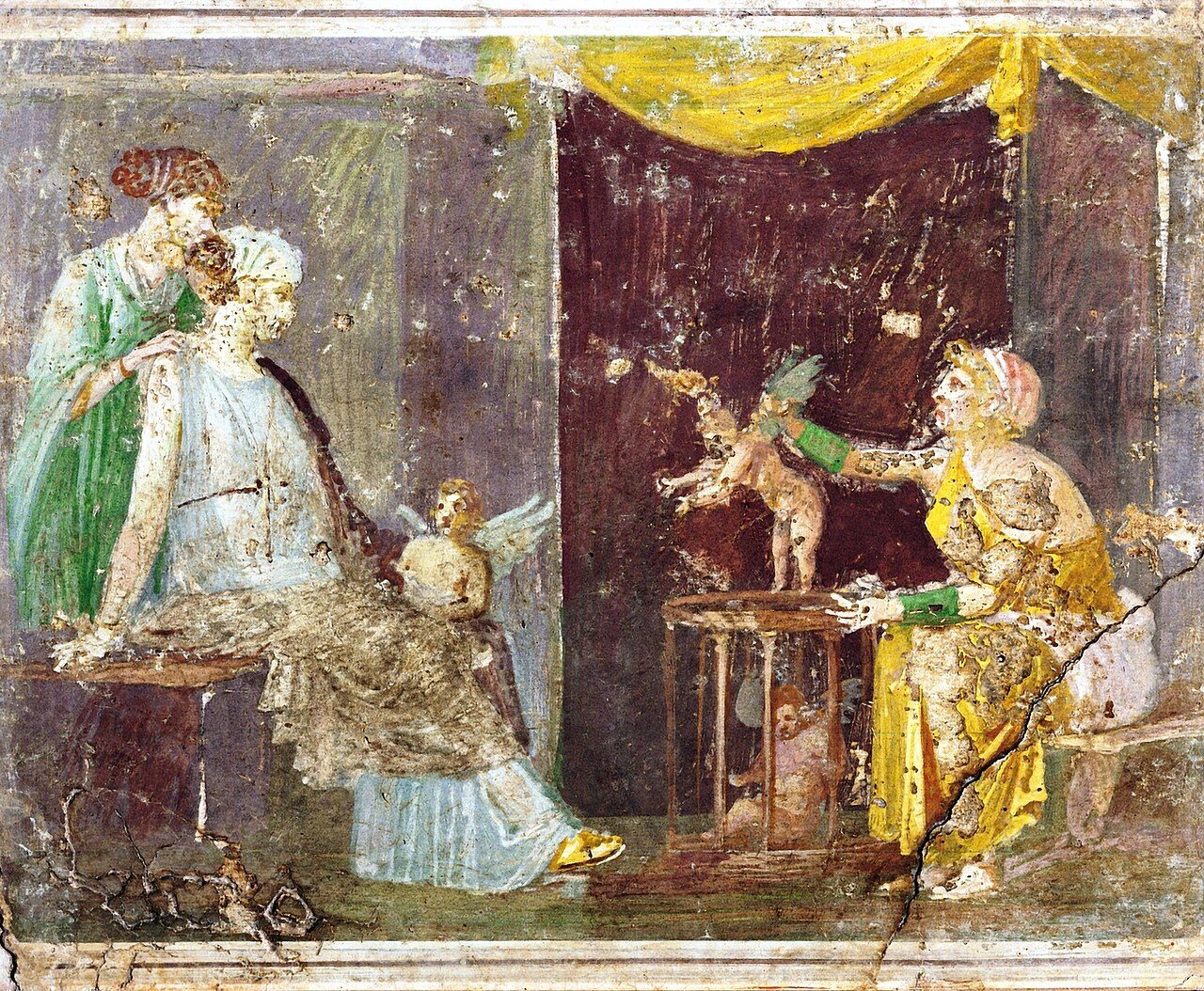
5 min read · 2 sourcesThe Cupid Seller is a 30 BC – 50 AD Roman genre fresco discovered in 1759 in Stabiae and now in the National Archaeological Museum, Naples. It shows a woman selling tiny cupids to a matrona. It was widely known and reproduced in the 18th and 19th centuries, proving a major influence on art such as Vien's The Cupid Seller. 1
Discovery
Roman Stabiae (now Castellammare di Stabia) lay between Naples and Sorrento. Rich people of that era built luxurious villas around Stabiae as summer residences, one of the largest and oldest of which is now known as the Villa Arianna, built in the 2nd century BC. It was located on a hillside with views of the Bay of Naples and was the centre of a 14 square kilometre estate. The name of the family which owned it is unknown, but it was very wealthy, judging by the number of wall paintings. All the villas around Stabiae were destroyed in the eruption of Mount Vesuvius in 79 AD, specifically by the lava flows. They were first excavated in 1749, with the ruins of Villa Arianna uncovered between 1757 and 1762. The Cupid Seller had broken into several pieces and formed the centre of a wall painting. With furnishings and the best wall paintings it was taken to Naples and other royal palaces and the ruins were infilled, to be re-excavated in 1950–1952. 1
Description
It was painted on the wet plaster using the fresco technique. Like most murals from the Villa Arianna, the fresco belongs to the Third Pompeian Style. The wall is divided into different fields horizontally and vertically. A central image is surrounded by areas that are sometimes completely flat and interrupted by ornamental decorations without great spatial depth. The murals from the Villa Arianna seem not to have been made by local craftsmen and artists from the area, but by workshops in Rome. 1
The mural is divided into two zones by the background and the arrangement of the figures. The suggested architecture and seating probably represent an interior. A total of three women and three winged creatures can be seen. On the left side, a seated Roman matrona is shown with a friend or relation standing behind her with her hand on her shoulder. They both thoughtfully look at the cupids, one of whom is partially hidden behind or between the matrona's legs. 1
On the right side, under a yellow curtain, a seller is depicted sitting on a small stool and offering her wares. She has taken a small cupid out of the cage and is now holding it by one of its wings, while another is still in the cage waiting to be shown. The two women are obviously looking through the dealer's offerings to decide on one of the small gods, while the winged creatures are impatiently waiting to go to their new mistress. Since the strap of the seller's dress has slipped over her left shoulder, she is thought to be a hetaera. The winged childlike creatures are cupids, described in ancient Greek mythology as headstrong and trouble-making, widely shown in Hellenistic and Roman art. 1
Afterlife
Charles VII (King of Naples until 1759), took the fresco to Portici Palace. He strictly enforced a royal monopoly on excavations and severely punished illegal ones, thus trying to prevent antiquities being stolen and sold off. In 1758 he also set up a museum in the wing of his palace at Naples for all archaeological finds from around Vesuvius, but only selected visitors were given tours of it by prior appointment, and visitors were not allowed to make notes or drawings during their tours—Johann Joachim Winckelmann complained about these restrictions. Even so, Charles VII was interested in researching and cataloguing the antiquities and so commissioned a comprehensive catalogue of them in 1759. Only completed in 1792, stretching to eight volumes with several illustrations and only published in a very small edition intended as exclusive gifts for a small circle of buyers in European courts, it was entitled Le antichità di Ercolano esposte (The Antiquity of Herculaneum Exhibited). The Cupid Seller appeared in volume 3, which was published in 1762. It was shown in a copperplate engraving by Giovanni Elia Morghen after a drawing by Carlo Nolli, reproducing the fresco almost exactly, and the text interpreted it as a scene of goddesses. 1
Despite the initially exclusive audience for the volumes, knowledge of the antiquities spread independently beyond owners of the volumes. Numerous copies of the copperplate illustrations were made and circulated, inspiring artists across Europe. 1
The text above is adapted from the Wikipedia article “The Cupid Seller (fresco)”, available under the Creative Commons Attribution-ShareAlike 4.0 licence. 1
The Cupids seller is Detached fresco from Villa Arianna, Stabiae, Italy, according to the structured record cited below. This entry was generated automatically from that record and has not yet been reviewed by a person familiar with the tradition. 2
The source record links this tradition to 1 external register, which can be verified through the citation. 2