The tradition & historical record
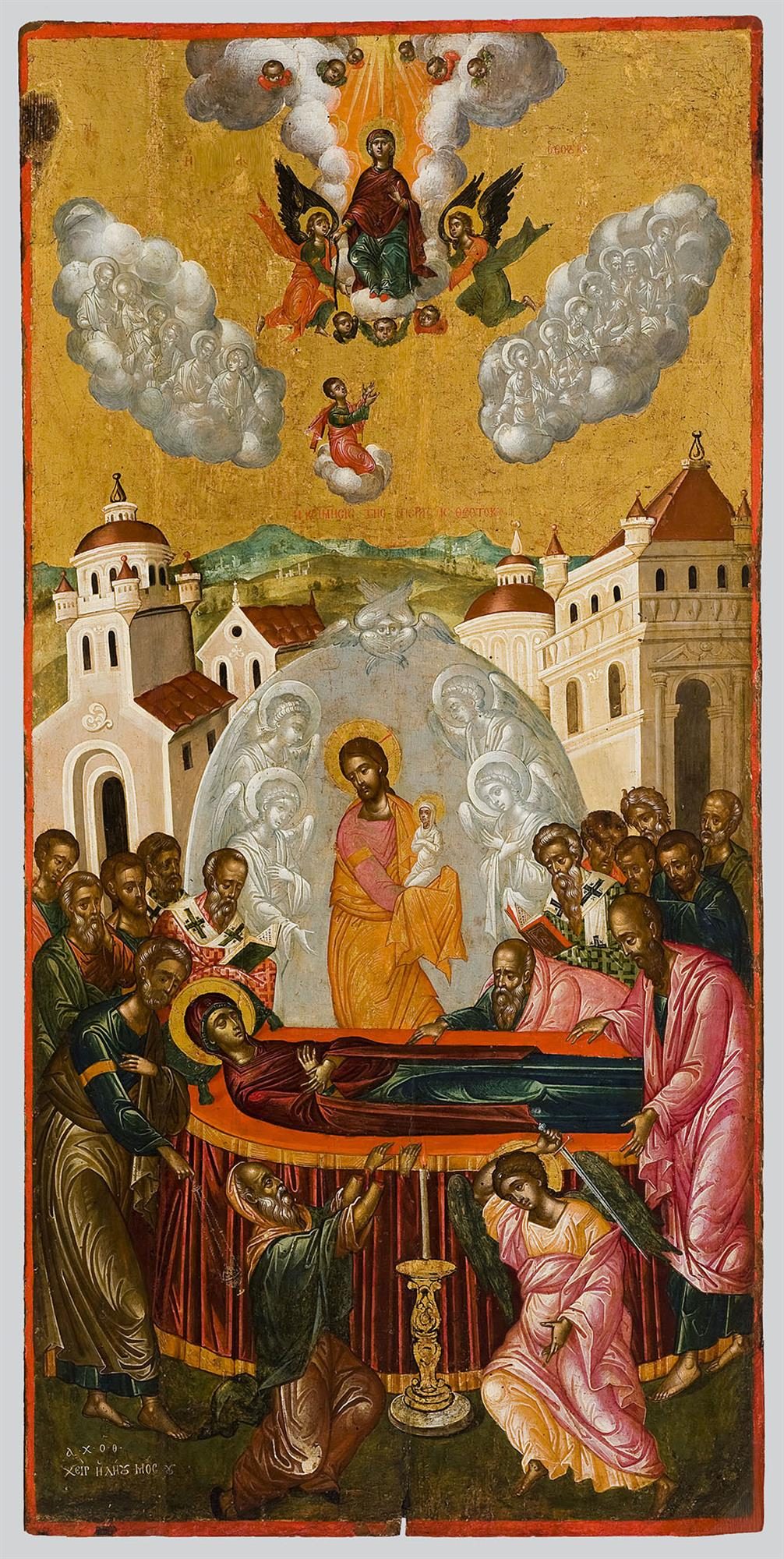
3 min read · 2 sourcesThe Dormition and Assumption of the Virgin is a tempera painting created by Elias Moskos. Moskos was a representative of the Late Cretan School and the Heptanese School. He migrated to Zakinthos from Crete. He was originally from the city of Rethymno. He participated in the transition of Greek painting from the Cretan School to the more refined Heptanese School of the Ionian islands. He also taught painting. His activity was from 1645 to 1687. He was active on the islands of Crete, Zakynthos, and Kefalonia. He was heavily involved with church committees. Church committees commissioned paintings. Half of his works were signed fifty-two of his works survived. The Dormition and Assumption of the Virgin was a popular theme painted by both Greek and Italian artists since the dawn of the new religion. The chronology of the New Testament states that Mary lived for 11 years after the death of Jesus, dying in AD 41 according to Hippolytus of Thebes. The sanhedrin feared that her body would disappear. According to the Greek Rite she arouse after the third day. She was resurrected. The work of art is a testimony to the event. Proto-Renaissance painter Fra Angelico completed a version of the theme around 1432 called Death and the Assumption of the Virgin. Greek painters employed a common technique during the early Cretan School following the traditional lines of Greek, Italian Byzantine painting. 1
History
The work of art was completed in 1679 on the island of Zakynthos. The materials used were tempera and gold leaf on a wood panel. The height of the work was 37.4 in. (94.9 cm) and the width 18.5 in. (46.9 cm). The work was completed nine years before the artist's death. The work of art is an example of the craftsmanship of the late Cretan School. The painter employs more modernistic techniques on the wood panel. The artist presents a foreground, middle ground, and background. The work is comparable to Proto-Renaissance paintings. The Death and the Assumption of the Virgin is a similar work completed by Fra Angelico around 1432. Andreas Ritzo's early Cretan painting is also very similar to Mosko's work. El Greco's work Dormition of the Virgin is also in-line with Mosko's icon. All five works are in the same style. In the foreground, two figures appear kneeling in front of the dead heavenly mother. The figure on our left grabs the holy surface on which the Virgin rests. His name was Iefonia (Ιεφονία). He was a sanhedrin priest who tried to disturb the body of the Virgin Mary. The sanhedrin feared the disappearance of her body and her resurrection. The painting is a testimony of her resurrection. To Iefonia’s left, an angel wields a sword, stopping Iefonia. The candle stands between them, establishing the space. The area the Virgin rests on is covered with a brilliantly painted curtain-like cloth with clear lines and folds of fabric. The figure to our left-right over the Virgin's head is Saint Peter holding a thymiaterion incensing the holy body of the Virgin Mary. Paul the Apostle is bowing at her feet, and John the Apostle is kneeling at her body to the right of Paul. 1
The text above is adapted from the Wikipedia article “The Dormition and Assumption of the Virgin (Moskos)”, available under the Creative Commons Attribution-ShareAlike 4.0 licence. 1
The Dormition and Assumption of the Virgin is painting by Elias Moskos, according to the structured record cited below. This entry was generated automatically from that record and has not yet been reviewed by a person familiar with the tradition. 2