The tradition & historical record
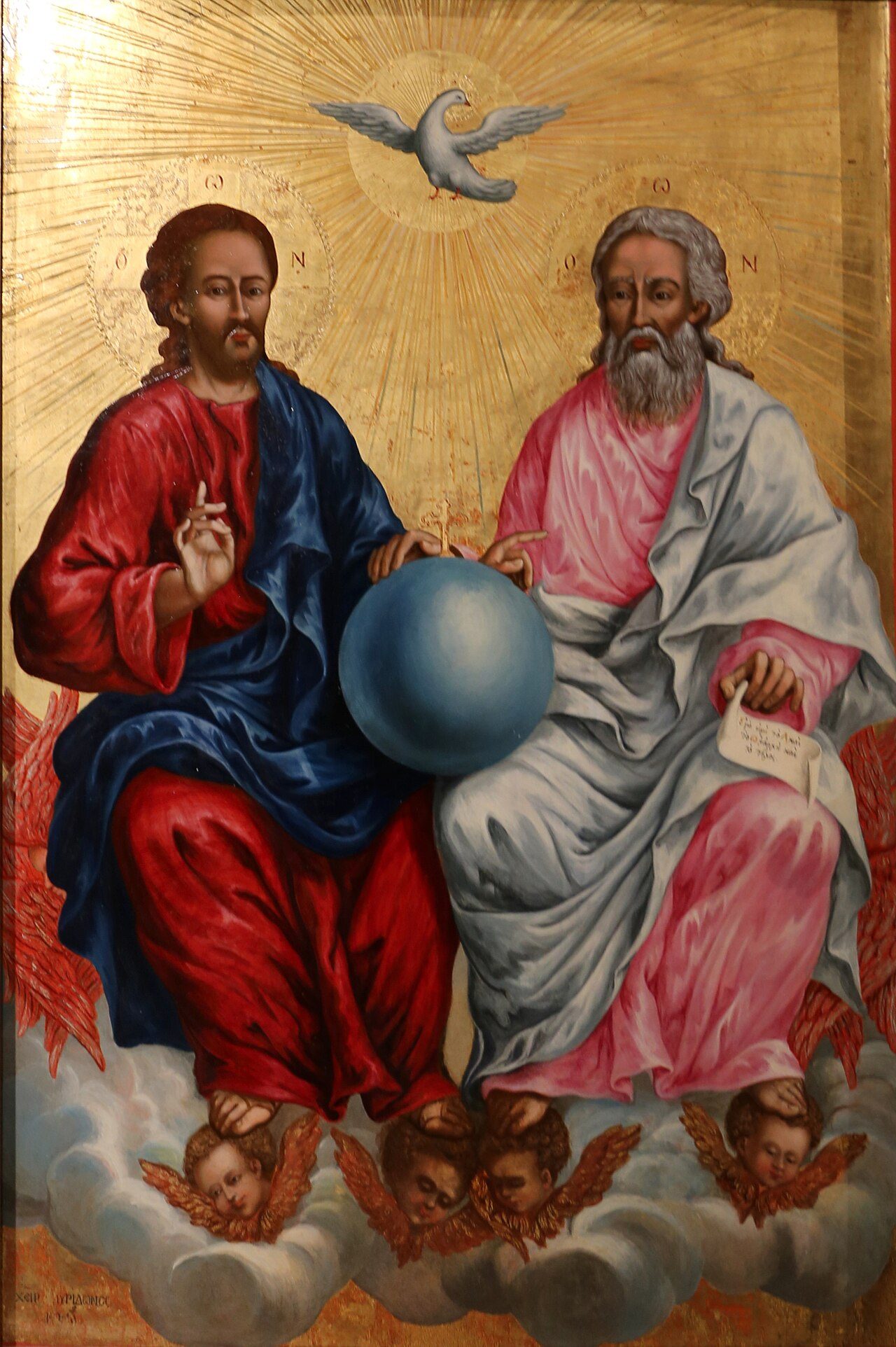
3 min read · 2 sourcesThe Holy Trinity is a tempera painting created by Spyridon Romas. He was a Greek painter from Corfu. He was a prominent member of the Heptanese School. He was active from 1745 to 1786. He traveled all over the world. He painted in Corfu, Lecce, Livorno, and London. According to the Hellenic Institute over 25 of his works survived. He is one of the few Greek painters to completely adopt a new style of painting. He traveled to London, England around 1770 and remained in the country until his death. He painted several portraits but also maintained artwork in the region. An iconostasis with most of his works is superlatively preserved in Livorno, Italy at the Museo della Città di Livorno (Museum of the City of Livorno). The Trinity is an integral part of the Christian religion. There have been many interpretations and debates about the subject. The Trinity historically refers to the Father (God), Son (Jesus), and the Holy Spirit. Countless Greek and Italian painters adopted the subject. Masaccio painted an Italian version known as the Holy Trinity. It was a very popular theme. A notable Greek-style version of the subject was painted in Constantinople around the 1450s by a Greek master. The painting is part of the collection at the Cleveland Museum in the United States. Painters of the Cretan School and the Heptanese School adopted the theme. Notable versions were painted by Thomas Bathas, Michael Damaskinos, Elias Moskos and Emmanuel Tzanes. 1
Description
The materials used were tempera paint, gold leaf, and wood panel. The height is 117 cm (46.1 in.) and the width is 78 cm (30.7 in.). Romas completed the work in 1764 for the Trinity Greek Orthodox church in Livorno, Italy. The icon was part of the iconostasis of the destroyed church. The church was torn down in 1942 because of a city rehabilitation project. The works of art were moved to a museum. The icon has evolved relative to its early predecessors. The painting is in line with comparable works of the Heptanese School. Compared to the Bathas version the figures are more detailed. The folds of fabric feature more realistic lines and grooves. The artist used a refined method of light and shadow. The sphere represents the earth. A cross appears on top of the sphere. Jesus is to our left, His right hand is depicted offering a blessing, upon which spells the name and title of Jesus through the gesture, "IC XC", Greek abbreviations that spell out "Jesus Christ", "ΙΗΣΟΥΣ ΧΡΙΣΤΟΣ". With His other hand resting upon the globe, He points to the figure on the right. His celestial robe is floating in a spaceless setting. The painter used the traditional brilliant blue and red color, within iconography, traditionally symbolizing the two natures of Christ; the blue representing His Divinity, while the red representing His humanity. Jesus's flesh tones and facial features exhibit a refined realism. The figure on the right portrays God the Father, a similar figure is present in Masaccio's Holy Trinity, though the depiction of the Father itself resembles many other pieces of artwork and iconography, especially within Western art. 1
The text above is adapted from the Wikipedia article “The Holy Trinity (Romas)”, available under the Creative Commons Attribution-ShareAlike 4.0 licence. 1
The Holy Trinity is painting by Spyridon Romas, according to the structured record cited below. This entry was generated automatically from that record and has not yet been reviewed by a person familiar with the tradition. 2