The tradition & historical record
3 min read · 2 sourcesLadder of Divine Ascent is a tempera painting created by painter and priest Emmanuel Tzanes. Tzanes flourished during the 17th century in Crete, Corfu, and Venice, Italy and his catalog of works numbers over 130. He was a member of an artistic family and both his brothers Konstantinos Tzanes and Marinos Tzanes were painters but Konstantinos is better known for his famous poem about Crete entitled The Cretan War (Greek: Ο Κρητικός Πόλεμος, O Kritikos Polemos). The family eventually settled in Venice where Emmanuel was elected priest of San Giorgio dei Greci where he completed a large number of his works from 1660 to 1690. Three years after his appointment he completed Ladder of Divine Ascent. Tzanes painted in the traditional Greek mannerisms or maniera greca following the lines of the Cretan School but also integrated the predominant painting style of Venice during that period. John Climacus was a 6th–7th century monk affiliated with Saint Catherine's Monastery. Climacus wrote a book entitled The Ladder of Divine Ascent which uses the analogy of Jacob's Ladder as the framework for his spiritual teaching. The book was a philosophical guide for monastic life following the teachings of Jesus Christ written for Abba John, Abbot of Raithu. In his book, there are 30 steps of a ladder. The Ladder describes how to raise one's soul and body to God by acquiring ascetic virtues. Countless painters adopted the theme of the Ladder of Divine Ascent. 1
Description
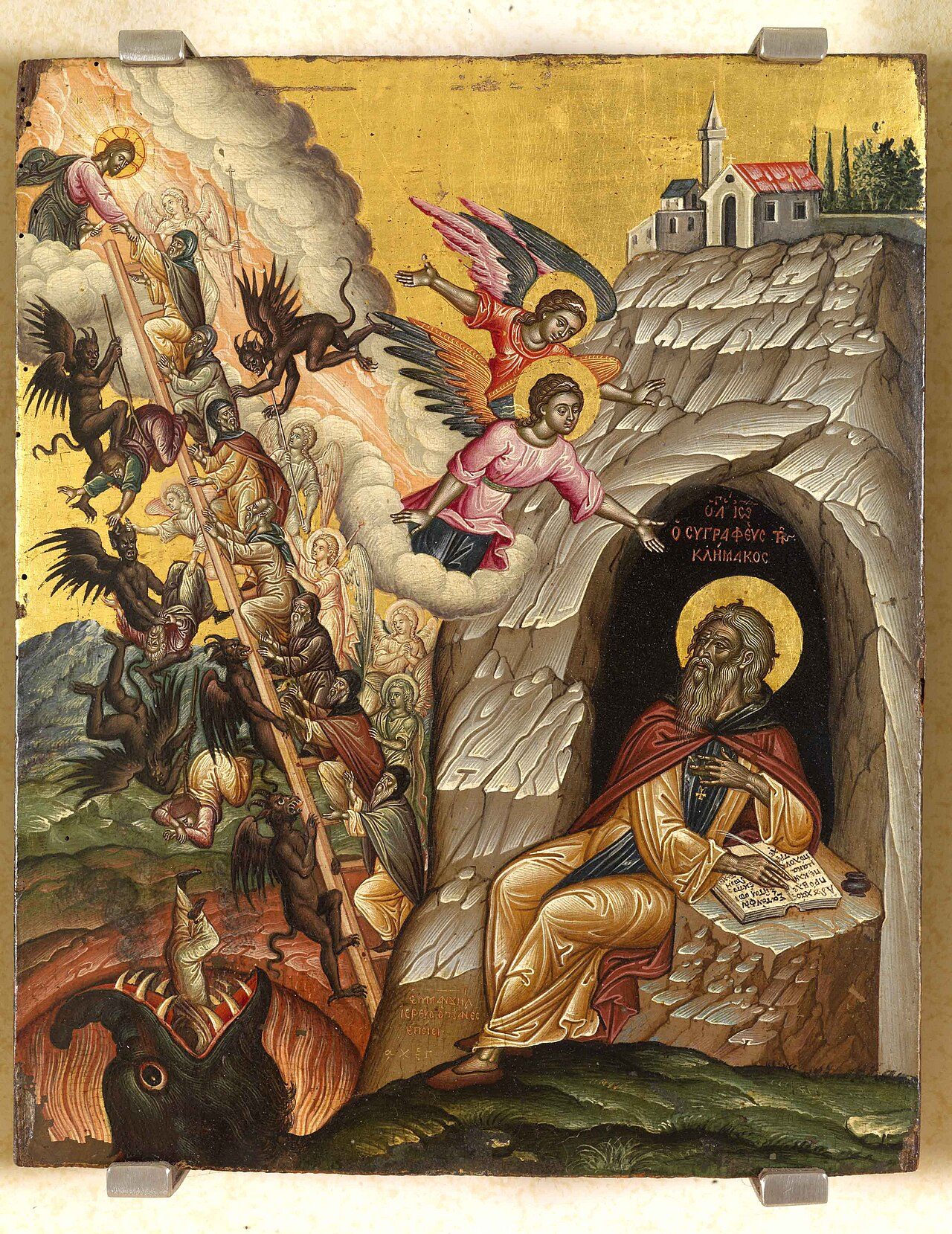
Ladder of Divine Ascent is a tempera painting on gold leaf and wood panel. The height is 13 in (33 cm) and the width is 10.6 in (26.9 cm). The work was completed in 1663 after the painter migrated from Corfu to Venice and became the priest of San Giorgio dei Greci. The work follows the traditional Greek Italian Byzantine painting style. The figure of John Climacus is outside of a monastic cave which is adorned by a monastery structure symbolizing Saint Catherine's Monastery in Mount Sinai. 1
Tzanes was a remarkable painter who significantly refined the maniera greca the figure of Climacus resembles Saint Mark a work completed by Tzanes six years prior. Tzanes implemented refined detail in Saint Mark's face a style he continued to implement in his work of Climacus. The brushstrokes of his beard establish lines, contours, and grooves while the painter clearly reveals his hair waves. The painter adds human anatomical features to Climacus where veins are visible and he implements a shading technique on his face which features an expression of amazement and reverence as he compiles his book of philosophical theological knowledge. Two angels appear above the monk and to our left an entire story unfolds with 6 angels and 6 demons fighting for the souls of the righteous over Jacobs Ladder. There are seven monks on the latter four are taken away by demons with eleven monks total or twelve including Climacus. The ladder of divine ascent leads to Jesus Christ who is awaiting the righteous. An angel is also at the top of the ladder overjoyed in the presence of Jesus Christ. 1
The text above is adapted from the Wikipedia article “Ladder of Divine Ascent (Tzanes)”, available under the Creative Commons Attribution-ShareAlike 4.0 licence. 1
The Ladder of Divine Ascent is painting by Emmanuel Tzanes, according to the structured record cited below. This entry was generated automatically from that record and has not yet been reviewed by a person familiar with the tradition. 2