The tradition & historical record
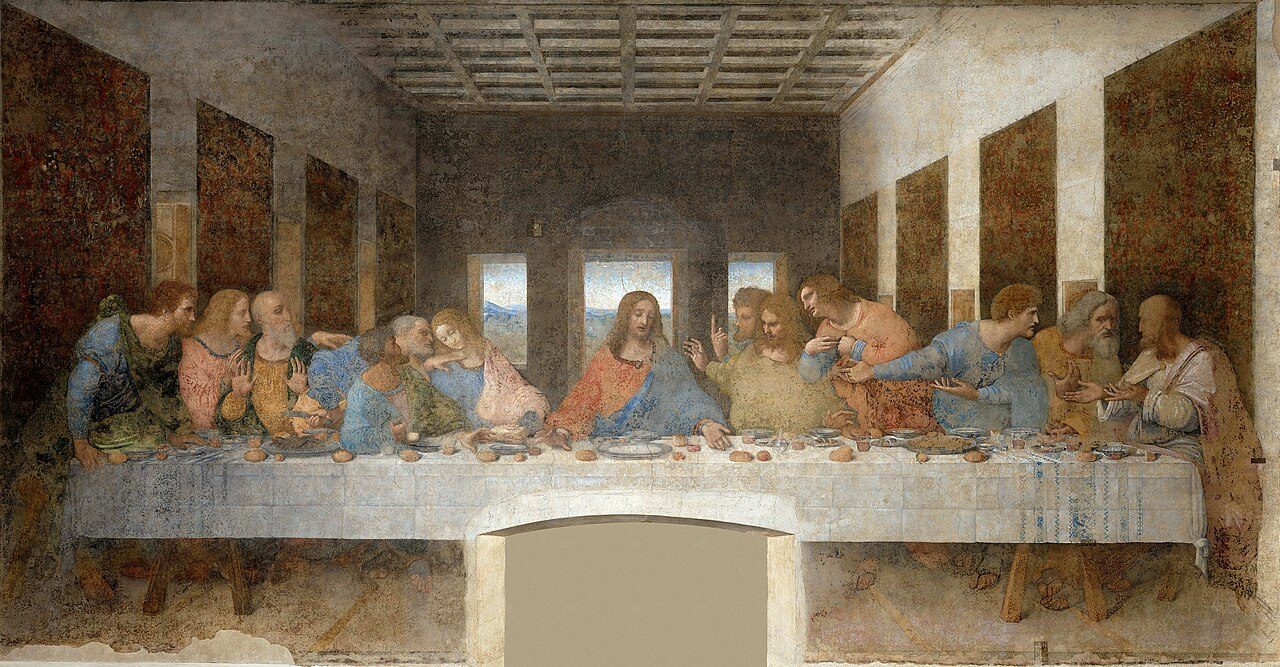
7 min read · 2 sourcesThe Last Supper (Italian: Il Cenacolo [il tʃeˈnaːkolo] or L'Ultima Cena [ˈlultima ˈtʃeːna]) is a mural painting by the Italian High Renaissance artist Leonardo da Vinci, dated to c. 1495–1498, housed in the refectory of the Convent of Santa Maria delle Grazie in Milan, Italy. The painting represents the scene of the Last Supper of Jesus with the Twelve Apostles, as it is told in the Gospel of John – specifically the moment after Jesus announces that one of his apostles will betray him. Its handling of space, mastery of perspective, treatment of motion and complex display of human emotion has made it one of the Western world's most recognizable paintings and among Leonardo's most celebrated works. Some commentators consider it pivotal in inaugurating the transition into what is now termed the High Renaissance. The work was commissioned as part of a plan of renovations to the church and its convent buildings by Leonardo's patron Ludovico Sforza, Duke of Milan. In order to permit his inconsistent painting schedule and frequent revisions, it is painted with materials that allowed for regular alterations: tempera on gesso, pitch, and mastic. Due to the methods used, a variety of environmental factors, and intentional damage, little of the original painting remains today despite numerous restoration attempts, the last being completed in 1999. The Last Supper is Leonardo's largest work, aside from the Sala delle Asse. 1
Commission and creation
The Last Supper measures 460 cm × 880 cm (15 ft 1 in × 28 ft 10 in) and covers an end wall of the dining hall at the monastery of Santa Maria delle Grazie in Milan, Italy. The theme was a traditional one for refectories, although the room was not a refectory at the time that Leonardo painted it. The main church building was still under construction while Leonardo was composing the painting. Leonardo's patron, Ludovico Sforza, planned that the church should be remodeled as a family mausoleum. To this end, changes were made, perhaps to plans by Donato Bramante. These plans were not fully carried out, and a smaller mortuary chapel was constructed, adjacent to the cloister. The painting was commissioned by Sforza to decorate the wall of the mausoleum. The lunettes above the main painting, formed by the triple arched ceiling of the refectory, are painted with Sforza coats-of-arms. The opposite wall of the refectory is covered by the Crucifixion fresco by Giovanni Donato da Montorfano, to which Leonardo added figures of the Sforza family in tempera; these figures have deteriorated in much the same way as has The Last Supper. Leonardo worked on The Last Supper from about 1495 to 1498, but he did not work continuously. The beginning date is not certain, as the archives of the convent for the period have been destroyed. A document dated 1497 indicates that the painting was nearly completed at that date. A prior from the monastery reportedly complained to Leonardo about its delay. 1
Medium
Leonardo, as a painter, favoured oil painting, a medium which allows the artist to work slowly and make changes with ease. Fresco painting does not facilitate either of these objectives. Leonardo also sought a greater luminosity and intensity of light and shade (chiaroscuro) than could be achieved with fresco, in which the water-soluble colours are painted onto wet plaster, laid freshly each day in sections. Rather than using the proven method of painting on walls, Leonardo painted The Last Supper in tempera, the medium generally used for panel painting. The painting is on a stone wall sealed with a double layer of gesso, pitch, and mastic. Then he added an undercoat of white lead to enhance the brightness of the tempera that was applied on top. This was a method that had been described previously by Cennino Cennini in the 14th century. However, Cennini described the technique as being more risky than fresco painting, and recommended the use of painting in a more superficial medium for the final touches only. 1
Subject
The Last Supper portrays the reaction given by each apostle when Jesus said one of them would betray him. All twelve apostles have different reactions to the news, with various degrees of anger and shock. The apostles were identified by their names, using an unsigned, mid-sixteenth-century fresco copy of Leonardo's Cenacolo. Before this, only Judas, Peter, John and Jesus had been positively identified. From left to right, according to the apostles' heads: 1
Bartholomew, James, son of Alphaeus, and Andrew form a group of three; all are surprised. Judas Iscariot, Peter, and John form another group of three. Judas is wearing red, blue, and green and is in shadow, looking withdrawn and taken aback by the sudden revelation of his plan. He is clutching a small bag, perhaps signifying the silver given to him as payment to betray Jesus, or perhaps a reference to his role as a treasurer. He is also tipping over the salt cellar, which may be related to the near-Eastern expression to "betray the salt" meaning to betray one's master. He is the only person to have his elbow on the table and his head is also vertically the lowest of anyone in the painting. Peter wears an expression of anger and appears to be holding a knife, foreshadowing his violent reaction in Gethsemane during the arrest of Jesus. Peter is leaning towards John and touching him on the shoulder, in reference to John's Gospel where he signals the "beloved disciple" to ask Jesus who is to betray him. The youngest apostle, John, appears to swoon and lean towards Peter. Jesus Thomas, James the Greater, and Philip are the next group of three. Thomas is clearly upset; the raised index finger foreshadows his incredulity of the Resurrection. James the Greater looks stunned, with his arms in the air. 1
Early copies
Two early copies of The Last Supper are known to exist, presumed to be work by Leonardo's assistants. The copies are almost the size of the original, and have survived with a wealth of original detail still intact. One, by Giampietrino, is in the collection of the Royal Academy of Arts, London, and the other, by Cesare da Sesto, is installed at the Church of St. Ambrogio in Ponte Capriasca, Switzerland. A third copy (oil on canvas) was painted by Andrea Solari (c. 1520) and is on display in the Leonardo da Vinci Museum of the Tongerlo Abbey, Belgium. 1
Damage and restorations
Because Sforza had ordered the church to be rebuilt hastily, the masons filled the walls with moisture-retaining rubble. The painting was done on a thin exterior wall, so the effects of humidity were felt keenly, and the paint failed to properly adhere to it. Because of the method used, soon after the painting was completed on 9 February 1498 it began to deteriorate. In 1499, Louis XII contemplated removing the painting from the wall and taking it to France. As early as 1517, the painting was starting to flake, and in 1532 Gerolamo Cardano described it as "blurred and colorless compared with what I remember of it when I saw it as a boy". 1
The text above is adapted from the Wikipedia article “The Last Supper (Leonardo)”, available under the Creative Commons Attribution-ShareAlike 4.0 licence. 1
The Last Supper is mural painting by Leonardo da Vinci, according to the structured record cited below. This entry was generated automatically from that record and has not yet been reviewed by a person familiar with the tradition. 2
The source record links this tradition to 28 external registers, which can be verified through the citation. 2