The tradition & historical record
7 min read · 2 sourcesThe Raft of the Medusa (French: Le Radeau de la Méduse [lə ʁado d(ə) la medyz])—originally titled Scène de Naufrage (Shipwreck Scene)—is an oil painting of 1818–1819 by the French Romantic painter and lithographer Théodore Géricault (1791–1824). Completed when the artist was 27, the work has become an icon of French Romanticism. At 491 by 716 cm (16 ft 1 in by 23 ft 6 in), it is an over-life-size painting that depicts a moment from the aftermath of the wreck of the French naval frigate Méduse, which ran aground off the coast of today's Mauritania on 2 July 1816. On 5 July 1816, at least 150 people were set adrift on a hurriedly constructed raft; all but 15 died in the 13 days before their rescue, and those who survived endured starvation and dehydration and practiced cannibalism. The event became an international scandal, in part because its cause was widely attributed to the incompetence of the French captain. Géricault chose this large-scale uncommissioned work to launch his career, using a subject that had already generated widespread public interest. The event fascinated him. Théodore Géricault's social circles had close family connections with the French Navy and were directly involved in France's colonies and France's slave trade. 1
Background
In June 1816, the French frigate Méduse, captained by Viscount Hugues Duroy de Chaumareys, departed from Rochefort, bound for the Senegalese port of Saint-Louis. She headed a convoy of three other ships: the storeship Loire, the brig Argus and the corvette Écho. De Chaumareys, a recently returned royalist émigré, had been appointed captain of the frigate by the newly restored Bourbon administration, despite having scarcely sailed in 20 years. After the wreck, public outrage mistakenly attributed responsibility for his appointment to Louis XVIII, though this was a routine naval appointment made within the Ministry of the Navy and far outside the concerns of the monarch. The frigate's mission was to accept the British return of Senegal under the terms of France's acceptance of the Peace of Paris. The appointed French governor of Senegal, Colonel Julien-Désiré Schmaltz, and his wife and daughter were among the passengers. In an effort to make good time, the Méduse overtook the other ships, but due to poor navigation it drifted 160 kilometres (100 mi) off course. On 2 July, it ran aground on a sandbank off the West African coast, near today's Mauritania. The collision was widely blamed on the incompetence of De Chaumareys, a returned émigré who lacked experience and ability, but had been granted his commission as a result of an act of political preferment. Efforts to free the ship failed, so, on 5 July, the frightened passengers and crew started an attempt to travel the 100 km (60 mi) to the African coast in the frigate's six boats. Although the Méduse was carrying 400 people, including 160 crew, there was space for only about 250 in the boats. 1
Description
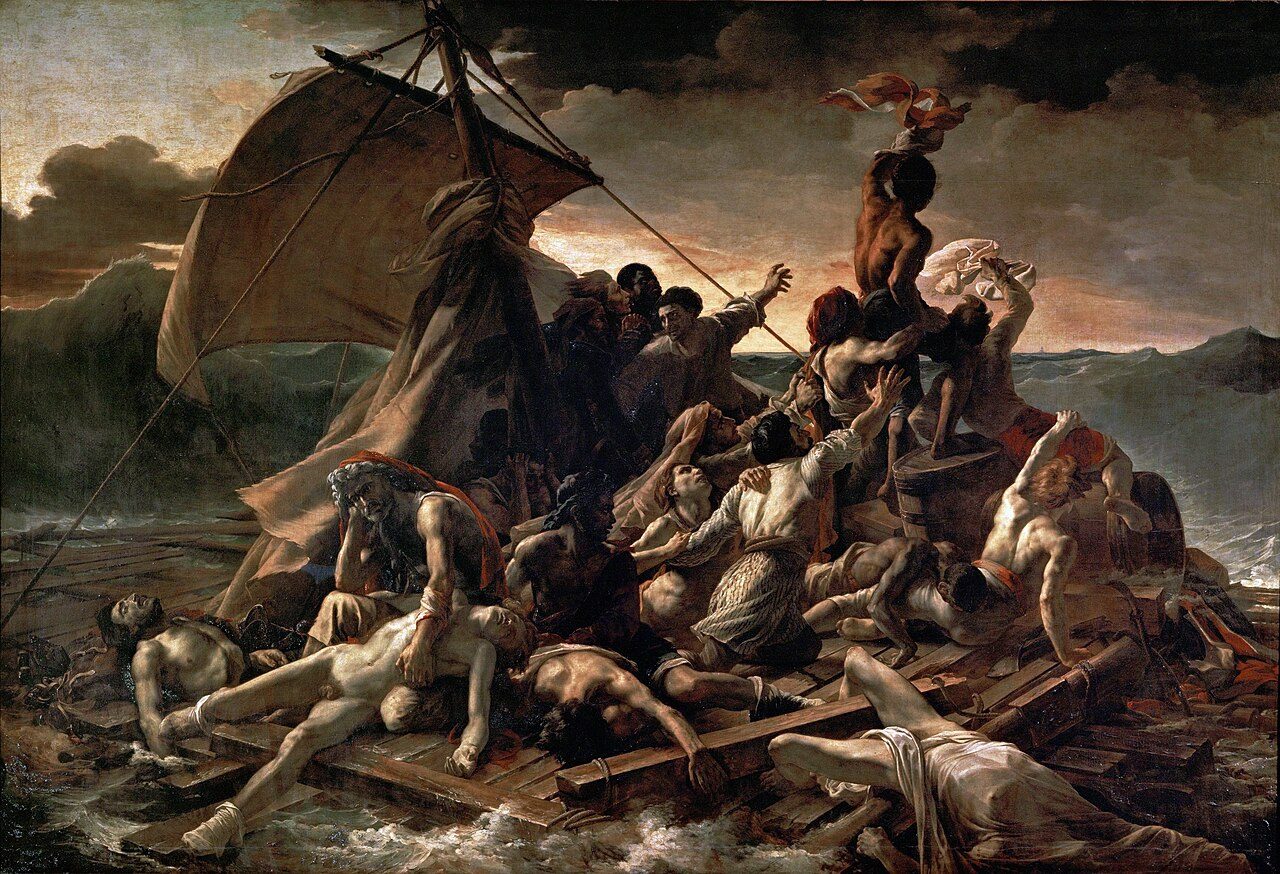
The Raft of the Medusa portrays the moment when, after 13 days adrift on the raft, the remaining 15 survivors view a ship approaching from a distance. According to an early British reviewer, the work is set at a moment when "the ruin of the raft may be said to be complete". The painting is on a monumental scale of 491 cm × 716 cm (193 in × 282 in), so that most of the figures rendered are life-sized and those in the foreground almost twice life-size, pushed close to the picture plane and crowding onto the viewer, who is drawn into the physical action as a participant. 1
The makeshift raft is shown as barely seaworthy as it rides the deep waves, while the men are rendered as broken and in utter despair. One old man holds the corpse of his son at his knees; another tears his hair out in frustration and defeat. A number of bodies litter the foreground, waiting to be swept away by the surrounding waves. The men in the middle have just viewed a rescue ship; one points it out to another, and an African crew member, Jean Charles, stands on an empty barrel and frantically waves his handkerchief to draw the ship's attention. 1
The pictorial composition of the painting is constructed on a pyramidal structure. The horizontal grouping of dead and dying figures in the foreground forms the base from which the survivors emerge, surging upward towards the emotional peak, where the central figure waves desperately at a rescue ship. 1
The viewer's attention is first drawn to the centre of the canvas, then follows the directional flow of the survivors' bodies, viewed from behind and straining to the right. 1
Research and preparatory studies
Géricault was captivated by accounts of the widely publicised 1816 shipwreck, and realised that a depiction of the event might be an opportunity to establish his reputation as a painter. Having decided to proceed, he undertook extensive research before he began the painting. In early 1818, he met with two survivors: Henri Savigny, a surgeon, and Alexandre Corréard, an engineer from the École nationale supérieure d'arts et métiers. Their emotional descriptions of their experiences largely inspired the tone of the final painting. According to the art historian Georges-Antoine Borias, "Géricault established his studio across from Beaujon hospital. And here began a mournful descent. Behind locked doors he threw himself into his work. Nothing repulsed him. He was dreaded and avoided." Earlier travels had exposed Géricault to victims of insanity and plague, and while researching the Méduse his effort to be historically accurate and realistic led to an obsession with the stiffness of corpses. To achieve the most authentic rendering of the flesh tones of the dead, he made sketches of bodies in the morgue of the Hospital Beaujon, studied the faces of dying hospital patients, brought severed limbs back to his studio to study their decay, and for a fortnight drew a severed head, borrowed from a lunatic asylum and stored on his studio roof. 1
He worked with Corréard, Savigny and another of the survivors, the carpenter Lavillette, to construct an accurately detailed scale model of the raft, which was reproduced on the finished canvas, even showing the gaps between some of the planks. Géricault posed models, compiled a dossier of documentation, copied relevant paintings by other artists, and went to Le Havre to study the sea and sky. 1
Final work
Géricault, who had just been forced to break off a painful affair with his aunt, shaved his head and, from November 1818 to July 1819, lived a disciplined monastic existence in his studio in the Faubourg du Roule, with meals brought by his concierge and only occasional evenings out. He and his 18-year-old assistant, Louis-Alexis Jamar, slept in a small room adjacent to the studio; occasionally there were arguments and on one occasion Jamar walked off; after two days Géricault persuaded him to return. 1
Influences
The Raft of the Medusa fuses many influences from the Old Masters, from the Last Judgment (1536–1541) and Sistine Chapel ceiling (1508–1512) of Michelangelo and Raphael's Transfiguration (1516–1520), to the monumental a… 1
The text above is adapted from the Wikipedia article “The Raft of the Medusa”, available under the Creative Commons Attribution-ShareAlike 4.0 licence. 1
The Raft of the Medusa is painting by Théodore Géricault, according to the structured record cited below. This entry was generated automatically from that record and has not yet been reviewed by a person familiar with the tradition. 2
The source record links this tradition to 24 external registers, which can be verified through the citation. 2