The tradition & historical record
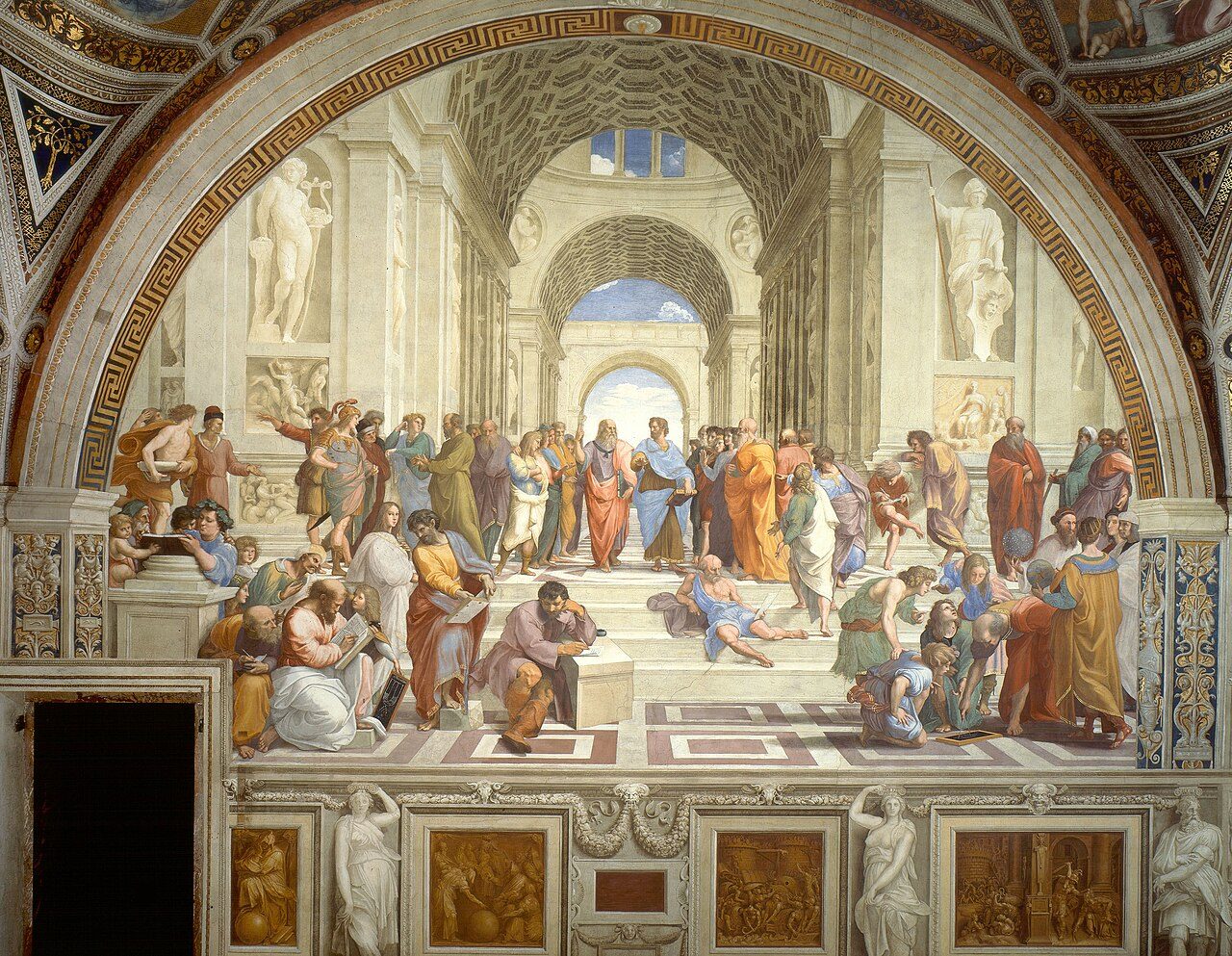
6 min read · 2 sourcesThe School of Athens (Italian: Scuola di Atene) is a fresco by the Italian Renaissance artist Raphael. It was painted between 1509 and 1511 as part of a commission by Pope Julius II to decorate the rooms now called the Stanze di Raffaello in the Apostolic Palace in Vatican City. The fresco depicts a congregation of ancient mathematicians, philosophers, and scientists, with Plato and Aristotle featured in the center. The identities of most figures are ambiguous or discernible only through subtle details or allusions; among those commonly identified are Socrates, Pythagoras, Archimedes, Heraclitus, Ibn Rushd (known as Averroes in the west), Euclid, and Zarathustra. Additionally, Italian artists Leonardo da Vinci and Michelangelo are believed to be portrayed through Plato and Heraclitus, respectively. Raphael included a self-portrait beside Ptolemy. The identity of the figure in the white robe on the left side of the fresco remains unknown. Notably, the figure is the only one to gaze directly at the viewer. 1
Program, subject, figure identifications and interpretations
The Stanza della Segnatura was the first of the rooms to be decorated, and The School of Athens, representing philosophy, is believed to be the third painting to be finished there, after La Disputa (Theology) on the opposite wall, and the Parnassus (Literature). The School of Athens is one of a group of four main frescoes on the walls of the Stanza (those on either side centrally interrupted by windows) that depict distinct branches of knowledge. Each theme is identified above by a separate tondo containing a majestic female figure seated in the clouds, with putti bearing the phrases: "Seek Knowledge of Causes", "Divine Inspiration", "Knowledge of Things Divine" (Disputa), "To Each What Is Due". Accordingly, the figures on the walls below exemplify philosophy, poetry (including music), theology, and justice. The traditional title is not Raphael's. The subject of the painting is actually philosophy, or at least ancient Greek philosophy, and its overhead tondo-label, "Causarum Cognitio", tells us what kind, as it appears to echo Aristotle's emphasis on wisdom as knowing why, hence knowing the causes, in Metaphysics Book I and Physics Book II. Indeed, Plato and Aristotle appear to be the central figures in the scene. However, many of the philosophers depicted sought knowledge of first causes. Many lived before Plato and Aristotle, and hardly a third were Athenians. 1
Figures
The identities of some of the philosophers in the picture, such as Plato and Aristotle, have been ascertained. Several other of Raphael's figures have been the subject of conjecture. Some have received multiple identifications, both as depictions of ancients and as portraits of Raphael's contemporaries. Vasari mentions a portrait of the young Duke of Mantua, leaning over Bramante with his hands raised near the bottom right, and a self-portrait of Raphael himself. 1
Central figures (14 and 15)
In the center of the fresco, at its architecture's central vanishing point, are the two undisputed main subjects: Plato on the left and his student Aristotle on the right. Both figures hold contemporary (of the time of painting) bound copies of their books in their left hands, while gesturing with their right. Plato holds Timaeus and Aristotle holds his Nicomachean Ethics. Plato is depicted as old, grey, and barefoot. By contrast, Aristotle, slightly ahead of him, is in mature manhood, wearing sandals and gold-trimmed robes, and the youths about them seem to look his way. In addition, these two central figures gesture along different dimensions: Plato vertically, upward along the picture-plane, into the vault above; Aristotle on the horizontal plane at right-angles to the picture-plane (hence in strong foreshortening), initiating a flow of space toward viewers. It is popularly thought that their gestures indicate central aspects of their philosophies: for Plato, his Theory of Forms, and for Aristotle, an emphasis on concrete particulars. Many interpret the painting to show a divergence of the two philosophical schools of classical Western philosophy. Plato argues a sense of timelessness whilst Aristotle looks into the physicality of life and the visible world. 1
Setting
The building is in the shape of a Greek cross, which some have suggested was intended to show a harmony between pagan philosophy and Christian theology (see Christianity and Paganism and Christian philosophy). The architecture of the building was inspired by the work of Bramante, who, according to Vasari, helped Raphael with the architecture in the picture. The resulting architecture was similar to the then new St. Peter's Basilica. There are two sculptures in the background. The one on the left is the god Apollo, god of light, archery and music, holding a lyre. The sculpture on the right is Athena, goddess of wisdom, in her Roman guise as Minerva. The main arch, above the characters, shows a meander (also known as a Greek fret or Greek key design), a design using continuous lines that repeat in a "series of rectangular bends" which originated on pottery of the Greek Geometric period and then became widely used in ancient Greek architectural friezes. 1
Drawings and cartoon
A number of drawings made by Raphael as studies for the School of Athens are extant. A study for the Diogenes is in the Städel in Frankfurt while a study for the group around Pythagoras, in the lower left of the painting, is preserved in the Albertina Museum in Vienna. Several drawings, showing the two men talking while walking up the steps on the right and the Medusa on Athena's shield, the statue of Athena (Minerva) and three other statues, a study for the combat scene in the relief below Apollo and "Euclid" teaching his pupils are in the Ashmolean Museum of Art and Archaeology at the University of Oxford. The cartoon for the painting is in the Pinacoteca Ambrosiana in Milan. Missing from it is the architectural background, the figures of Heraclitus, Raphael, and Protogenes. The group of the philosophers in the left foreground strongly recall figures from Leonardo's Adoration of the Magi. Additionally, there are some engravings of the scene's sculptures by Marcantonio Raimondi; they may have been based on lost drawings by Raphael, as they do not match the fresco exactly. 1
The text above is adapted from the Wikipedia article “The School of Athens”, available under the Creative Commons Attribution-ShareAlike 4.0 licence. 1
The School of Athens is fresco by Raphael, according to the structured record cited below. This entry was generated automatically from that record and has not yet been reviewed by a person familiar with the tradition. 2
The source record links this tradition to 21 external registers, which can be verified through the citation. 2