The tradition & historical record
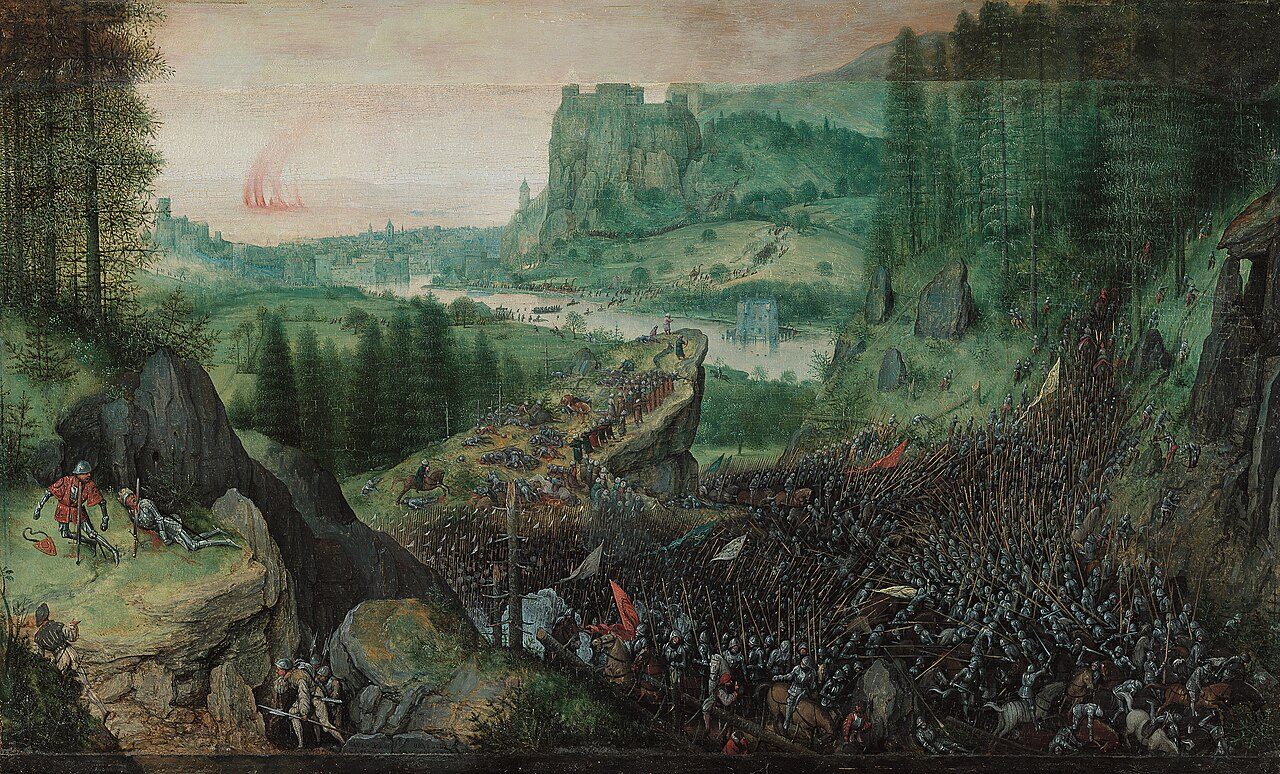
4 min read · 2 sourcesThe Suicide of Saul is an oil-on-panel painting by the Flemish Renaissance artist Pieter Bruegel the Elder, painted in 1562. It is in the collection of the Kunsthistorisches Museum, in Vienna. The Suicide of Saul is an early attempt by Bruegel to reconcile landscape and figure painting. Despite the scale of the subject, at 33.5 cm × 55 cm (13.2 in × 22 in) it is rather small compared to his later landscape subjects, but has an "astonishingly dense and highly dramatic composition". If it is compared with one of his last works, The Magpie on the Gallows of 1568, its weaknesses are apparent: the foreground and background are not yet reconciled and the jutting outcrop of rock in the centre see 2nd detail is a Mannerist device which one may see again in The Procession to Calvary. However, the distant world landscape is seen through a shimmering haze, which seems to have the effect of emphasizing the foreground detail, and this does represent a new stage in the evolution of Bruegel's depiction of naturalistic landscape. This appears to be the first time this subject was put in a painting, although there had been works in other media, such as manuscript miniatures. The painting has been cut down, with a thin strip of c. 1cm removed along the bottom, and a rather wider one, c. 4cm, along the top. These portions were later re-added, with new pieces of fruitwood panel, in Vienna in 178–82. The transition is visible in the paint today. 1
Description
An inscription on the painting identifies the subject as the rarely represented scene of the suicide of Saul after his defeat by the Philistines. These events are described in 1 Samuel 31, 1-5: 1
Now the Philistines fought against Israel; and the men of Israel fled from before the Philistines, and fell slain on Mount Gilboa. Then the Philistines followed hard after Saul and his sons. And the Philistines killed Jonathan, Abinadab, and Malchishua, Saul's sons. The battle became fierce against Saul. The archers hit him, and he was severely wounded by the archers. Then Saul said to his armorbearer, "Draw your sword, and thrust me through with it, lest these uncircumcised men come and thrust me through and abuse me." 1
But his armorbearer would not, for he was greatly afraid. Therefore Saul took a sword and fell on it. And when his armorbearer saw that Saul was dead, he also fell on his sword, and died with him. Bruegel follows the biblical account closely, representing different parts of the battle in different areas. At the left he has chosen the highly dramatic moment of the death of the armourbearer, just as Philistines are approaching below the rock platform.See 1st detail Saul's death was interpreted as a punishment of pride - it was among the proud that Dante met Saul in the Purgatorio - and this may account for Bruegel's choice of such an unusual subject. Saul was placed in the 2nd Terrace of Purgatory, with King Nimrod, the subject of another Bruegel painting (in two versions, 1563–65), The Tower of Babel. 1
Provenance
Little is known. In 1640 it was possibly in the collection of Rubens in Antwerp, who had other Bruegels, such as the small The Death of the Virgin. However, the catalogue entry describes the work as a watercolour, suggesting either that it was a different work, or referring to the very detailed painting, as in manuscript illumination. By 1781 it had entered the Austrian imperial collection, then mostly collected in the Belvedere, Vienna; this later passed to the Kunsthistorisches Museum. 1
The text above is adapted from the Wikipedia article “The Suicide of Saul”, available under the Creative Commons Attribution-ShareAlike 4.0 licence. 1
The Suicide of Saul is painting by Pieter Brueghel the Elder, according to the structured record cited below. This entry was generated automatically from that record and has not yet been reviewed by a person familiar with the tradition. 2
The source record links this tradition to 5 external registers, which can be verified through the citation. 2