The tradition & historical record
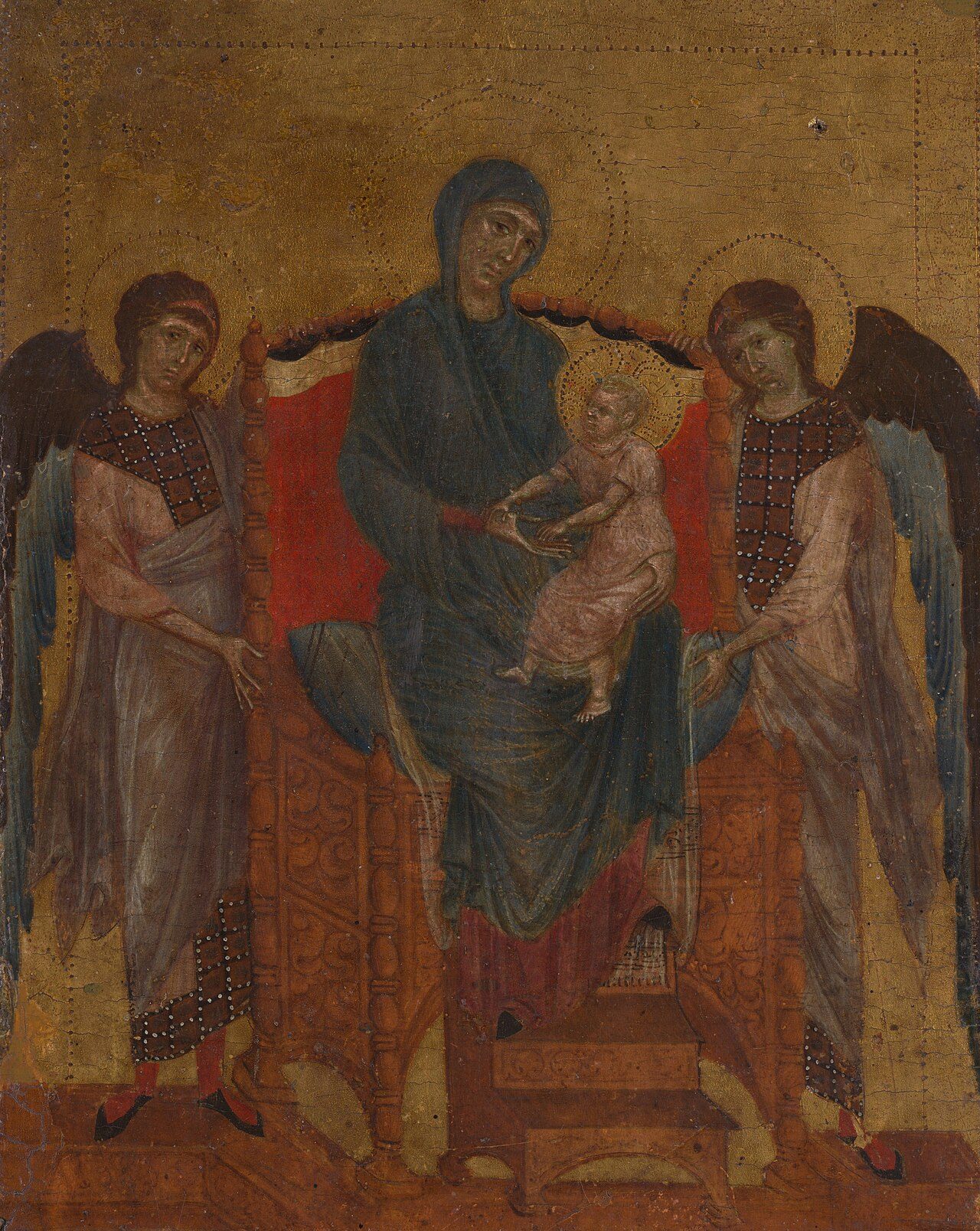
2 min read · 2 sourcesThe Virgin and Child with Two Angels is a panel painting by the Italian artist Cimabue in egg tempera on a poplar panel, dated to c. 1280. It has been held by the National Gallery in London since 2000. The painting measures 25.6 cm × 20.8 cm (10.1 in × 8.2 in). It depicts the Virgin and Child seated together on a throne, accompanied by two angels with long feathered wings. The composition is based on Byzantine models, but modified for a Western European audience: the throne has become three-dimensional, and the figures of the Virgin and Child are more human and less stylised than similar traditional Byzantine icons such as the Hodegetria. The panel was rediscovered at Benacre Hall near Lowestoft in Suffolk in 2000, after the death of Sir John Gooch, 12th Baronet, as the contents of the house were being prepared for an auction sale. It may have been acquired in Florence in the early 19th century by his ancestor, Sir Edward Gooch, 6th Baronet, and survived a fire at the house in the 1920s. It is one of three known panels from a polyptych depicting the Passion of Christ. From its physical characteristics, it was the top left of four panels on the left leaf of a diptych, and it quickly became apparent from its size, style and method that it was almost identical to a panel held by the Frick Collection in New York since 1950, The Flagellation of Christ. The discovery of this panel encouraged a change in the attribution of the Frick panel from Duccio to Cimabue. 1
The text above is adapted from the Wikipedia article “Virgin and Child with Two Angels (Cimabue)”, available under the Creative Commons Attribution-ShareAlike 4.0 licence. 1
The Virgin and Child with Two Angels is painting by Cimabue, National Gallery, according to the structured record cited below. This entry was generated automatically from that record and has not yet been reviewed by a person familiar with the tradition. 2
The source record links this tradition to 4 external registers, which can be verified through the citation. 2