The tradition & historical record
6 min read · 2 sourcesThis article about the development of themes in Italian Renaissance painting is an extension to the article Italian Renaissance painting, for which it provides additional pictures with commentary. The works encompassed are from Giotto in the early 14th century to Michelangelo's Last Judgement of the 1530s. The themes that preoccupied painters of the Italian Renaissance were those of both subject matter and execution – what was painted and the style in which it was painted. The artist had far more freedom of both subject and style than did a medieval painter. Certain characteristic elements of Renaissance painting evolved a great deal during the period. These include perspective, both in terms of how it was achieved and the effects to which it was applied, and realism, particularly in the depiction of humanity, either as symbolic, portrait or narrative element. 1
Themes
The Flagellation of Christ by Piero della Francesca (above) demonstrates in a single small work many of the themes of Italian Renaissance painting, both in terms of compositional elements and subject matter. Immediately apparent is Piero's mastery of perspective and light. The architectural elements, including the tiled floor which becomes more complex around the central action, combine to create two spaces. The inner space is lit by an unseen light source to which Jesus looks. Its exact location can be pinpointed mathematically by an analysis of the diffusion and the angle of the shadows on the coffered ceiling. The three figures who are standing outside are lit from a different angle, from both daylight and light reflected from the pavement and buildings. The artistic execution of the figures depicted is tied to the painting's immediate historical context. The figure of Pontius Pilate (seated, on the far left) is a portrait of the visiting Emperor of Byzantium. Flagellation is also called "scourging". The term "scourge" was applied to the plague. Outside the hall, in the foreground of the painting, stand three men representing those who buried the body of Christ. The two older men, Nicodemus and Joseph of Arimathaea, are believed to be portraits of acquaintances of Piero della Francesca who had recently lost their sons, one of them to the plague. The third figure, the young disciple St. John the Evangelist, may be a portrait of one of the sons, or else represent both of them in a single idealized figure, painted in a similar style to Piero's angels in other paintings. 1
Elements of Renaissance painting
Renaissance painting differed from the painting of the late medieval period in its emphasis upon the close observation of nature, particularly with regards to human anatomy, and the application of scientific principles to the use of perspective and light. 1
Linear perspective
Primarily through the depiction of architecture, Renaissance artists were able to practice the art of three-dimensional illusion using linear perspective, which gave their works a greater sense of depth. The pictures in the gallery below show the development of linear perspective in buildings and cityscapes. 1
In Giotto's fresco, the building is like a stage set with one side open to the viewer. In Paolo Uccello's fresco, the townscape gives an impression of depth. Masaccio's Holy Trinity was painted with carefully calculated mathematical proportions, in which he was probably assisted by the architect Brunelleschi. Fra Angelico uses the simple motif of a small loggia accurately drafted to create an intimate space. Gentile Bellini has painted a vast space, the Piazza San Marco in Venice, in which the receding figures add to the sense of perspective. Leonardo da Vinci did detailed and measured drawings of the background Classical ruins preparatory to commencing the unfinished Adoration of the Magi. Domenico Ghirlandaio created an exceptionally complex and expansive setting on three levels, including a steeply descending ramp and a jutting wall. Elements of the landscape, such as the church on the right, are viewed partly through other structures. Raphael's design for Fire in the Borgo shows buildings around a small square in which the background events are highlighted by the perspective. 1
Landscape
The depiction of landscape was encouraged by the development of linear perspective and the inclusion of detailed landscapes in the background of many Early Netherlandish paintings of the 15th century. Also through this influence came an awareness of atmospheric perspective and the observation of the way distant things are affected by light. 1
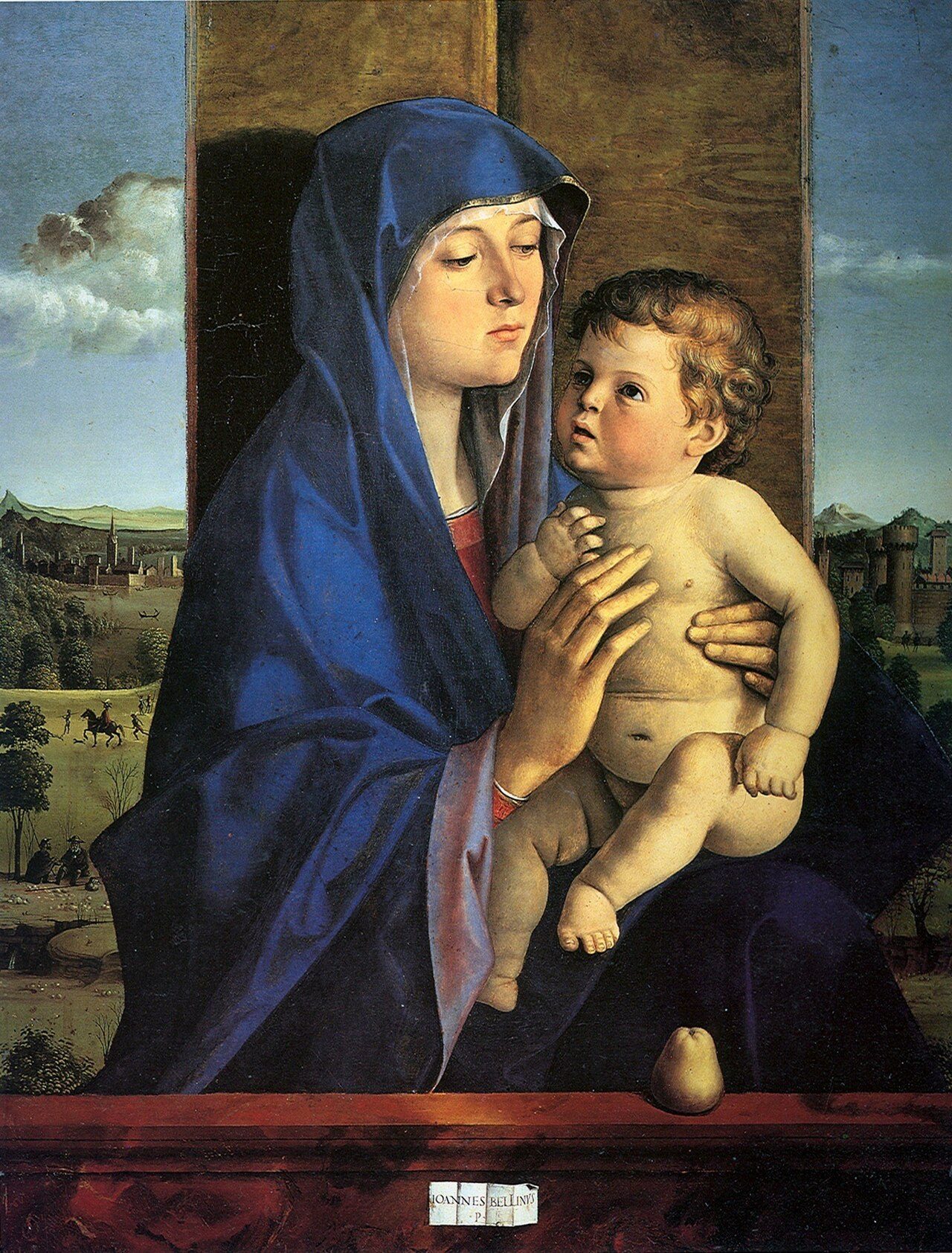
Giotto uses a few rocks to give the impression of a mountain setting. Paolo Uccello has created a detailed and surreal setting as a stage for many small scenes. In Carpaccio's Deposition of the Body of Christ, the desolate rocky landscape echoes the tragedy of the scene. Mantegna's landscape has a sculptural, three-dimensional quality that is suggestive of a real physical space. The details of the rocks, their strata and fractures, suggest that he studied the geological formations of the red limestone prevalent in areas of Northern Italy. Antonello da Messina sets the grim scene of the Crucifixion in contrast to the placid countryside which rolls into the far distance, becoming paler and bluer as it recedes. Giovanni Bellini has created a detailed landscape with a pastoral scene between the foreground and background mountains. There are numerous levels in this landscape, making it the equivalent of Ghirlandaio's complex cityscape (above). Perugino has set the Adoration of the Magi against the familiar hilly landscape of Umbria. Leonardo da Vinci, displays a theatrical use of atmospheric perspective in his view of the precipitous mountains around Lago di Garda at the foothills of the Alps in Northern Italy. 1
Light
Light and shade exist in a painting in two forms. Tone is simply the lightness and darkness of areas of a picture, graded from white to black. Tonal arrangement is a very significant feature of some paintings. Chiaroscuro is the modelling of apparent surfaces within a picture by the suggestion of light and shadow. While tone was an important feature of paintings of the medieval period, chiaroscuro was not. It became increasingly important to painters of the 15th century, transforming the depiction of three-dimensional space. 1
Taddeo Gaddi's Annunciation to the Shepherds is the first known large painting of a night scene. The internal light source of the picture is the angel. In Fra Angelico's painting, daylight, which appears to come from the actual window of the friary cell which this fresco adorns, gently illuminates the figures and defines the architecture. In his Emperor's Dream, Piero della Francesca takes up the theme of the night scene illuminated by an angel and applies his scientific knowledge of the diffusion of light. 1
The text above is adapted from the Wikipedia article “Themes in Italian Renaissance painting”, available under the Creative Commons Attribution-ShareAlike 4.0 licence. 1
Themes in Italian Renaissance painting is recorded in open cultural data. The structured record cited below does not describe the practice, and this entry has not yet been reviewed by a person familiar with the tradition. 2