The tradition & historical record
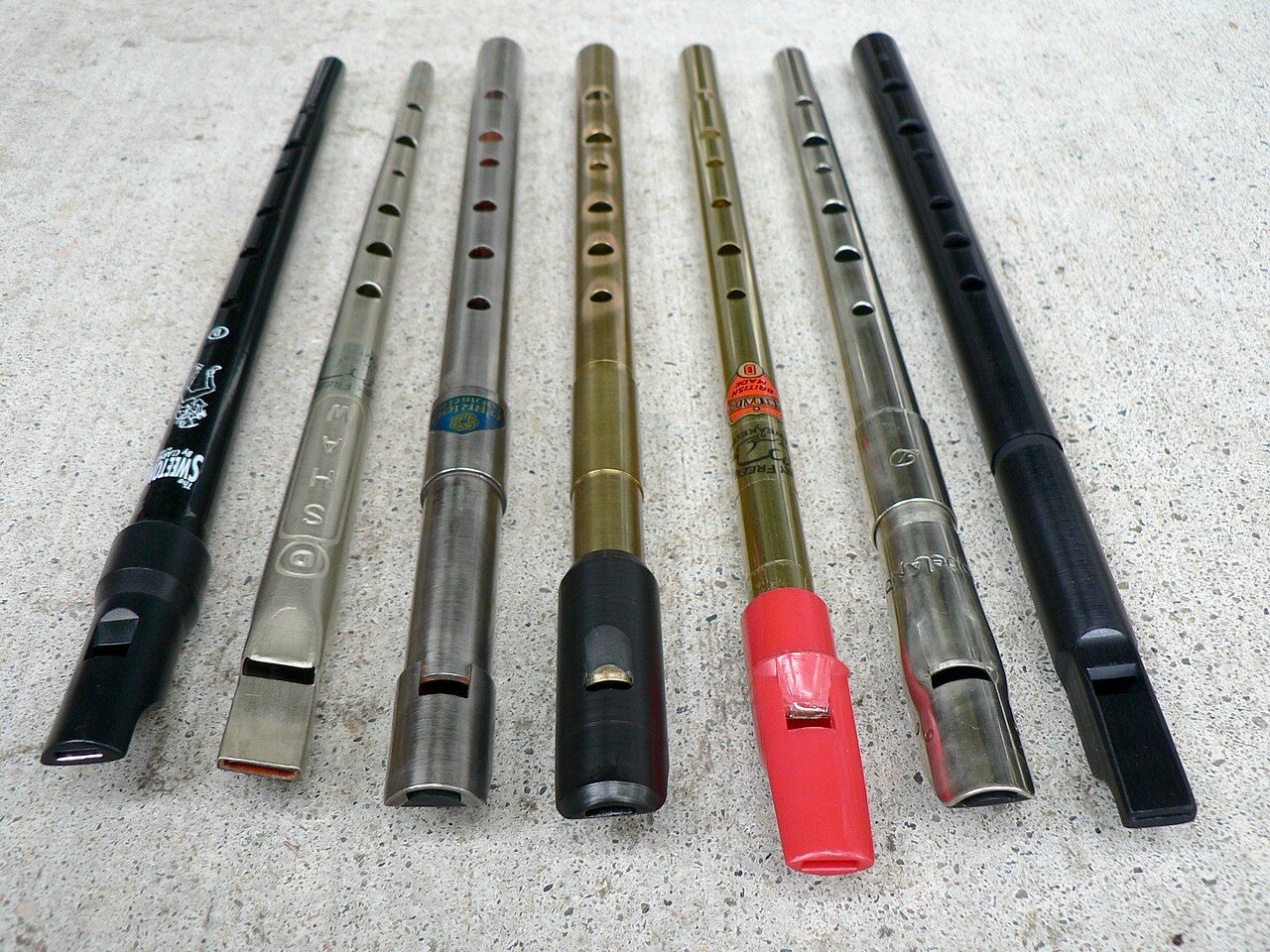
6 min read · 2 sourcesThe tin whistle, also known as the penny whistle, is a simple six-holed woodwind instrument. It is a type of fipple flute, a class of instrument which also includes the recorder and Native American flute. A tin whistle player is called a whistler. The tin whistle is closely associated with Irish traditional music and Celtic music. Other names for the instrument are the flageolet, English flageolet, Scottish penny whistle, tin flageolet, or Irish whistle (also Irish: feadóg stáin or feadóg). 1
History
The tin whistle in its modern form is from a wider family of fipple flutes which have been seen in many forms and cultures throughout the world. In Europe, such instruments have a long and distinguished history and take various forms, of which the most widely known are the recorder, tin whistle, Flabiol, Txistu and tabor pipe. 1
Predecessors
Almost all early cultures had a type of fipple flute, and it is most likely the first pitched flute-type instrument in existence. Examples found to date include a possible Neanderthal fipple flute from Slovenia, which according to some scientists may date from 81,000 to 53,000 BC; a German flute from 35,000 years ago; and a flute, known as the Malham Pipe, made from sheep's bone in West Yorkshire dating to the Iron Age. (A revised dating of the Malham Pipe now places it within the early medieval period.) Written sources that describe a fipple-type flute include the Roman tibia and Greek aulos. In the early Middle Ages, peoples of northern Europe were playing the instrument as seen in 3rd-century British bone flutes, and Irish Brehon Law describes a flute-like instrument. By the 12th century, Italian flutes came in a variety of sizes, and fragments of 12th-century Norman bone whistles have been found in Ireland, as well as an intact 14 cm Tusculum clay whistle from the 14th century in Scotland. In the 17th century, whistles were called flageolets, a term to describe a whistle with a French-made fipple headpiece (common to the modern penny whistle); and such instruments are linked to the development of the English flageolet, French flageolet and recorders of the renaissance and baroque period. The term flageolet is still preferred by some modern tin whistlers, who feel that this better describes the instrument, as the term characterises a wide variety of fipple flutes, including penny whistles. 1
19th century
The modern penny whistle is indigenous to Great Britain and Ireland, in particular to England, when factory-made "tin whistles" were produced by Robert Clarke from 1840 to 1889 in Manchester, and later New Moston, England. Down to 1900, they were also marketed as "Clarke London Flageolets" or "Clarke Flageolets". The whistle's fingering system is similar to that of the six-hole, "simple system Irish flutes" ("simple" in comparison to Boehm system flutes). The six-hole, diatonic system is also used on baroque flutes, and was of course well-known before Robert Clarke began producing his tin whistles. Clarke's first whistle, the Meg, was pitched in high A (A5), and was later made in other keys suitable for Victorian parlour music. The company showed the whistles in The Great Exhibition of 1851. The Clarke tin whistle is voiced somewhat on an organ-pipe with a flattened tube forming the lip of the fipple mouthpiece, and is usually made from rolled tin sheet or brass. They were mass-produced and widespread due to their relative affordability. As the penny whistle was generally considered a toy, it has been suggested that children or street musicians were paid a penny by those who heard them playing the whistle. However, in reality, the instrument was so called because it could be purchased for a penny. The name "tin-whistle" was also coined as early as 1825 but neither the tin whistle nor the penny whistle name seems to have been common until the 20th century. The instrument became popular in several musical traditions, namely: English, Scottish, Irish and American traditional music. Due to its affordability, the tin whistle was a popular household instrument, as ubiquitous as the harmonica. 1
Low whistle
While whistles have most often been produced in higher pitches, the "low" whistle has historically been produced. The Museum of Fine Arts, Boston, in the United States, has in its collection an example of a 19th-century low whistle from the Galpin collection. 1
Modern tin whistle
The most common whistles today are made of brass or nickel-plated brass, with a plastic mouthpiece, which contains the fipple. Generation, Feadóg, Oak, Acorn, Soodlum's (now Walton's), and other brands fall in this category. The Generation Whistle was introduced in 1966, and featured a brass tube with a lead fipple. Founded by businessman and engineer Alfred Brown in Oswestry, Shropshire, their most popular whistle, the Generation Flageolet, was introduced in 1968. The design was updated somewhat over the years, most notably the substitution of a plastic fipple for the lead fipple. Although most whistles have a cylindrical bore, other designs exist, for example a conical sheet metal whistle with a wooden stop in the wide end to form the fipple, the Clarke's brand being the most prevalent. Other less common variants are the all-metal whistle, the PVC whistle, the Flanna square holed whistle, and the wooden whistle. Gaining popularity as a folk instrument in the early 19th-century Celtic music revivals, penny whistles now play an integral part in several folk traditions. Whistles are a prevalent starting instrument in English traditional music, Scottish traditional music and Irish traditional music, since they are usually inexpensive; relatively easy to play, free of tricky embouchure such as found with the transverse flute; and use fingerings are nearly identical to those on traditional six-holed flutes, such as the Irish flute and the Baroque flute. The tin whistle is a good starting instrument to learn the uilleann pipes, which has similar finger technique, range of notes and repertoire. 1
The text above is adapted from the Wikipedia article “Tin whistle”, available under the Creative Commons Attribution-ShareAlike 4.0 licence. 1
tin whistle is six-holed woodwind instrument, according to the structured record cited below. This entry was generated automatically from that record and has not yet been reviewed by a person familiar with the tradition. 2
The source record links this tradition to 21 external registers, which can be verified through the citation. 2