The tradition & historical record
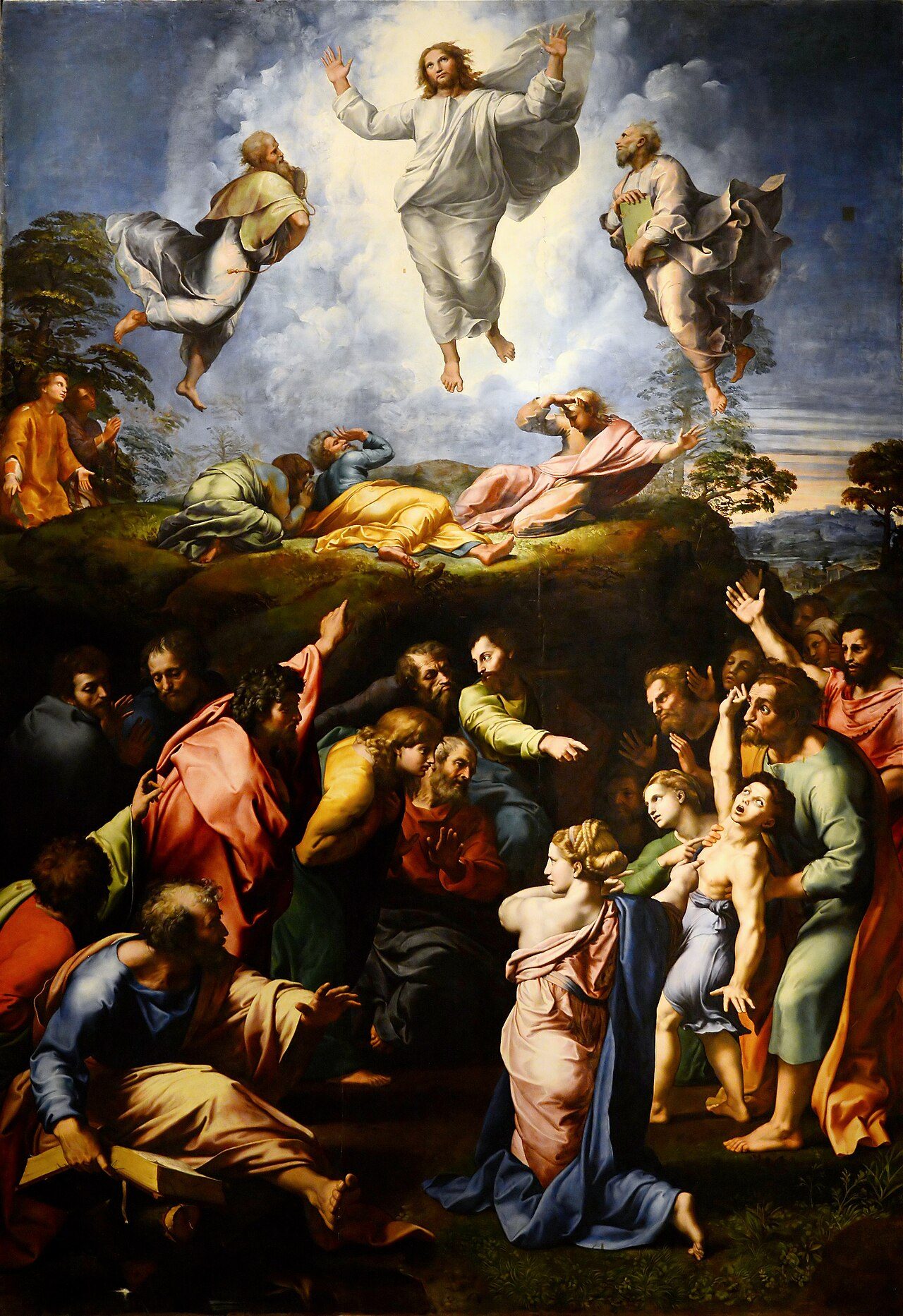
6 min read · 2 sourcesThe Transfiguration is the last painting by the Italian High Renaissance master Raphael. Cardinal Giulio de Medici – who later became Pope Clement VII (in office: 1523–1534) – commissioned the work, conceived as an altarpiece for Narbonne Cathedral in France; Raphael worked on it in the years preceding his death in 1520. The painting exemplifies Raphael's development as an artist and the culmination of his career. Unusually for a depiction of the Transfiguration of Jesus in Christian art, the subject is combined with the next episode from the Gospels (the healing of a possessed boy) in the lower part of the painting. The work is now in the Pinacoteca Vaticana in the Vatican City. From the late 16th century until the early 20th century, various commentators regarded it as the most famous oil painting in the world. 1
History of the painting
By December 1517, the latest date of commission, Cardinal Giulio de Medici, cousin to Pope Leo X (1513–1521), was also the Pope's vice-chancellor and chief advisor. He had been endowed with the legation of Bologna, the bishoprics of Albi, Ascoli, Worcester, Eger and others. From February 1515, this included the archbishopric of Narbonne. He commissioned two paintings for the cathedral of Narbonne, The Transfiguration of Christ from Raphael and The Raising of Lazarus from Sebastiano del Piombo. With Michelangelo providing drawings for the latter work, Medici was rekindling the rivalry initiated a decade earlier between Michelangelo and Raphael, in the Stanze and Sistine Chapel. From 11 to 12 December 1516, Michelangelo was in Rome to discuss with Pope Leo X and Cardinal Medici the facade of the Basilica of San Lorenzo in Florence. During this meeting, he was confronted with the commission of The Raising of Lazarus and it was here that he agreed to provide drawings for the endeavour, but not to execute the painting himself. The commission went to Michelangelo's friend Sebastiano del Piombo. As of this meeting the paintings would become emblematic of a paragone between two approaches to painting, and between painting and sculpture in Italian art. An early modello for the painting, done in Raphael's studio by Giulio Romano, depicted a 1:10 scale drawing for The Transfiguration. Here Christ is shown on Mount Tabor. Moses and Elijah float towards him; John and James are kneeling to the right; Peter is to the left. The top of the model depicts God the Father and a throng of angels. A second modello, done by Gianfrancesco Penni, shows a design with two scenes, as the painting was to develop. 1
Reception
The reception of the painting is well documented. Between the year 1525 and 1935, at least 229 written sources can be identified that describe, analyse, praise or criticise The Transfiguration. The first descriptions of the painting after Raphael's death in 1520 called The Transfiguration already a masterpiece, but this status evolved until the end of the 16th century. In his notes of a travel to Rome in 1577, the Spanish humanist Pablo de Céspedes called it the most famous oil painting in the world for the first time. The painting would preserve this authority for more than 300 years. It was acknowledged and repeated by many authors, like the connoisseur François Raguenet, who analysed Raphael's composition in 1701. In his opinion, its outline drawing, the effect of light, the colours and the arrangement of the figures made The Transfiguration the most perfect painting in the world. 1
Jonathan Richardson Senior and Junior dared to criticise the overwhelming status of The Transfiguration, asking if this painting could really be the most famous painting in the world. They criticised that the composition was divided into an upper and a lower half that would not correspond to each other. Also the lower half would draw too much attention instead of the upper half, while the full attention of the viewer should be paid to the figure of Christ alone. This criticism did not diminish the fame of the painting, but provoked counter-criticism by other connoisseurs and scholars. For the German-speaking world, it was the assessment by Johann Wolfgang von Goethe that prevailed. He interpreted the upper and the lower half as complementary parts. 1
Reproductions
The fame of the painting is also based on its reproduction. While the original could only be admired in one place – in Rome, and for a short period of time in Paris after it had been taken away by Napoleon – the large number of reproductions ensured that the composition of the painting was omnipresent in nearly every important art collection in Europe. It could thus be studied and admired by many collectors, connoisseurs, artists and art historians. Including the mosaic in St Peter's in the Vatican, at least 68 copies were made between 1523 and 1913. Good copies after the painting were highly sought after during the Early Modern period and young artists could earn money for an Italian journey by selling copies of The Transfiguration. One of the best painted copies ever was made by Gregor Urquhart in 1827. At least 52 engravings and etchings were produced after the painting until the end of the 19th century, including illustrations for books like biographies and even for Christian songbooks. The Istituto nazionale per la grafica in Rome possesses twelve of these reproductions. At least 32 etchings and engravings can be traced that depict details of the painting, sometimes to use them as a part of a new composition. Among these depictions of details is one set of prints of heads, hands and feet engraved by G. Folo after Vincenzo Camuccini (1806), and another set of heads produced in stipple engraving by J. Godby after drawings by I. Goubaud (1818 and 1830). The first engraved reproduction of The Transfiguration is also called to be the first reproductive print of a painting ever. 1
Iconography
Raphael's painting depicts two consecutive, but distinct, biblical narratives from the Gospel of Matthew, also related in the Gospel of Mark. In the first, the Transfiguration of Christ itself, Moses and Elijah appear before the transfigured Christ with Peter, James and John looking on (Matthew 17:1–9; Mark 9:2–13). In the second, the Apostles fail to cure a boy from demons and await the return of Christ (Matthew 17:14–21; Mark 9:14). The upper register of the painting shows the Transfiguration itself (on Mount Tabor, according to tradition), with the transfigured Christ floating in front of illuminated clouds, between the prophets Moses, on the right, and Elijah, on the left, with whom he is conversing (Matthew 17:3). The two figures kneeling on the left are commonly identified as Justus and Pastor who shared August 6 as a feast day with the Feast of the Transfiguration. These saints were the patrons of Medici's archbishopric and the cathedral for which the painting was intended. 1
Analysis and interpretation
The iconography of the picture has been interpreted as a reference to the delivery of the city of Narbonne from the repeated assaults of the Saracens. 1
The text above is adapted from the Wikipedia article “Transfiguration (Raphael)”, available under the Creative Commons Attribution-ShareAlike 4.0 licence. 1
Transfiguration is painting by Raphael, according to the structured record cited below. This entry was generated automatically from that record and has not yet been reviewed by a person familiar with the tradition. 2
The source record links this tradition to 8 external registers, which can be verified through the citation. 2