The tradition & historical record
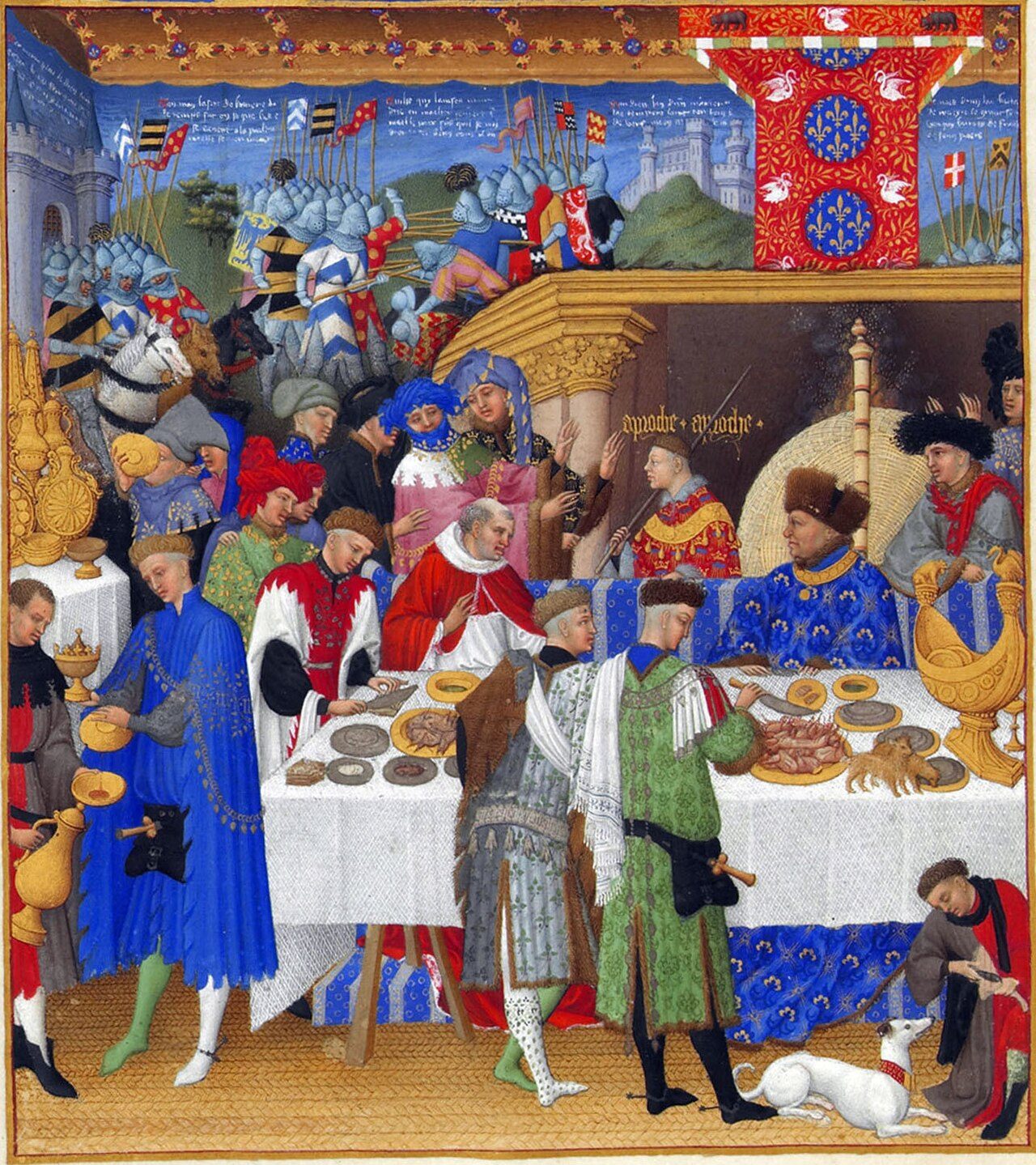
6 min read · 2 sourcesThe Très Riches Heures du Duc de Berry (French pronunciation: [tʁɛ ʁiʃz‿œʁ dy dyk də beʁi]; lit. 'The very rich Hours of the Duke of Berry'), or Très Riches Heures (also referred to more colloquially as "The Très Riches Heures of Jean, Duke of Berry") is an illuminated manuscript that was created between c. 1412 and 1416. It is a book of hours, which is a Christian devotional book and collection of prayers said at canonical hours that originated in the 13th century as a means of bringing daily prayer to the laiety, or laypeople. The manuscript was created for John, Duke of Berry, the brother of King Charles V of France, by Limbourg brothers Paul, Johan and Herman. The book is now MS 65 in the Musée Condé, Chantilly, France. Consisting of a total of 206 leaves of very fine quality parchment, 30 cm (12 in) in height by 21.5 cm (8+1⁄2 in) in width, the manuscript contains 66 large miniatures and 65 small. The design of the book, which is long and complex, has undergone many changes and reversals. Many artists contributed to its miniatures, calligraphy, initials, and marginal decorations, but determining their precise number and identity remains a matter of debate. Painted largely by artists from the Low Countries, often using rare and costly pigments and gold, and with an unusually large number of illustrations, the book is one of the most lavish late medieval illuminated manuscripts. 1
Historical context
The "Golden Age" of the book of hours in Europe took place from 1350 to 1480; the book of hours became popular in France around 1400 (Longnon, Cazelles and Meiss, 1969). At this time many major French artists undertook manuscript illumination. 1
Duke of Berry
John, Duke of Berry, is the French prince for whom the Très Riches Heures was made. Berry was the third son of the future King of France, John II the Good, and the brother and uncle of the next two kings. Little is known of Berry's education, but it is certain that he spent his adolescence among arts and literature (Cazelles and Rathofer, 1988). The young prince lived an extravagant life, necessitating frequent loans. He commissioned many works of art, which he amassed in his Sainte-Chapelle mansion. Upon Berry's death in 1416, a final inventory was done on his estate that described the incomplete and unbound gatherings of the book as the "très riches heures" ("very rich[ly decorated] hours") to distinguish it from the 15 other books of hours in Berry's collection, including the Belles Heures ("beautiful hours") and Petites Heures ("little hours") (Cazelles and Rathofer, 1988). 1
Provenance
The Très Riches Heures has changed ownership many times since its creation. The gatherings were certainly in Berry's estate on his death in 1416, but after this little is clear until 1485. A good deal is known about the lengthy and messy disposal of Berry's goods to satisfy his many creditors, which was disrupted by the insanity of the king and the Burgundian and English occupation of Paris, but there are no references to the manuscript. It seems to have been in Paris for much of this period, and probably earlier; some borders suggest the style of the Parisian Bedford Master's workshop, and works from the 1410s to the 1440s by the Bedford workshop — later taken over by the Dunois Master — use border designs from other pages, suggesting that the manuscript was available for copying in Paris. 1
Duke Charles I of Savoy acquired the manuscript, probably as a gift, and commissioned Jean Colombe to complete the manuscript around 1485–1489. Sixteenth-century Flemish artists imitated the figures or entire compositions found in the calendar (Cazelles and Rathofer 1988). The manuscript belonged to Margaret of Austria, Duchess of Savoy (1480–1530), Governor of the Habsburg Netherlands from 1507 to 1515 and again from 1519 to 1530. She was the second wife of Charles' son in law. After this its history is unknown until the 18th century, when it was given its present bookbinding with the arms of the Serra family of Genoa, Italy. It was inherited from the Serras by Baron Felix de Margherita of Turin and Milan. The French Orléanist pretender, Henri d'Orléans, Duke of Aumale, then in exile at Twickenham near London, bought it from the baron in 1856. 1
Recent history
When Aumale saw the manuscript in Genoa he was able to recognize it as a commission of Berry, probably because he was familiar with a set of plates of other manuscripts of Berry published in 1834, and subsidized by the government of the duke's father, King Louis Philippe I. Aumale gave the German art historian Gustav Friedrich Waagen breakfast and a private view of the manuscript at Orleans House, just in time for a 10-page account to appear in Waagen's Galleries and Cabinets of Art in Great Britain in 1857, so beginning its rise to fame. He also exhibited it in 1862 to the members of the Fine Arts Club. The connection with the "très riches heures" listed in the 1416 inventory was made by Léopold Victor Delisle of the Bibliothèque nationale de France and communicated to Aumale in 1881, before being published in 1884 in the Gazette des Beaux-Arts; it has never been seriously disputed. The manuscript took pride of place in a three-part article on all of Berry's manuscripts then known, and was the only one illustrated, with four plates in heliogravure. However the manuscript was called the "Grandes Heures du duc de Berry" in this, a title now given to another manuscript, based on its larger page size. The name "Heures de Chantilly" was also used in the next decades. A monograph with 65 heliogravure plates was published by Paul Durrieu in 1904, to coincide with a major exhibition of French Gothic art in Paris where it was exhibited in the form of 12 plates from the Durrieu monograph, as the terms of Aumale's bequest forbade its removal from Chantilly. The work became increasingly famous, and increasingly reproduced. The first colour reproductions, using the technique of photogravure, appeared in 1940 in the French art quarterly Verve. 1
Artists
There has been much debate regarding the identity and number of artists who contributed to the Très Riches Heures. 1
The text above is adapted from the Wikipedia article “Très Riches Heures du Duc de Berry”, available under the Creative Commons Attribution-ShareAlike 4.0 licence. 1
Très Riches Heures du duc de Berry is illuminated manuscript book of hours, according to the structured record cited below. This entry was generated automatically from that record and has not yet been reviewed by a person familiar with the tradition. 2
The source record links this tradition to 18 external registers, which can be verified through the citation. 2