The tradition & historical record
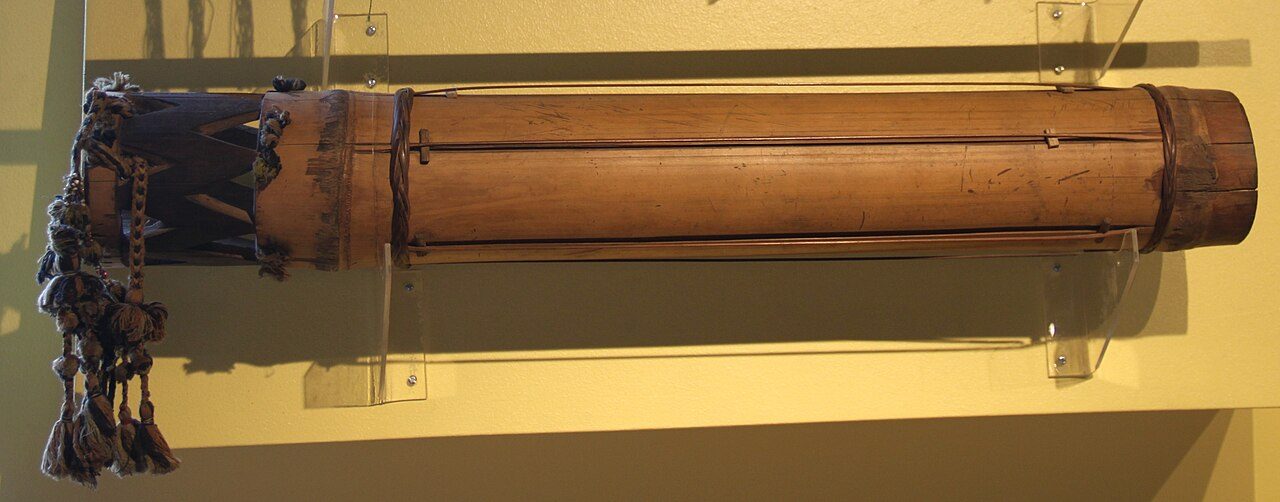
6 min read · 2 sourcesThe tube zither is a stringed musical instrument in which a tube functions both as an instrument's neck and its soundbox. As the neck, it holds strings taut and allows them to vibrate. As a soundbox, it modifies the sound and transfers it to the open air. The instruments are among the oldest of chordophones, being "a very early stage" in the development of chordophones, and predate some of the oldest chordophones, such as the Chinese Se, zithers built on a tube split in half. Most tube zithers are made of bamboo, played today in Madagascar, India, Southeast Asia and Taiwan. Tube zithers made from other materials have been found in Europe and the United States, made from materials such as cornstalks and cactus. There are both round and half tube zithers, as well as tube zithers with the strings cut out of the bamboo body, idiochordic, or, rarely, have separate strings, heterochordic. 1
Cultural connections
The areas where the bamboo tube zither has been used was connected by trade and migrations of people. One widespread group who still have some members using the bamboo-tube zither today were the Austronesian peoples, inhabiting an area that includes Madagascar, Southeast Asia, Oceania and Taiwan. Musicologists use iconography, linguistics, and literature to look for clues about existence and traits of musical instruments in the past, as well as modern instrument and variations among them. From these clues they create a history, basing their story of the instrument on the clues they have uncovered. Existing instruments, names in different languages, methods of manufacture and playing, music theory and tonal systems all offer clues to instrument origins. Among the historical trends in the background of the bamboo tube zither, traders from India sailed east and "passed the Malay peninsula" by the 6th century b.c. Indonesians sailed west to Madagascar by the 1st century A.D. By the 3rd century a.d, Buddhists were making statues in Java, and by the 7th century A.D. the "Indianized" Srivijaya empire (650-1377) was founded in Sumatra. The Khmer Empire (802-1431 a.d.) was founded in the 9th century a.d. Wars among countries (including the Khmer Empire, Champa) (192–1832) and Đại Việt caused people to migrate overland, including a defeated tribe from the Tonkin plains in modern Vietnam moving overland eastward to Assam near North India. Currently known evidence in pictures for the tube zither and bar zither dates to between the 7th and 10th centuries AD. The history of the tube zithers is interconnected with that of bar-zithers. It may not always be possible to tell from the artwork if a stick or a thin bamboo tube is being depicted on a relief artwork. 1
Basic divisions
Tube zithers can be divided by the materials used to create the tube and strings. They can be divided by the method used to get sound from the strings. They can be divided by the way the strings are arranged on the tube, which can interact with the way the strings are sounded. They can be divided by whether the tube is a whole tube or a half tube. Most tube zithers are made from bamboo, a material that is naturally hollow. Other plants have been adapted to make tubes, including cactus and breadfruit trees. Half zithers are made of both bamboo and of curved-wood boards, as much a board zither as a tube zither. After addressing the device used to stretch the strings, a tube as opposed to a stick for a bar-zither, Hornbostel-Sachs divides the tube zithers into two types, based on the types of strings they use: idiochord and heterochord. Idiochord tube zithers have "strings" which are made from the material of the tube itself. With bamboo, the surface of the tube is cut and peeled into strips, leaving both ends still attached to the tube. Small pieces of bamboo are put under the strip to make it tight. The tight strip of bamboo acts as a string and can be plucked, hammered or bowed. Heterochord tube zithers use a separate material for strings, such as wire, fishing line or guitar strings. The strings are secured to the tube on each end, and tension is placed on them. Some resemble the idiochord zithers, the string put through holes in the tube, secured there and bamboo put underneath to make them taut. Another version secures one end through a hole in the tube, the other end wrapped around a peg that can be tightened. Another way of looking at the instruments is the way strings are arranged on the tube. Polychordal tube zithers circle the tube with string-rows. 1
Bamboo
The bamboo-tube zither exists in the 21st century in pockets from Madagascar, to India, Southeast Asia and the Philippine Islands of Northern Luzon and Mindanao. Historically, it was found in India and China, where in the 21st century the Rudra veena and non-bamboo guzheng are modern relations. The basic instruments were constructed by cutting strips into the outer edges, raising the strips with wedges to create tension and make idiochord strings. They could be tuned by the positioning of the wedges, tightening and loosening the bamboo-strip strings. Beneath the strips, the holes started below the strips of bamboo were expanded downward, until they went all the way through the side of the tube. Modern instrument makers in Madagascar, Cambodia, Thailand, and Vietnam have taken advantage of modern materials. Fishing line, wire and other modern string materials have been repurposed as musical instrument strings, with pegs to tune the instruments. There is less fall-off of the note with the new materials and the sound of the instruments are different. The instruments are connected with gongs in cultures in Burma, Cambodia, Vietnam, Indonesia and the Philippines. When hammered, the zithers with bamboo strings have a gong or bell-like tone which rings and falls off. In Indonesia, there have been gong-ensembles made entirely of bamboo instruments, and some groups use a word for gong in the instruments' names (such as ogoeng boeloeg [gong bamboo]).<--verify--> Where gongs are a public instrument, the polychord bamboo-zithers can be used privately in the home. Furthermore, with a tube-zither, a musician can play music that normally takes an entire group of gongs. Kolitong and kulibaw mimic the cyclic sequence of the gangsa (ensembles of flat gongs). 1
Africa
The tube zither, called valiha, arrived in Madagascar in the 15th century a.d. with the Hova people, from Indonesian Archipelago. Two forms exist. The traditional form has as many as 14 strings cut and raised from the bamboo tube. Starting in the 20th century, the bamboo strips were replaced by metal strings, changing the instrument's sound. Africa also uses the raft zither, in which tube zithers are put together into a single musical instrument. One example of a raft zither is the Totombito zither, from Congo. Other African examples may be found in Nigeria and East Africa. 1
Southeast Asia
The instruments were used differently, depending on the cultures. 1
The text above is adapted from the Wikipedia article “Tube zither”, available under the Creative Commons Attribution-ShareAlike 4.0 licence. 1
tube zither is class of plucked string instruments, according to the structured record cited below. This entry was generated automatically from that record and has not yet been reviewed by a person familiar with the tradition. 2
The source record links this tradition to 10 external registers, which can be verified through the citation. 2