The tradition & historical record
7 min read · 2 sourcesThe Turin–Milan Hours (or Milan–Turin hours, Turin Hours etc.) is a partially destroyed illuminated manuscript, which despite its name is not strictly a book of hours. It is of exceptional quality and importance, with a very complicated history both during and after its production. It contains several miniatures of about 1420 attributed to an artist known as "Hand G" who was probably either Jan van Eyck, his brother Hubert van Eyck, or an artist very closely associated with them. About a decade or so later Barthélemy d'Eyck may have worked on some miniatures. Of the several portions of the book, that kept in Turin was destroyed in a fire in 1904, though black-and-white photographs exist. Work on the manuscript began around 1380 or 1390, and over the course of almost sixty years involved a variety of artists, assistants and patrons during perhaps seven separate campaigns of work. Its conception and first leaves were commissioned by a high-ranking member of the French court whose identity is now lost, and involved mainly French artists. Before 1413 it was in the possession of Jean, Duc de Berry; by 1420 in that of John of Bavaria, Count of Holland, who contracted mostly Flemish artists. The early leaves are highly decorative and ornate and completed within International Gothic traditions, with stylized backgrounds but comparatively flat depth of field. 1
History
The work was commissioned in about 1380 or 1390, perhaps by the person who later owned it, Jean, Duc de Berry, brother of Charles V of France, and the leading commissioner of illuminated manuscripts of the day. The original commissioner was certainly a great person of the French court – Louis II, Duke of Bourbon, uncle of the King and Berry, has also been suggested. It seems to have been conceived, very unusually, as a combined book of hours, prayer-book and missal, all parts to be lavishly illustrated. The first artist involved was the leading master of the period known as the Master of the Narbonne Parement. There was another campaign by other artists in about 1405, by which time the manuscript was probably owned by the Duke of Berry, who had certainly acquired it by 1413, when the work, still very incomplete, was given to the Duke's treasurer, Robinet d'Estampes, who divided it. D'Estampes retained most of the actual book of hours, whose illustrations were largely complete, which became known as the Très Belles Heures de Notre-Dame. This remained in his family until the 18th century, and was finally given to the BnF in Paris (MS: Nouvelle acquisition latine 3093) by the Rothschild family in 1956, after they had owned it for nearly a century. This section contains 126 folios with 25 miniatures, the latest perhaps of about 1409, and includes work by the Limbourg brothers. Robinet d'Estampes appears to have sold the other sections, with completed text but few illustrations other than the borders, and by 1420 these were owned by John, Count of Holland, or a member of his family, who commissioned a new generation of Netherlandish artists to resume work. It is the miniatures of this phase that are of the greatest interest. 1
The miniatures and borders
The page size is about 284 x 203 mm. Nearly all the pages illustrated with miniatures have the same format, with a main picture above four lines of text and a narrow bas-de-page ("foot of the page") image below. Most miniatures mark the beginning of a section of text, and the initial is a decorated or historiated square. Often the bas de page image shows a scene of contemporary life related in some way to the main devotional image, or an Old Testament subject. The borders, with one exception, all follow the same relatively simple design of stylised foliage, typical of the period when the work was started, and are largely or completely from the first phase of decoration in the 14th century. These would have been done by less senior artists in the workshop, or even sub- contracted out. During the earlier campaigns, the borders are further decorated by the miniaturists with small angels, animals (mostly birds), and figures, but the later artists usually did not add these. The single exception to the style of the borders is a destroyed page, with the main miniature a Virgo inter virgines by Hand H. The border here is in a richer and later 15th century style, from 1430 at the earliest, partly overpainting a normal border, which has also been partly scraped off. 1
The artists
The French art historian Paul Durrieu fortunately published his monograph, with photographs, on the Turin Hours in 1902, two years before it was burnt. He was the first to recognise that the Turin and Milan Hours were from the same volume, and to connect them with the van Eyck brothers. Georges Hulin de Loo, in his work on the Milan portion published in 1911 (by which time the Turin portion was already lost), made a division of the artists into "Hands" A–K in what he thought was their chronological sequence. This has been broadly accepted – as regards the lost Turin portion few have been in a position to dispute it – but attribution has been the subject of great debate, and Hand J in particular is now sub-divided by many. Hands A–E are French, from before the division of the work, Hands G–K are Netherlandish from after it, and Hand F has been attributed to both groups. 1
The dating of the Hand G miniatures has been placed at various points between 1417 and the late 1430s. The pages attributed to him are universally agreed to be the most innovative; Hulin de Loos described these miniatures as "the most marvelous that had ever decorated a book, and, for their time the most stupefying known to the history of art. For the first time we see realized, in all of its consequences, the modern conception of painting... For the first time since antiquity, painting recovers the mastery of space and light" Hulin de Loos thought these the work of Hubert van Eyck, who, like most art historians of the time, he also believed to be the main artist of the Ghent Altarpiece. He thought the less exciting, but similar, Hand H might be Jan van Eyck. Since then art historical opinion has shifted to see both Hand G and most of the Ghent Altarpiece as the work of Jan; Max J. 1
The style and identity of Hand G
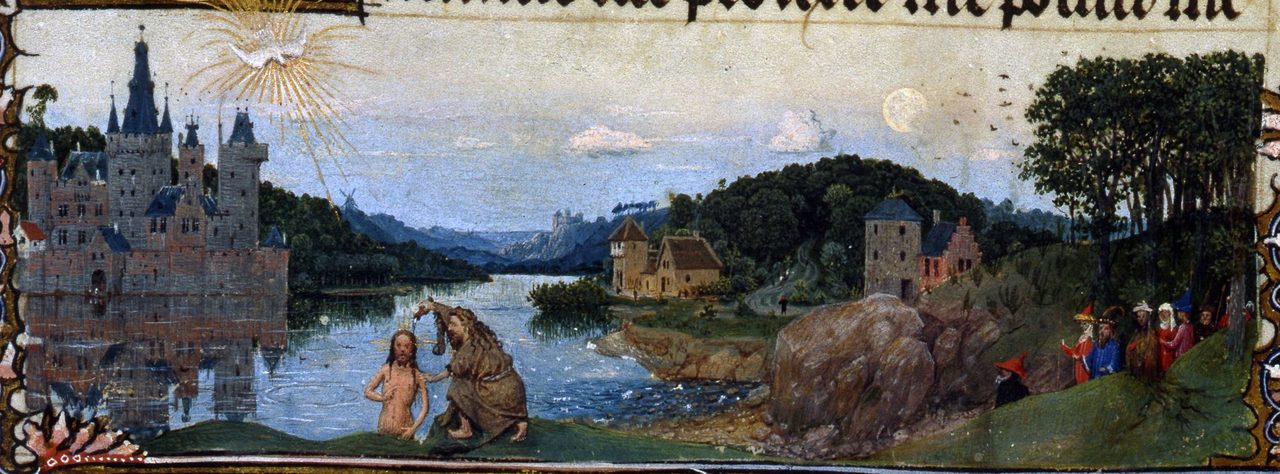
Hand G, who may or may not have been Jan van Eyck, paralleled the achievement and innovation of that artist's panel paintings in the miniature form, firstly in the technical development of the tempera medium and use of glazes to achieve unprecedented detail and subtlety, and also in his illusionist realism, especially seen in interiors and landscapes – the John the Baptist page shows both well. Many of the background portions of the attributed leaves seem concerned with the depiction of receding space, and it is often thought that in this aspect that the work of Hand G is most innovative. However, from the earlier pages he seems to be grappling with the techniques for the first time. 1
Facsimiles
Facsimile editions have been published of the surviving Turin section (1994:980 copies), accompanied by a large commentary, and separate… 1
The text above is adapted from the Wikipedia article “Turin–Milan Hours”, available under the Creative Commons Attribution-ShareAlike 4.0 licence. 1
Turin–Milan Hours is Illuminated manuscript of the 14/15th-century, according to the structured record cited below. This entry was generated automatically from that record and has not yet been reviewed by a person familiar with the tradition. 2
The source record links this tradition to 2 external registers, which can be verified through the citation. 2