The tradition & historical record
5 min read · 2 sourcesUnderglaze is a method of decorating pottery in which painted decoration is applied to the surface before it is covered with a transparent ceramic glaze and fired in a kiln. Because the glaze subsequently covers it, such decoration is completely durable, and it also allows the production of pottery with a surface that has a uniform sheen. Underglaze decoration uses pigments derived from oxides which fuse with the glaze when the piece is fired in a kiln. It is also a cheaper method, as only a single firing is needed, whereas overglaze decoration requires a second firing at a lower temperature. Many historical styles, for example Persian mina'i ware, Japanese Imari ware, Chinese doucai and wucai, combine the two types of decoration. In such cases the first firing for the body, underglaze decoration and glaze is followed by the second firing after the overglaze enamels have been applied. However, because the main or glost firing is at a higher temperature than used in overglaze decoration, the range of colours available in underglaze is more limited, and was especially so for porcelain in historical times, as the firing temperature required for the porcelain body is especially high. Early porcelain was largely restricted to underglaze blue, and a range of browns and reds. 1
Ptolemaic faience
Ancient Egyptian faience production in the New Kingdom period employed the use of underglaze in works producing green and blue pieces that are distinct from other eras of production. This was achieved by the use of an underglaze that contrasts with the overglaze. This produces the effect of highlighting and lending spectral variance to relief patterns that are embossed into pieces such as tableware such as bowls or jars. Desired blue and green finishes were achieved with the use of copper oxide on their glazing process. Ptolemaic faience has a self-glazing process. In addition to not using successive layers of glaze after the underglaze, Ptolemaic faience also applied a lower kiln temperature. At the firing stage a bake between 900 and 1,000 °C (1,650 and 1,830 °F) is applied to achieve a spectrum between turquoise blue and green. Underglaze in Ptolemaic faience was widely used for Ushabti dolls en masse for grave goods in the late Kingdom period. 1
Chinese porcelain
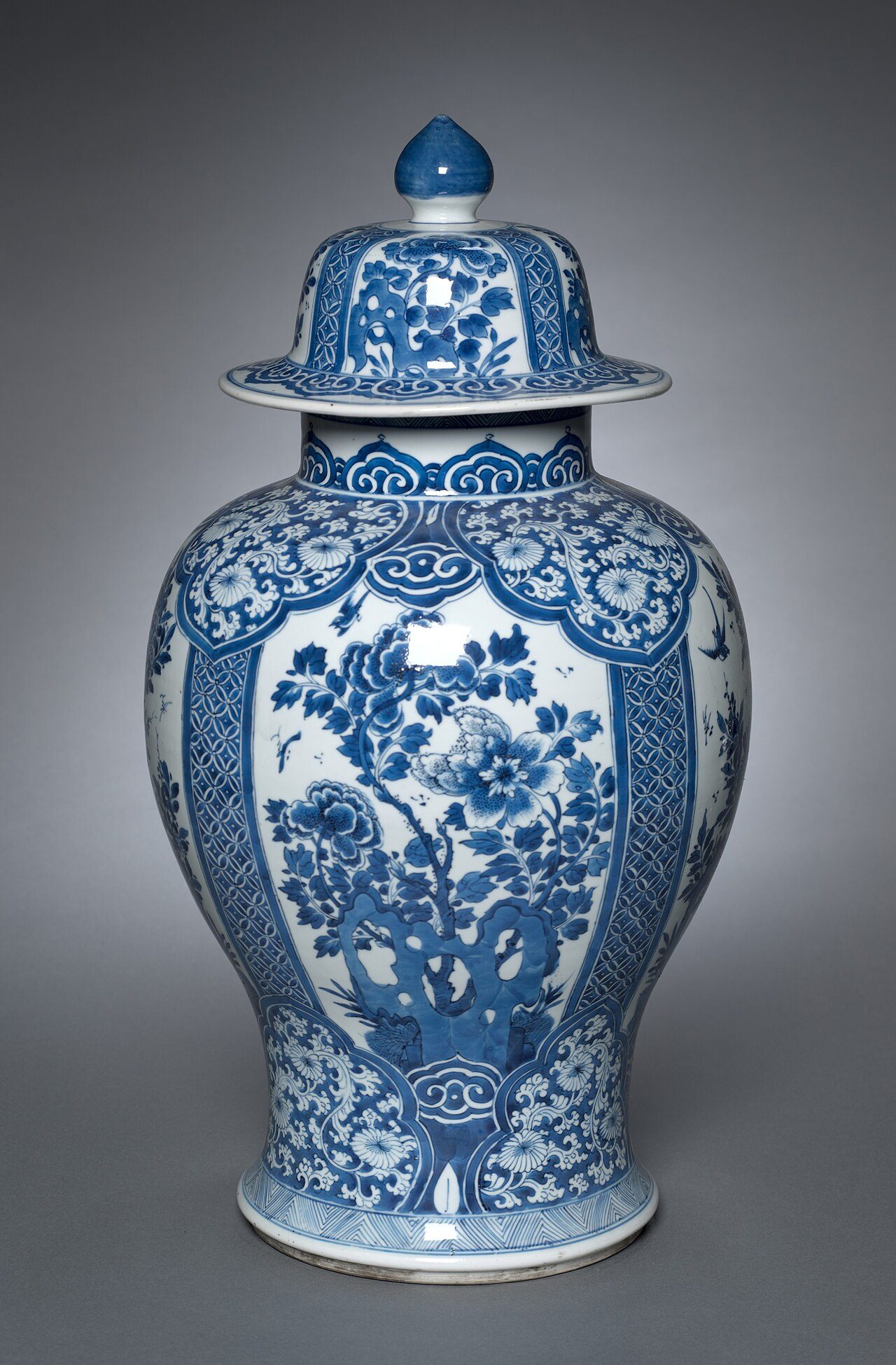
Through the Yuan and Ming dynasty, Imperial porcelain was produced with red oxide underglazes and more popular cobalt blue. Cobalt blue underglaze porcelain was adopted into the imperial style for both domestic production and Chinese export porcelain under the Yuan, Ming and Qing dynasties. Until late in the Xuande period the cobalt was imported from Persia; it has specks with high iron and low manganese content. This cobalt had a tendency to run when used in a tin glaze, and Persian artisans relied on the experimentation of the Chinese in Jingdezhen porcelain to achieve clear blue designs in their ceramics. Chinese whiteware was prized as an import to Islamic countries that would then trade cobalt for the manufacture of more Chinese porcelain. This was changed to a Chinese form of cobalt that in its ore form had a higher composition of MnFe2O4 (Jacobsite) rather than Fe3O4 (Iron(II,III) oxide). Due to the Middle Eastern demand for blue and white porcelain the primary use of this underglaze technology was utilised in creating many designs with Islamic decoration. 1
Faience
Most styles in this group, such as Delftware, mostly used blue and white pottery decoration. 1
Islamic world
Classical İznik pottery from the Ottoman Empire has a stonepaste or frit body, and uses lead glazing rather than tin, and has usually been painted in polychrome. Persian pottery, which was aware of Chinese styles throughout the period, made great use of underglaze decoration, but mostly in a single colour, often blue using the local cobalt, but also black. 1
English transfer printed earthenware
Underglaze normally uses a transparent glaze, and therefore reveals the undecorated parts of the fired body. In porcelain these are white, but many of the imitative types, such as Delftware, have brownish earthenware bodies, which are given a white tin-glaze and either inglaze or overglaze decoration. With the English invention of creamware and other white-bodied earthenwares in the 18th century, underglaze decoration became widely used on earthenware as well as porcelain. Transfer printing of underglaze was developed in England in Staffordshire pottery from the 1760s. The patterns were produced in the same way as printed engravings which were in industrial production at the time. A copper printing plate engraved with the design would transfer underglaze pigment to a piece of dampened tissue paper through a rolled press which could then be adhered to earthenware. The colourants were metallic pigments such as cobalt blue but also include the use of chromium to create greens and browns. To ensure clean transfer, quick firing at a low temperature might be given to fix the colours, known as "hardening on". Initially most production just included one colour, but later techniques were developed for printing in several colours. One type of English Creamware using blue, green, orange and yellow colours is known as "Prattware", after the leading manufacturer. This technique was also used in Europe and America in the 19th century on Creamware. 1
The text above is adapted from the Wikipedia article “Underglaze”, available under the Creative Commons Attribution-ShareAlike 4.0 licence. 1
underglazing is technique of painting or printing pottery before applying a transparent glaze, according to the structured record cited below. This entry was generated automatically from that record and has not yet been reviewed by a person familiar with the tradition. 2
The source record links this tradition to 7 external registers, which can be verified through the citation. 2