The tradition & historical record
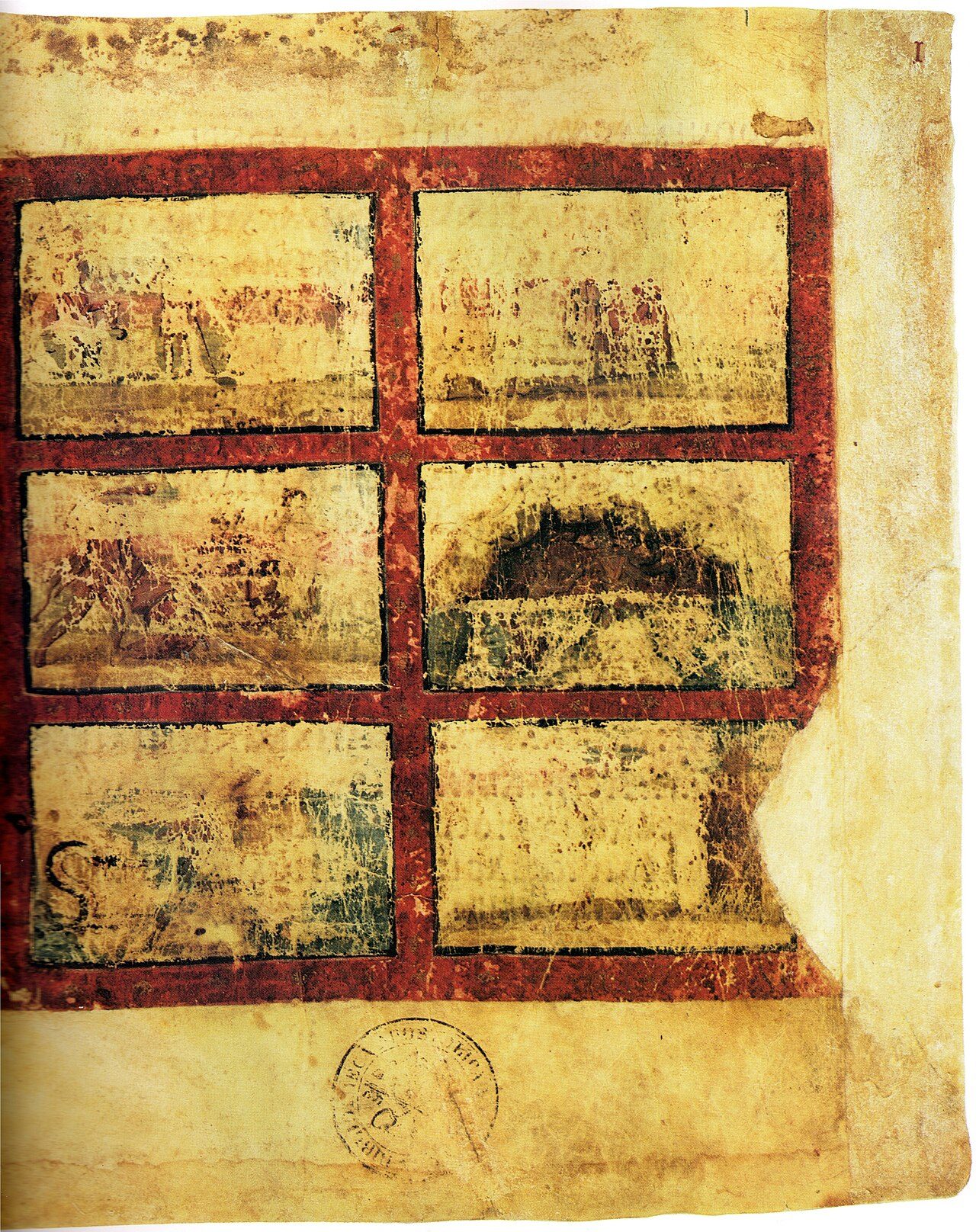
6 min read · 2 sourcesThe Vergilius Vaticanus, also known as Vatican Virgil (Vatican, Biblioteca Apostolica, Cod. Vat. lat. 3225), is a Late Antique illuminated manuscript containing fragments of Virgil's Aeneid and Georgics. It was made in Rome in around 400 CE, and is one of the oldest surviving sources for the text of the Aeneid. It is the oldest of just three remaining ancient illustrated manuscripts of classical literature. 1
Contents
The two other surviving illustrated manuscripts of classical literature are the Vergilius Romanus and the Ambrosian Iliad. The Vergilius Vaticanus is not to be confused with the Vergilius Romanus (Vatican City, Biblioteca Apostolica, Cod. Vat. lat. 3867) or the unillustrated Vergilius Augusteus, two other ancient Vergilian manuscripts in the Biblioteca Apostolica. Virgil created a classic of Roman literature in the Aeneid. He used vivid locations and emotions to create images through poetry in the story. It discusses Aeneas and his Trojan comrades wandering into the seas until reaching their final destination in Italy after escaping the city of Troy after the Trojan War. The narrative includes themes of love, loss, and war. The Trojan War is an inspiration and a catalyst in a long line of epic poetry that came after Virgil. 1
Attribution
The illustrations were added by three different painters, all of whom used iconographic copybooks. The first worked on the Georgics and parts of the Eclogues; the other two worked on the Aeneid. Each individual artist's illustrations are apparent based on his ability. The first artist is distinguished by his knowledge of spatial perspective and anatomy. His illustrations creates in the Georgics and Eclogues focus on his skill of creating distances and landscapes. The illustration of the herd being led to water is found in the artist's illustration of the Georgics. Each figure and object in the background is distinguishable with a realistic spatial arrangement. Compared to the first artist, the second artist, who worked on the Aeneid, lacks the same familiarity with spatial perspective. The inclusion of crowds with buildings, people and mountains creates a striking contrast in the discovery of Carthage. There are ideas of spatial perspective, realistic space and figures in the third artist's illustrations. He used his ability to depict a realistic background based on his skill in human anatomy. One example was where the deceased Dido lays in repose in her decorated bedchamber in the Lamentation Over Dido. 1
Description
There are 76 surviving leaves in the manuscript with 50 illustrations. If, as was common practice at the time, the manuscript contained all of the canonical works of Virgil, the manuscript would originally have had about 440 leaves and 280 illustrations. The illustrations are contained within frames and include landscapes and architectural and other details. Many of the folios survive in fragments. Some fragments are grouped in fours or fives. There are 50 damaged illustrations in poor condition. It is simple to reconstruct the original book based on each fragment. Of the several editions of Virgil, the Vergilius Vaticanus is the first edition in codex form. It may have been copied from a set of scrolls, which caused a lack of clarity with the transmission of the text. There was a well-organized workshop that created the Vergilius Vaticanus. By leaving spaces at certain places in the text, a master scribe planned the inclusion of illustrations when copying the text. Out of tradition and convenience, there were iconographic models that were from three different artists who filled in the illustrations. For the painter to finish this work, a set of illustrated rolls was studied and adapted which were to serve as iconographic models for the Aeneid. These kinds of small illustrations were placed in the columns of text which was written in papyrus style on rolls. 1
Text and script
The text was written by a single scribe in rustic capitals. As was common at the time, words are not separated by whitespace; a dot is used instead. One scribe used a late antique brown ink to write the entire text. Using eight-power magnification, the ink is grainless which appears smooth and well-preserved. The Vergilius Vaticanus is in very good condition, compared to other manuscripts from the same time period, which had been inefficiently prepared causing the parchment to break from oak gallnuts and ferrous sulphate. For distinctions to be made between thick and thin strokes the scribe used a trimmed broad pen. The pen was nearly held at 60 degrees where most strokes would occur. 1
Illustrations
The miniatures are set within the text column, although a few miniatures occupy a full page. The human figures are painted in classical style with natural proportions and drawn with vivacity. The illustrations often convey the illusion of depth quite well. The gray ground of the landscapes blend into bands of rose, violet, or blue to give the impression of a hazy distance. The interior scenes are based on earlier understanding of perspective, but occasional errors suggest that the artists did not fully understand the models used. The style of these miniatures has much in common with the surviving miniatures of the Quedlinburg Itala fragment and have also been compared to the frescos found at Pompeii. Each miniature had a proportional figure with a landscape creating a hazy effect, featuring classical architecture and clothing. Popular myths such as Hylas and the Nymphs were represented by the nine surviving illustrations of the Georgics through a command of pastoral and genre scenes by competent artists. The illustrations in the Aeneid are mixed with the Georgics; however, the Georgics’ artistic ingenuity is greater than the Aeneid illustrations. Without decorated frames and painted backgrounds or landscape settings, the illustrated verses used only the essentials for telling a story using minimal figures and objects. Neither framed nor painted in the background, the Vergilius Vaticanus uses a roll of illustrations in the Papyrus style. 1
The text above is adapted from the Wikipedia article “Vergilius Vaticanus”, available under the Creative Commons Attribution-ShareAlike 4.0 licence. 1
Vergilius Vaticanus is early illustrated copy of Virgil, according to the structured record cited below. This entry was generated automatically from that record and has not yet been reviewed by a person familiar with the tradition. 2
The source record links this tradition to 12 external registers, which can be verified through the citation. 2