The tradition & historical record
7 min read · 2 sourcesAgrippa Postumus, a grandson of the Emperor Augustus, had a villa on the slopes of Mount Vesuvius, which was buried in the eruption of 79 AD. The villa lies within the current comune of Boscotrecase, Campania, Italy. The villa is best known for its ancient Roman works of art, especially its frescoes. Because the ash from Mount Vesuvius's eruption preserved the frescoes, they were able to be excavated between 1903 and 1905. The frescoes come from various cubicula, or bedrooms that served as places of sociability and business, along the villa's southern hallway that overlooks the bay of Naples. The frescoes that were excavated are now shared between the Metropolitan Museum of Art and the National Archaeological Museum of Naples. A fragment from the villa was discovered in the collection of the Harvard Art Museums in 2007, having been acquired in 1921 from Albert Gallatin. 1
History
It is commonly accepted that the villa itself was built between 21 and 16 BC. The excavation of the villa uncovered a roof tile inscribed "Papillus Agrippae Tuberi Fabio consulibus." It is from this tile that 11 BC. is commonly accepted as the date of the cubicula's decorations since Tuberones and Fabius, two of the names inscribed on this tile, were consuls in 11 BC. The question surrounding the paintings, however, is who commissioned them since Agrippa, the supposed builder and owner of the villa, died in 12 BC, leaving the villa to his infant son, Agrippa Postumus. Some scholars such as Umberto Pappalardo argue that Julia would have been in charge of the villa after her husband's death since as an infant Agrippa Postumus could not take on the responsibilities of maintaining the villa as Agrippa's heir. The inscription "Caesaris Augusti femina mater erat" carved on a column shaft alludes to Julia. Many aristocratic women owned and managed villa properties in the Bay of Naples, so it would not have been uncommon for Julia to be the villa's proprietor when her son was not of age. While Julia is often seen as the patron of the cubicula's paintings, Elfriede Knauer presents the possibility that Agrippa commissioned the rooms’ decorations while he was governing in the eastern Roman provinces. Augustus is also often associated with having control over and ownership of the villa. When Agrippa died, Augustus became the owner of many of Agrippa's properties. Augustus's will also supports the claim that he had some ownership of the villa. Augustus's will stated that he would give any inheritances he received from any man to the child of the deceased if they were of age. 1
Frescoes
In 1922, archaeologist Matteo Della Corte published a report about the villa including a partial floor plan. The residential area of the villa was designated to the left, oriented around the central peristyle. The slaves, horses, and farming equipment were on the right side in a separate court. A tile in the slave quarters dates it to 2 BC, the year of Julia's exile and when an overseer would have taken over the villa from the imperial family. The surviving frescoes come from four cubicula along the villa's southern hallway around the villa's central peristyle, where social and business activities occurred. The paintings are from cubiculum 15, 16, and 19, also known as the Black Room, the Red Room, and the Mythological Room, respectively, for the paintings that were in those specific rooms. A few panels were also excavated from cubiculum 20, or the White Room. It is speculated that the Black Room and the Red Room possibly served as triclinia, or dining rooms. The Mythological Room and the White Room were most likely cubicula, which served as places for rest. Artifacts found around the Black Room suggest that a later owner utilized it for agrarian purposes, most likely as a storage room. The proximity of the room to the terrace, which connected the residential area to the slave quarters, would have made it ideal for storage. The villa's frescoes fall into the Pompeian Third Style of wall-paintings which were created during the imperial rule of Augustus. Key characteristics of the Third Style found in the villa were Egyptian imagery, mythological scenery, and intricate ornamentation. The materials of the rooms explain the gap between when the villa was built and when the cubicula were decorated. 1
The Black Room
Located at the east end of the hallway, the Black Room, cubiculum 15, had a doorway in the south wall leading to a terrace with a view of the sea. In the fresco on the northern wall opposite the doorway, thin columns support a pavilion structure. Portrait medallions of either Agrippa and another male member of the imperial family or Julia and Livia sit at the top of the columns supporting the pavilion's roof. In between the pavilion's columns floats a sacro-idyllic landscape of a small building with a porch decorated with garlands, grapes, and patrea. On either side of the pavilion are two candelabras. In the middle of each candelabra, two swans, symbols of Apollo, Augustus's patron god, hold fillets in their beaks while perching on protruding spirals. At the top of each candelabra is a yellow framed picture, or pinakes, of Egyptian deities, such as Isis, and symbols of the crocodile god Sobek, Hathor, or Apis, with leaders worshipping them. The pinakes on the right candelabrum show a ruler kneeling and offering an olive branch, a symbol of peace, to the shrine of Amubis. Some argue that these pinakes show Agrippa and Julia in the guise of the Egyptian leader and Isis. The pinakes share stylistic similarities with Egyptian funerary illustrations, and similar iconography is echoed in both. The Sobek pinake was most likely replicated iconography in the other cubiculum in either the dados or upper walls. 1
The Red Room
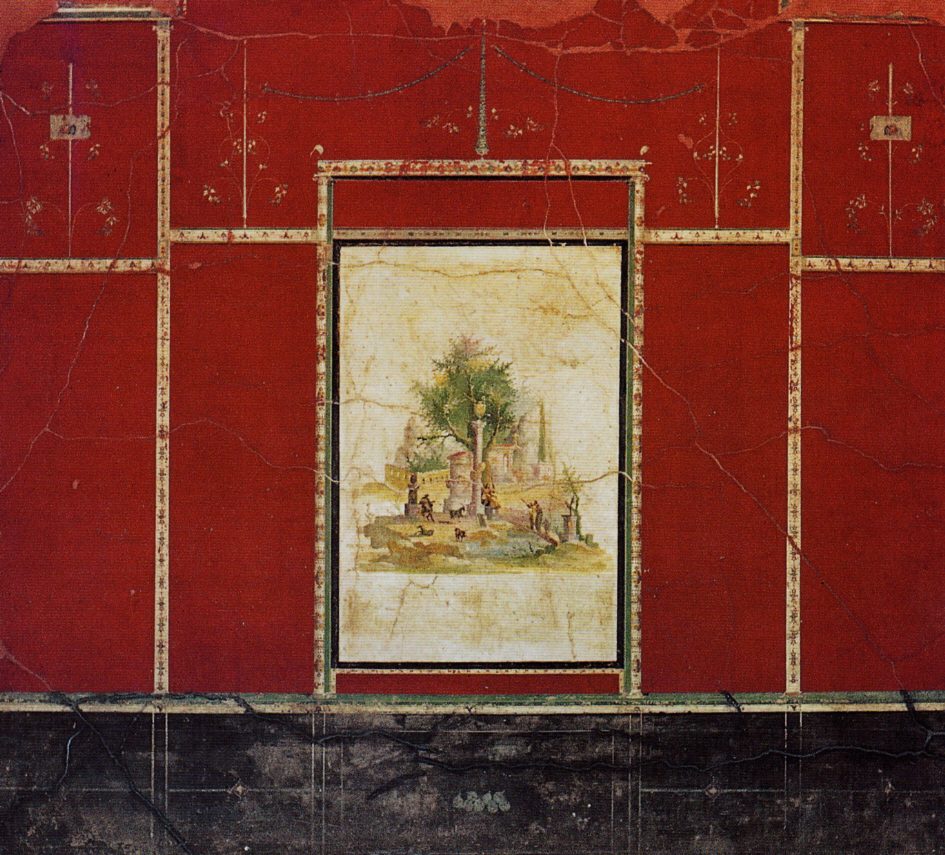
The Red Room, cubiculum 16, like its eastern neighbor the Black Room, had a southern entryway that led to the southern terrace of the villa. Also similar to its neighbor, the walls of the Red Room were decorated with aedicula and sacro-idyllic landscapes. The fresco on the northern wall is a large sacro-idyllic landscape of a tomb with an altar and statue of a seated deity floating on a white background. This sacred scene takes up the majority of the central aedicula and has more iconic columns and entablatures flanking it on both sides. Two ibises perch at the corners of the central aedicula. In the upper portion of the northern fresco, various plants, including ivy and oleander shrubs sprout from thin shafts sitting on the entablatures, and a flower candelabrum and its shafts fall in organized and symmetrical curves. The upper right- and left-hand corners of the fresco include two lectern boxes. On the black dado, figs lie beneath the sacro-idyllic landscapes. In the center of the eastern and western walls are two more large sacro-idyllic landscapes on white backgrounds surrounded by iconic columns. 1
The Mythological Room
On the west side of room 17, which connected the central peristyle of the villa to the southern terrace, was the Mythological Room, cubiculum 19. 1
The text above is adapted from the Wikipedia article “Villa of Agrippa Postumus”, available under the Creative Commons Attribution-ShareAlike 4.0 licence. 1
Villa of Agrippa Postumus is ancient Roman villa in Boscotrecase, Italy, according to the structured record cited below. This entry was generated automatically from that record and has not yet been reviewed by a person familiar with the tradition. 2
The source record links this tradition to 1 external register, which can be verified through the citation. 2