The tradition & historical record
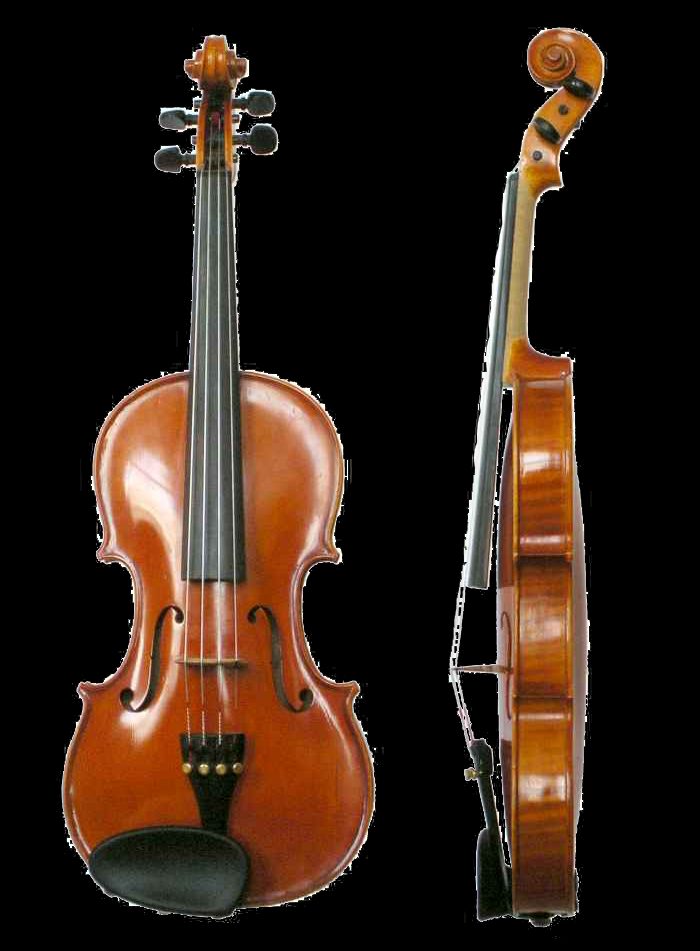
7 min read · 2 sourcesThe violin, sometimes referred to as a fiddle, is a wooden chordophone, and is the smallest, and thus highest-pitched instrument (soprano) in regular use in the violin family. Smaller violin-type instruments exist, including the violino piccolo and the pochette, but these are virtually unused. Most violins have a hollow wooden body, and commonly have four strings (sometimes five), usually tuned in perfect fifths with notes G3, D4, A4, E5, and are most commonly played by drawing a bow across the strings. The violin can also be played by plucking the strings with the fingers (pizzicato) and, in specialized cases, by striking the strings with the wooden side of the bow (col legno). Violins are important instruments in a wide variety of musical genres. They are most prominent in the Western classical tradition, both in ensembles (from chamber music to orchestras) and as solo instruments. Violins are also important in many varieties of folk music, including country music, bluegrass music, and in jazz. Electric violins with solid bodies and piezoelectric pickups are used in some forms of rock music and jazz fusion, with the pickups plugged into instrument amplifiers and speakers to produce sound. The violin has come to be incorporated in many non-Western music cultures, including Indian music and Iranian music. 1
Etymology
The word "violin" was first used in English in the 1570s. The word "violin" comes from Italian violino, a diminutive of viola. The term "viola" comes from the expression for "tenor violin" in 1797, from Italian and Old Provençal viola, [which came from] Medieval Latin vitula as a term which means 'stringed instrument', perhaps [coming] from Vitula, Roman goddess of joy, or from related Latin verb vitulari, "to cry out in joy or exaltation". The related term Viola da gamba meaning 'bass viol' (1724) is from Italian, literally "a viola for the leg" (i.e. to hold between the legs)". A violin is the "modern form of the smaller, medieval viola da braccio" ("arm viola"). The violin is oftentimes called a "fiddle" in folk music, or as an informal name for the instrument in other styles of music. The word "fiddle" was first used in English in the late 14th century. The word "fiddle" comes from fedele, fydyll, fidel, earlier fithele, from Old English fiðele 'fiddle', which is related to Old Norse fiðla, Middle Dutch vedele, Dutch vedel, Old High German fidula, German Fiedel, 'a fiddle'; all of uncertain origin. As to the origin of the word "fiddle", the "usual suggestion, based on resemblance in sound and sense, is that it is from Medieval Latin vitula". 1
History
The earliest stringed instruments were mostly plucked (for example, the Greek lyre). Two-stringed, bowed instruments, played upright and strung and bowed with horsehair, may have originated in the nomadic equestrian cultures of Central Asia, in forms closely resembling the modern-day Mongolian morin huur and the Kazakh kobyz. Similar and variant types were probably disseminated along east–west trading routes from Asia into the Middle East, and the Byzantine Empire. Rebec, fiddle and lira da braccio are generally considered the ancestors of the violin, Several sources suggest alternative possibilities for the violin's origins, such as northern or western Europe. The first makers of violins probably borrowed from various developments of the Byzantine lyra. These included the vielle (also known as the fidel or viuola) and the lira da braccio. The violin in its present form emerged in early 16th-century northern Italy. The earliest pictures of violins, albeit with three strings, are seen in northern Italy around 1530, at around the same time as the words "violino" and "vyollon" are seen in Italian and French documents. One of the earliest explicit descriptions of the instrument, including its tuning, is from the Epitome musical by Jambe de Fer, published in Lyon in 1556. The violin proved very popular, both among street musicians and the nobility; the French king Charles IX ordered Andrea Amati to construct 24 violins for him in 1560. One of these "noble" instruments, the Charles IX, is the oldest surviving violin. It is now located in the Ashmolean Museum of Oxford. 1
Construction and mechanics
A violin generally consists of a spruce (especially Norway spruce) top (the soundboard, also known as the top plate, table, or belly), maple ribs and back, two endblocks, a neck, a bridge, a soundpost, four strings, and various fittings, optionally including a chinrest, which may attach directly over, or to the left of, the tailpiece. A distinctive feature of a violin body is its hourglass-like shape and the arching of its top and back. The hourglass shape comprises two upper bouts, two lower bouts, and two concave C-bouts at the waist, providing clearance for the bow. The "voice" or sound of a violin depends on its shape, the wood it is made from, the graduation (the thickness profile) of both the top and back, the varnish that coats its outside surface and the skill of the luthier in doing all of these steps. The varnish and especially the wood continue to improve with age, making the fixed supply of old well-made violins built by famous luthiers much sought after. The majority of glued joints in the instrument use animal hide glue rather than common white glue for a number of reasons. Hide glue is capable of making a thinner joint than most other glues. It is reversible (brittle enough to crack with carefully applied force and removable with hot water) when disassembly is needed. Since fresh hide glue sticks to old hide glue, more original wood can be preserved when repairing a joint. (More modern glues must be cleaned off entirely for the new joint to be sound, which generally involves scraping off some wood along with the old glue.) Weaker, diluted glue is usually used to fasten the top to the ribs, and the nut to the fingerboard, since common repairs involve removing these parts. 1
Strings
Strings were first made of sheep gut (commonly known as catgut, which despite the name, did not come from cats), or simply gut, which was stretched, dried, and twisted. In the early years of the 20th century, strings were made of either gut or steel. Modern strings may be gut, solid steel, stranded steel, or various synthetic materials such as perlon, wound with various metals, and sometimes plated with silver. Most E strings are unwound, either plain or plated steel. Gut strings are not as common as they once were, but many performers use them to achieve a specific sound especially in historically informed performance of Baroque music. Strings have a limited lifetime. Eventually, when oil, dirt, corrosion, and rosin accumulate, the mass of the string can become uneven along its length. Apart from obvious things, such as the winding of a string coming undone from wear, players generally change a string when it no longer plays "true" (with good intonation on the harmonics), losing the desired tone, brilliance and intonation. String longevity depends on string quality and playing intensity. 1
Pitch range
A… 1
The text above is adapted from the Wikipedia article “Violin”, available under the Creative Commons Attribution-ShareAlike 4.0 licence. 1
violin is bowed string instrument, according to the structured record cited below. This entry was generated automatically from that record and has not yet been reviewed by a person familiar with the tradition. 2
The source record links this tradition to 81 external registers, which can be verified through the citation. 2