The tradition & historical record
6 min read · 2 sourcesVotive paintings in Mexico go by several names in Spanish such as “ex voto,” “retablo” or “lámina,” which refer to their purpose, place often found, or material from which they are traditionally made respectively. The painting of religious images to give thanks for a miracle or favour received in this country is part of a long tradition of such in the world. The offering of such items has more immediate precedence in both the Mesoamerican and European lines of Mexican culture, but the form that most votive paintings take from the colonial period to the present was brought to Mexico by the Spanish. As in Europe, votive paintings began as static images of saints or other religious figures which were then donated to a church. Later, narrative images, telling the personal story of a miracle or favor received appeared. These paintings were first produced by the wealthy and often on canvas; however, as sheets of tin became affordable, lower classes began to have these painted on this medium. The narrative version on metal sheets is now the traditional and representative form of votive paintings, although modern works can be executed on paper or any other medium. Narrative votive paintings can be found by the thousands in many locations in Mexico although certain shrines and sanctuaries such as that of the Virgin of Guadalupe and in Chalma attract a very large number of these. 1
Definition
Most votive paintings in Mexico are small, depicting the petitioner, the saint or other religious figure and a description of the favor or miracle received. The purpose of the painting is to give testimony and thanks for the divine help. Most votive paintings depict a kind of near disaster, such as car accidents and robbery, which the believer survived or recuperation from sickness or injury. 1
Votive painting go by several names in Mexico, some of which overlap with other artworks or offerings. A common name is ex voto. This phrase comes from Latin and means from the vow made. This refers to the fact that many of these paintings are made and brought to churches or other holy sites to fulfill a vow made to the religious persona. However, the term “ex voto” also applies to any number of other objects left for similar purposes, stamped metal pieces wax figures or other crafted items, often fastened near the image which was petitioned. Another common name is “retablo.” This is also from Latin and means “behind the altar” as many of these votive paintings could be found behind church altars up until the mid 20th century. However, “retablo” also refers to any painting or artwork found behind altar. Most of these are static images of saints. These two common terms are generally used interchangeably, but other names such as “lamina” (referring to the metal plates used to paint the images on) are used as well. Unlike static images of saints, these votive paintings are considered to be very public and intensely personal expressions of faith, often signed and even painted by the petitioner. 1
Origin and history
Examples of votive art can be found in various places around the globe and at many different periods of history. In Mesoamerica, developed cultures such as the Olmec, Zapotec, Maya and Mexica had sophisticated religious systems and evidence of votive offerings have been found at many temples, including the Templo Mayor in modern Mexico City, where many of the offerings are left to the rain god Tlaloc and the war god Huitzilopochtli. Many ex voto offerings were related to hunting, war and agriculture. A number of cave paintings found in northwest Mexico are thought to be votive in purpose. 1
The European tradition can be definitively traced back to ancient Greece and can be seen though various European cultures over the centuries. With the dominance of Christianity, ex votos took on Christian themes. Ex voto paintings of the type seen today in Mexico began as artworks commissioned by wealthy patrons as a result of an answered prayer or recovery from illness. These have their origins in 15th century Italy, and spread over Europe quickly and eventually were painted or commissioned by various levels of society. Ex voto paintings started as two types: one of a static image of a saint or other personage and one with a depiction of the miracle. The static images came first and vary little. By the 16th century, the narrative version had been established. The European ex voto tradition was introduced shortly after the Conquest with the earliest known to exist dating from the 1590s. In fact, there is a record of the conquistador Hernán Cortés making an ex-voto to give thanks for being able to walk away from a scorpion bite without becoming ill. 1
Structure and subject matter
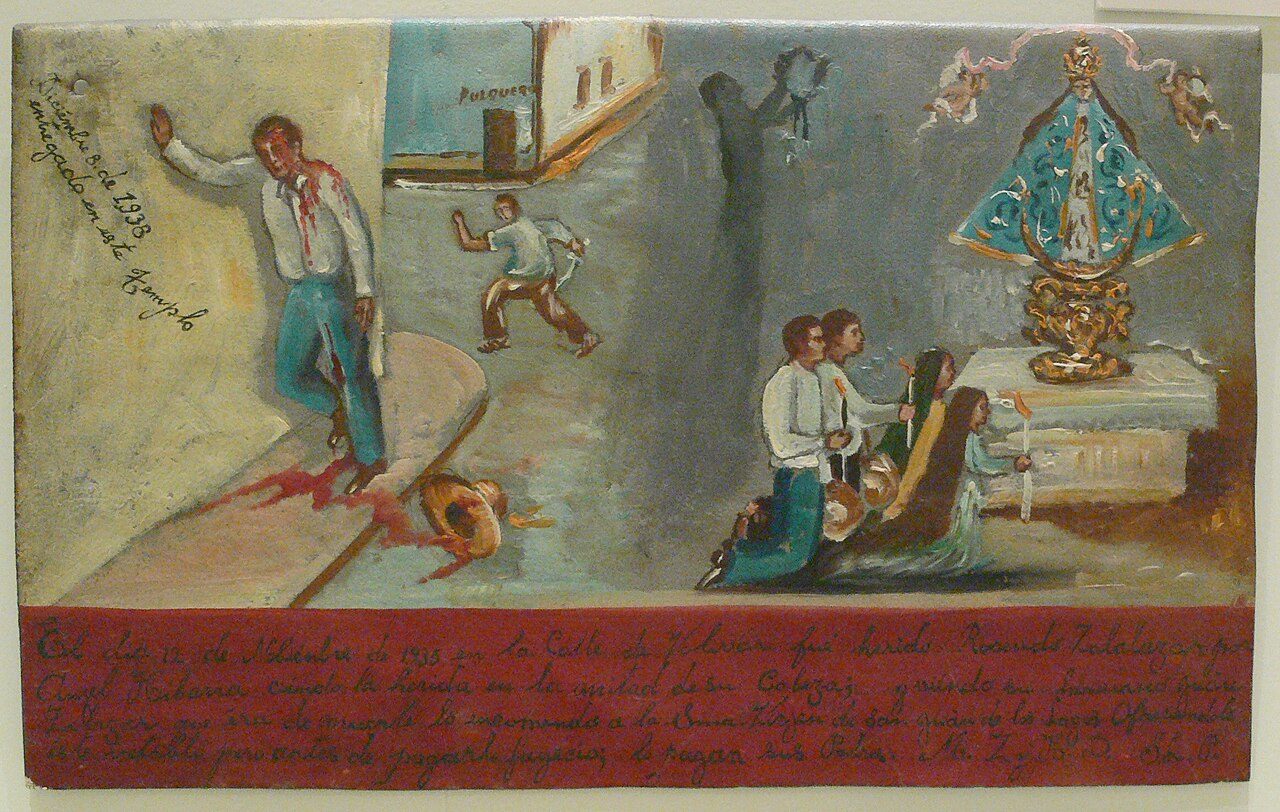
Although votive paintings have changed in styles and materials used, certain characteristics have remained the same up to the present day. The metal sheet or other canvas is laid horizontally. Most of the space is taken up with one or more scenes narrating the event, with an image of the saint or other figure floating at the top. At the bottom, a line separates the depiction from a written testimony below. The miraculous event can be shown in one or more scenes. When an illness is recounted, the stricken one often is shown surrounded by his or her family who pray for recovery. In the more dramatic scenes, events surrounding an accident are recounted where the victim has escaped grave danger. Because these paintings commemorate an action that has already occurred, depiction of the miraculous cure or rescue event is constructed purely from the imagination of the artist. God or a Saint floating above the scene is often in the right hand corner and is often surrounded by clouds to indicate his/her heavenly presence. The narrative written beneath the scene of the painting supplies the synopsis for what is often a two-act play: a grim, even catastrophic event, involving the world of mortals, followed by the divine intervention of the proper saint. Modern votive “paintings” are frequently made on paper, and often have the look of children's art, most likely designed and created by the giver. They may include photographs, or even photocopies. Even those who have been commissioned are often not done by classically trained artists. They often have no clear perspective, and spelling errors are common. The most common scenes depicted in votive paintings are related to health, with many dedicated after operations. Survival of accidents is a close second. 1
Significance
Ex votos of all types are found in nearly all Mexican churches, with hundreds of thousands of votive paintings to be found in churches and shrines all over the country. Certain sanctuaries or pilgrimage sites are known for having extremely large collections of votive paintings. 1
The text above is adapted from the Wikipedia article “Votive paintings of Mexico”, available under the Creative Commons Attribution-ShareAlike 4.0 licence. 1
Votive paintings of Mexico is recorded in open cultural data. The structured record cited below does not describe the practice, and this entry has not yet been reviewed by a person familiar with the tradition. 2
The source record links this tradition to 1 external register, which can be verified through the citation. 2