The tradition & historical record
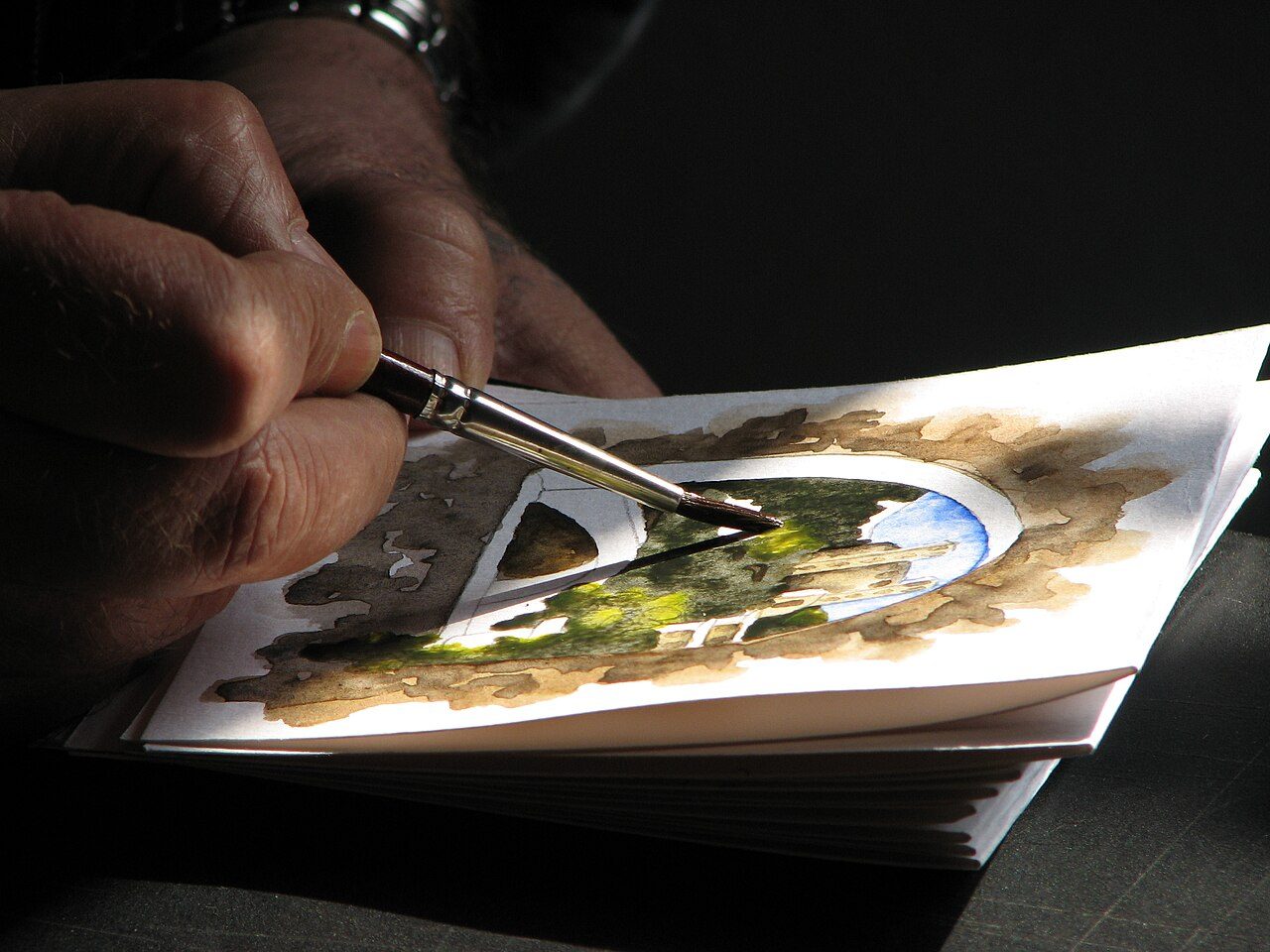
6 min read · 2 sourcesWatercolor (American English) or watercolour (Commonwealth English; see spelling differences), also aquarelle (French: [akwaʁɛl]; from Italian diminutive of Latin aqua 'water'), is a painting method in which the paints are made of pigments suspended in a water-based solution. Watercolor refers to both the medium and the resulting artwork. The conventional and most common support—material to which the paint is applied—for watercolor paintings is paper, usually special types of watercolor paper. Other supports or substrates include stone, ivory, silk, reed, papyrus, bark papers, plastics, vellum, leather, fabric, wood, and watercolor canvas (coated with a gesso that is specially formulated for use with watercolors). Watercolor paper is often made entirely or partially with cotton. This gives the surface the appropriate texture and minimizes distortion when wet. Watercolor papers are usually cold-pressed papers that provide better texture and appearance. Another variation is hot-pressed watercolor paper, which has a smoother texture and appearance than cold-pressed paper. Transparency is the main characteristic of watercolors. It is caused by the gum binder being absorbed by the paper, leaving a top layer of dispersed pigment particles, through which the paper shimmers. 1
History
Watercolor art dates back to the cave paintings of Paleolithic Europe and has been used for manuscript illustration since at least Egyptian times, with particular prominence in the European Middle Ages. However, its continuous history as an art medium begins with the Renaissance. The German Northern Renaissance artist Albrecht Dürer (1471–1528), who painted several fine botanical, wildlife, and landscape watercolors, is generally considered among the earliest examples of watercolor. An important school of watercolor painting in Germany was led by Hans Bol (1534–1593) as part of the Dürer Renaissance. 1
Despite this early start, watercolors were generally used by Baroque easel painters only for sketches, copies or cartoons (full-scale design drawings) Notable early practitioners of watercolor painting were Van Dyck (during his stay in England), Claude Lorrain, Giovanni Benedetto Castiglione, and many Dutch and Flemish artists. However, botanical illustration and wildlife illustration perhaps form the oldest and most important traditions in watercolor painting. Botanical illustrations became popular during the Renaissance, both as hand-tinted woodblock illustrations in books or broadsheets and as tinted ink drawings on vellum or paper. Botanical artists have traditionally been some of the most exacting and accomplished watercolor painters, and even today, watercolors—with their unique ability to summarize, clarify, and idealize in full color—are used to illustrate scientific and museum publications. Wildlife illustration reached its peak in the 19th century with artists such as John James Audubon, and today many naturalist field guides are still illustrated with watercolor paintings. 1
English school
Several factors contributed to the spread of watercolor painting during the 18th century, particularly in England. Among the elite and aristocratic classes, watercolor painting was one of the incidental adornments of a good education; mapmakers, military officers, and engineers valued it for its usefulness in depicting properties, terrain, fortifications, field geology, and for illustrating public works or commissioned projects. Watercolor artists were commonly taken on geological or archaeological expeditions, funded by the Society of Dilettanti (founded in 1733), to document discoveries in the Mediterranean, Asia, and the New World. These expeditions stimulated the demand for topographical painters, who churned out memento paintings of famous sites (and sights) along the Grand Tour to Italy that was undertaken by every fashionable young man of the time. In the late 18th century, the English cleric William Gilpin wrote a series of hugely popular books describing his picturesque journeys throughout rural England, and illustrated them with self-made sentimentalized monochrome watercolors of river valleys, ancient castles, and abandoned churches. This example popularized watercolors as a form of personal tourist journal. The confluence of these cultural, engineering, scientific, tourist, and amateur interests culminated in the celebration and promotion of watercolor as a distinctly English "national art". William Blake published several books of hand-tinted engraved poetry, provided illustrations to Dante's Inferno, and he also experimented with large monotype works in watercolor. 1
United States
Watercolor painting also became popular in the United States during the 19th century; outstanding early practitioners included John James Audubon, as well as early Hudson River School painters such as William H. Bartlett and George Harvey. By mid-century, the influence of John Ruskin led to increasing interest in watercolors, particularly the use of a detailed "Ruskinian" style by such artists as John W. Hill Henry, William Trost Richards, Roderick Newman, and Fidelia Bridges. The American Society of Painters in Watercolor (now the American Watercolor Society) was founded in 1866. Late-19th-century American exponents of the medium included Thomas Moran, Thomas Eakins, John LaFarge, John Singer Sargent, Childe Hassam, and, preeminently, Winslow Homer. 1
Europe
Watercolor was less popular in Continental Europe. In the 18th century, gouache was an important medium for the Italian artists Marco Ricci and Francesco Zuccarelli, whose landscape paintings were widely collected. Gouache was used by a number of artists in France as well. In the 19th century, the influence of the English school helped popularize "transparent" watercolor in France, and it became an important medium for Eugène Delacroix, François Marius Granet, Henri-Joseph Harpignies, and the satirist Honoré Daumier. Other European painters who worked frequently in watercolor were Adolph Menzel in Germany and Stanisław Masłowski in Poland. During the nineteenth century, watercolor was used to create detailed replicas of large scale oil paintings. One example is the watercolor version of Frederic Edwin Church's The Heart of the Andes, which scholars have actually identified as a copy rather than the original work. Analysis of the works materials and alterations shows the importance of watercolor during this period. 1
The adoption of brightly colored, petroleum-derived aniline dyes (and pigments compounded from them), which all fade rapidly on exposure to light, and the efforts to properly conserve the twenty thousand J. M. W. Turner paintings inherited by the British Museum in 1857, led to a negative reevaluation of the permanence of pigments in watercolor. This caused a sharp decline in their status and market value. Nevertheless, isolated practitioners continued to prefer and develop the medium into the 20th century. 1
20th and 21st centuries
Among the many 20th-century artists who produced important works in watercolor were Wassily Kandinsk… 1
The text above is adapted from the Wikipedia article “Watercolor painting”, available under the Creative Commons Attribution-ShareAlike 4.0 licence. 1
watercolor is practice of applying watercolor to a surface, according to the structured record cited below. This entry was generated automatically from that record and has not yet been reviewed by a person familiar with the tradition. 2
The source record links this tradition to 51 external registers, which can be verified through the citation. 2