The tradition & historical record
6 min read · 2 sourcesWestern calligraphy is the art of writing and penmanship as practiced in the Western world, especially using the Latin alphabet (but also including calligraphic use of the Cyrillic and Greek alphabets, as opposed to Eastern traditions such as Turko-Perso-Arabic, Chinese or Indian calligraphy). A contemporary definition of calligraphic practice is "the art of giving form to signs in an expressive, harmonious and skillful manner." The story of writing is one of aesthetic development framed within the technical skills, transmission speed(s) and material limitations of a person, time and place. A style of writing is described as a script, hand or alphabet. Calligraphy ranges from functional hand-lettered inscriptions and designs to fine art pieces where the abstract expression of the handwritten mark may or may not supersede the legibility of the letters. Classical calligraphy differs from typography and non-classical hand-lettering, though a calligrapher may create all of these; characters are historically disciplined yet fluid and spontaneous, improvised at the moment of writing. Calligraphic writing continued to play a role long after the introduction of the printing press in the West, official documents being drawn up in engrossed or handwritten form well into the 18th century. 1
Late Antiquity
The rolls of papyrus used in classical antiquity (the biblia or librī) in Late Antiquity were gradually replaced by the codex. Reed pens were replaced by quill pens. Isidore of Seville explained the then-current relation between codex, liber ('book') and volumen ('scroll') in his Etymologiae (VI.13): 1
Codex multorum librorum est; liber unius voluminis. Et dictus codex per translationem a codicibus arborum seu vitium, quasi caudex, quod ex se multitudinem librorum quasi ramorum contineat. "A codex is composed of many books; a book is of one scroll. It is called codex by way of metaphor from the trunks of trees or vines, as if it were a wooden stock (caudex), because it contains in itself a multitude of books, as it were of branches." A tradition of biblical manuscripts in codex form goes back to the 2nd century (Codex Vaticanus), and from about the 5th century, two distinct styles of writing known as uncial and half-uncial (from the Latin uncia, or 'inch') developed from various Roman bookhands. 1
Early Middle Ages
With the onset of the Middle Ages from about the 7th century, literacy in Latin Europe was increasingly limited to the monasteries. The tradition of illumination has its origins in Late Antiquity, and reaches early medieval Europe in about the 8th century, notable early examples including the Book of Durrow, Lindisfarne Gospels and the Book of Kells. Charlemagne's devotion to improved scholarship resulted in the recruiting of "a crowd of scribes", according to Alcuin, the Abbot of York. Alcuin developed the style known as the Caroline or Carolingian minuscule. The first manuscript in this hand was the Godescalc Evangelistary (finished 783) — a Gospel book written by the scribe Godescalc. Carolingian remains the one progenitor hand from which modern booktype descends. 1
Later Middle Ages
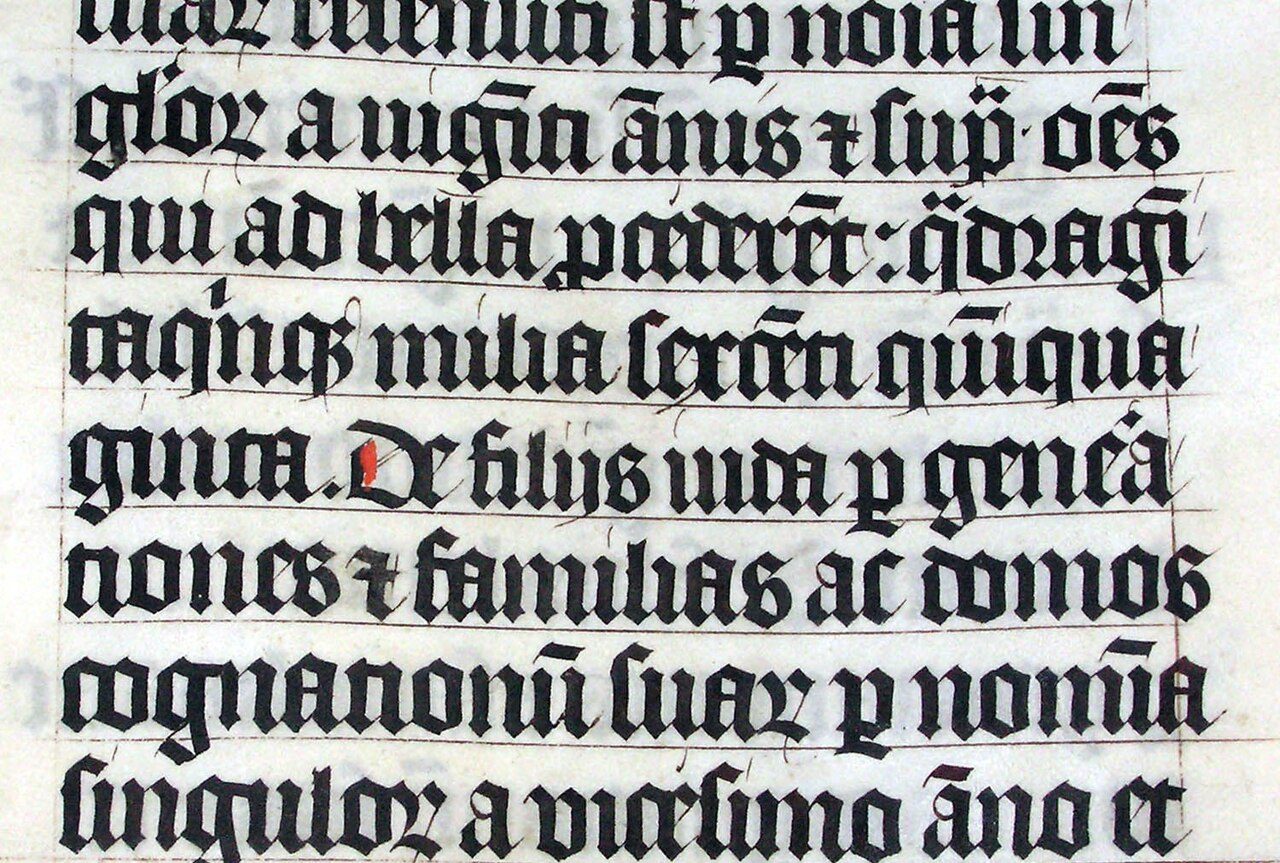
Blackletter (also known as Gothic) and its variation Rotunda, gradually developed from the Carolingian hand during the 12th century. Over the next three centuries, the scribes in northern Europe used an ever more compressed and spiky form of Gothic. Those in Italy and Spain preferred the rounder but still heavy-looking Rotunda. During the 15th century, Italian scribes returned to the Roman and Carolingian models of writing and designed the Italic hand, also called Chancery cursive, and Roman bookhand. These three hands — Gothic, Italic, and Roman bookhand — became the models for printed letters. Johannes Gutenberg used Gothic to print his famous Bible, but the lighter-weight Italic and Roman bookhand have since become the standard. During the Middle Ages, hundreds of thousands of manuscripts were produced: some illuminated with gold and fine painting, some illustrated with line drawings, and some just textbooks. Towards the end of the Middle Ages, administration in the states of Western Europe became more centralised. Paper was again widely available in Europe, which allowed a bureaucracy with standardized bookkeeping. In late medieval England, this led to the development of the Chancery Standard of Late Middle English, along with new forms of standardised calligraphy used for the production of legal or official documents. By the mid-15th century, Chancery Standard was used for most official purposes except by the Church, which still used Latin, and for some legal purposes, for which Law French and some Latin were used. It was disseminated around England by bureaucrats on official business and slowly gained prestige. 1
Early Modern era
In the mid-1600s French officials, flooded with documents written in various hands and varied levels of skill, complained that many such documents were beyond their ability to decipher. The Office of the Financier thereupon restricted all legal documents to three hands, namely the coulée, the rhonde (known as Round hand in English) and a Speed Hand sometimes simply called the bastarda. While there were many great French masters at the time, the most influential in proposing these hands was Louis Barbard, who published Les Ecritures Financière et Italienne Bastarde dans Leur Naturel circa 1650. With the destruction of the Camera Apostolica during the sack of Rome (1527), the capitol for writing masters moved to Southern France. By 1600, the Italic Cursiva began to be replaced by a technological refinement, the Italic Chancery Circumflessa, which in turn fathered the Rhonde and later English Roundhand. In England, Ayres and Banson popularized the Round Hand while Snell is noted for his reaction to them, and warnings of restraint and proportionality. Still, Edward Crocker began publishing his copybooks 40 years before the aforementioned. 1
Modern revival
After printing became ubiquitous from the 15th century, the production of illuminated manuscripts began to decline. However, the rise of printing did not mean the end of calligraphy. The modern revival of calligraphy began at the end of the 19th century, influenced by the aesthetics and philosophy of William Morris and the Arts and Crafts movement. Edward Johnston is regarded as the father of modern calligraphy. After studying published copies of manuscripts by architect William Harrison Cowlishaw, he was introduced to William Lethaby in 1898, principal of the Central School of Arts and Crafts, who advised him to study manuscripts at the British Museum. This triggered Johnston's interest in the art of calligraphy with the use of a broad edged pen. He began a teaching course in calligraphy at the Central School in Southampton Row, London from September 1899, where he influenced the typeface designer and sculptor Eric Gill. 1
The text above is adapted from the Wikipedia article “Western calligraphy”, available under the Creative Commons Attribution-ShareAlike 4.0 licence. 1
Western calligraphy is Art of writing, according to the structured record cited below. This entry was generated automatically from that record and has not yet been reviewed by a person familiar with the tradition. 2
The source record links this tradition to 4 external registers, which can be verified through the citation. 2