The tradition & historical record
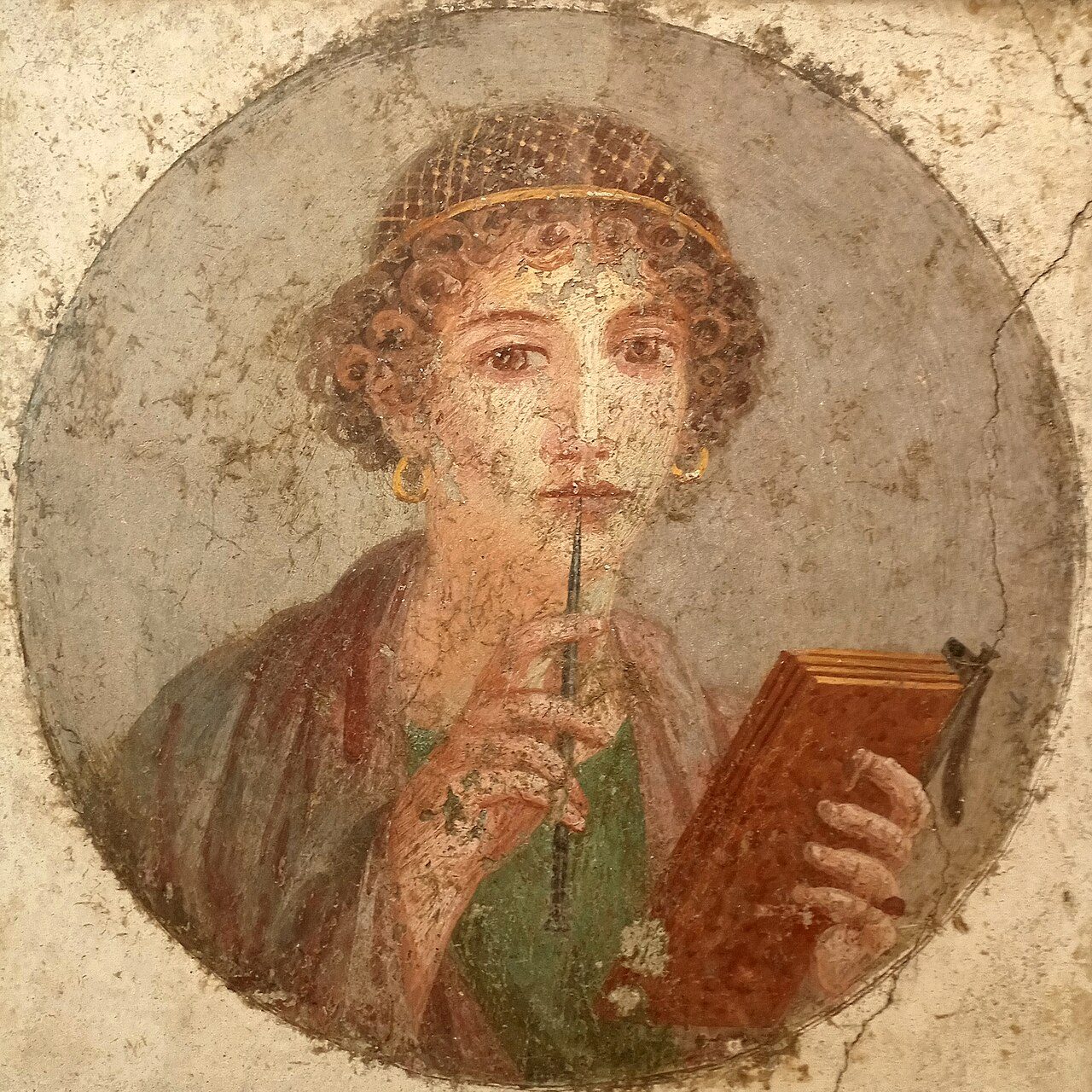
6 min read · 2 sourcesThe "Sappho" fresco or Portrait of a Young Woman with Stylus is a fresco dating to the 1st century AD from the city of Pompeii, which was buried during the eruption of Mount Vesuvius in 79 AD. It depicts a finely dressed young woman with a writing tablet and stylus, used in Roman painting to indicate literacy and education. The fresco is ascribed to the Fourth Style of Pompeiian painting and was recovered on 17 May 1760, in a house in the north-west of the city. It is displayed at the National Archaeological Museum, Naples. The portrait was speculatively identified as a depiction of the Greek poet Sappho in the nineteenth century, though no corroborating evidence for this suggestion exists. Most modern scholars treat it as a portrait of an educated, upper-class Pompeiian woman, though it has also been conjectured to be a representation of the Flavian satirist Sulpicia, who was active in the final quarter of the first century AD. The fresco was one of a number of artworks discovered at Pompeii between 1750 and 1760 which were speculatively identified as depictions of Sappho. These sparked renewed interest in the poet in European literature. The fresco was an important influence on the Chinese poet Shao Xunmei, who was inspired to take up poetry after seeing it on a visit to Naples in the early 1920s, and may also have influenced the American performance artist Eva Palmer. 1
Description
The fresco is dated to the third quarter of the 1st century AD. It depicts a woman, with brown hair, holding the type of writing tablet and stylus used by Romans during the 1st century AD. Her clothing and hairstyle closely reflect mid-century fashions, and include a golden hairnet and large golden earrings. The hairnet and tightly curled hairstyle were both characteristic of fashion under the reign of Nero (r. 54–68) and the early Flavian period that followed. It is considered part of the Fourth Style of Pompeian wall-painting. 1
The art historian Roger Ling considers the portrait likely to be a generic representation: a "rather bland form of classicising beauty" similar to idealised portrait busts of women from earlier periods. The subject holds a stylus in her right hand and rests its tip on her lips. The archaeologist Amedeo Maiuri describes the painting as "almost academically formal", and the subject's appearance as "refreshingly schoolgirlish". The fresco embodies the literary and artistic trope of the docta puella ("learned girl"). Writing tablets in Pompeiian portraits often functioned as symbols of education and literacy, and other frescoes show women with writing tablets in contexts that suggest commercial record-keeping. Since only a minority of the Roman population was literate, images of the docta puella type were used by wealthy families to indicate their education and corresponding social status. According to Mauri, the subject's delicate features and tranquil gaze were intended to convey aristocratic breeding, while the writing implements serve as "but a pretext for a high-romantic pose". 1
Subject
During the 19th century, scholars speculated that the subject of the portrait was Sappho of Lesbos, an Ancient Greek poet active during the seventh and sixth centuries BC. This connection lent fame to the work. However, there is no label identifying the portrait as Sappho, and modern scholars now generally treat the portrait as that of an educated, upper-class Pompeiian woman. Another Pompeiian painting, showing a marriage scene and from the Villa Imperiale, includes a figure sometimes identified as Sappho. Until the later twentieth century, roundel portraits such as the "Sappho" fresco were often considered purely decorative, with scholars generally discounting the suggestion that they may portray specific individuals. More recent studies have judged that Pompeiian painters used life models for their works, though it is usually difficult to discern which individuals are portrayed in specific works, and that roundel portraits could fill various roles, including as religious images and to signify the domestic nature of a space. The art historian Susan Silberberg-Peirce has suggested that it could represent the Flavian satirist Sulpicia, and that the portrait of a young man found nearby would therefore represent Calenus, her husband. 1
Excavation and display
The first major excavations in Pompeii began in 1748. This fresco was uncovered on 17 May 1760 in a house on land belonging to the local Cuomo family. Alongside it was a central panel depicting the myth of Andromeda and Perseus; the side panels contained the "Sappho" fresco paired with the pendant medallion of a young man clutching a scroll. It was removed from the walls of the original house, a common practice prior to the site's opening to the public in 1764, when ornamental pieces were often extracted for collections. Some of the other frescoes found near it were destroyed, and others were sold to private collectors. The "Sappho" fresco currently resides at the National Archaeological Museum of Naples. In 1974, it was placed on display alongside fragments of other frescoes found nearby by the curator Agnes Allroggen-Bedel, reconstructing one wall of the original building. In 2022, it was exhibited in Japan at the Tokyo National Museum. 1
Legacy
The Chinese poet Shao Xunmei saw the "Sappho" fresco during a visit to Naples in the early 1920s; in the words of the literary scholar Jingling Chen, the experience made him "the most passionate admirer of Sappho in modern China". Shao began writing poetry following his visit, and often imitated of Sappho's works, which he read in English translation. His output included a 1925 poem titled "Sappho" and dedicated to her. The American actress, artist and Hellenist Eva Palmer probably saw the painting during a year spent in Europe between 1898 and 1899: she subsequently performed a tableau vivant themed around Sappho in a 1900 variety show in Bar Harbor, Maine. The classicist Margaret Reynolds credits the "Sappho" fresco, along with a bust, a statue and a mosaic – all found at Pompeii in the 1750s and all equally speculatively identified as images of the poet – with inspiring the Italian poet Vincenzo Imperiale's La Faoniade: Inni ed Odi di Saffo ("The Faoniad: Hymns and Odes of Sappho"), which spuriously claimed to be a translation of a lost work of hers. She also considers these artworks an inspiration for the French writer Étienne-François de Lantier's 1798 Voyages d’Anténor en Grèce et en Asie ("Voyages of Antenor in Greece and in Asia"), in which the title character meets Sappho on the day of her death by suicide. 1
The text above is adapted from the Wikipedia article “"Sappho" fresco (Pompeii)”, available under the Creative Commons Attribution-ShareAlike 4.0 licence. 1
Woman with wax tablets and stylus is fresco, according to the structured record cited below. This entry was generated automatically from that record and has not yet been reviewed by a person familiar with the tradition. 2
The source record links this tradition to 1 external register, which can be verified through the citation. 2