The tradition & historical record
6 min read · 2 sourcesWoodblock printing in Japan (木版画, mokuhanga) is a technique best known for its use in the ukiyo-e artistic genre, but it was also used for printing books in the same period. Invented in China during the Tang dynasty, woodblock printing was widely adopted in Japan during the Edo period (1603–1868). It is similar to woodcut in Western printmaking in some regards, but was widely used for text as well as images. The Japanese mokuhanga technique differs in that it uses water-based inks—as opposed to Western woodcut, which typically uses oil-based inks. Japanese water-based inks provide a wide range of vivid colors, glazes, and transparency. 1
Early, to 13th century
Woodblock printing was invented in China under the Tang dynasty, and eventually migrated to Japan in the late 700s, where it was first used to reproduce foreign literature. In 764 the Empress Kōken commissioned one million small wooden pagodas, each containing a small woodblock scroll printed with a Buddhist text (Hyakumantō Darani). These were distributed to temples around the country as thanks for the suppression of the Emi Rebellion of 764. These are the earliest examples of woodblock printing known, or documented, from Japan. By the eleventh century, Buddhist temples in Japan produced printed books of sutras, mandalas, and other Buddhist texts and images. For centuries, printing was mainly restricted to the Buddhist sphere, as it was too expensive for mass production, and did not have a receptive, literate public as a market. However, an important set of fans of the late Heian period (12th century), containing painted images and Buddhist sutras, reveals from loss of paint that the underdrawing for the paintings was printed from blocks. In the Kamakura period from the 12th century to the 13th century, many books were printed and published by woodblock printing at Buddhist temples in Kyoto and Kamakura. One of the earliest documented examples is a print of the Lotus Sutra produced in 1225 by Koei for the Kofuku-ji temple in Nara, followed by numerous religious prints in Kyoto between the 13th and 14th centuries. 1
Early Edo period
A Western-style movable type printing-press was brought to Japan by the Tenshō embassy in 1590, and was first used for printing in Kazusa, Nagasaki in 1591. However, the use of the western printing press was discontinued after the ban on Christianity in 1614. The printing press seized from Korea by Toyotomi Hideyoshi's forces in 1593 was also in use at the same time as the printing press from Europe. An edition of the Confucian Analects was printed in 1598, using a Korean moveable type printing press, at the order of Emperor Go-Yōzei. Tokugawa Ieyasu established a printing school at Enko-ji in Kyoto and started publishing books using a domestic wooden movable type printing press instead of metal from 1599. Ieyasu supervised the production of 100,000 types, which were used to print many political and historical books. In 1605, books using a domestic copper movable type printing press began to be published, but copper type did not become mainstream after Ieyasu died in 1616. The great pioneers in applying the movable type printing press to the creation of artistic books, and in preceding mass production for general consumption, were Honami Kōetsu and Suminokura Soan. At their studio in Saga, Kyoto, the pair created a number of woodblock versions of the Japanese classics, both text and images, essentially converting emaki (handscrolls) to printed books, and reproducing them for wider consumption. These books, now known as Kōetsu Books, Suminokura Books, or Saga Books (嵯峨本, Saga-bon), are considered the first and finest printed reproductions of many of these classic tales; the Saga Book of the Tales of Ise (Ise monogatari), printed in 1608, is especially renowned. 1
Later Edo period
The mass production of woodblock prints in the Edo period was due to the high literacy rate of Japanese people in those days. The literacy rate of the Japanese in the Edo period was due to the spread of private schools terakoya. There were more than 600 rental bookstores in Edo, and people lent woodblock-printed illustrated books of various genres. While the Saga Books were printed on expensive paper and used various embellishments, being printed specifically for a small circle of literary connoisseurs, other printers in Edo quickly adapted the conventional woodblock printing to produce cheaper books in large numbers, for more general consumption. The content of these books varied widely, including travel guides, gardening books, cookbooks, kibyōshi (satirical novels), sharebon (books on urban culture), kokkeibon (comical books), ninjōbon (romance novel), yomihon, kusazōshi, art books, play scripts for the kabuki and jōruri (puppet) theatre, etc. The best-selling books of this period were Kōshoku Ichidai Otoko (Life of an Amorous Man) by Ihara Saikaku, Nansō Satomi Hakkenden by Takizawa Bakin, and Tōkaidōchū Hizakurige by Jippensha Ikku, and these books were reprinted many times. 1
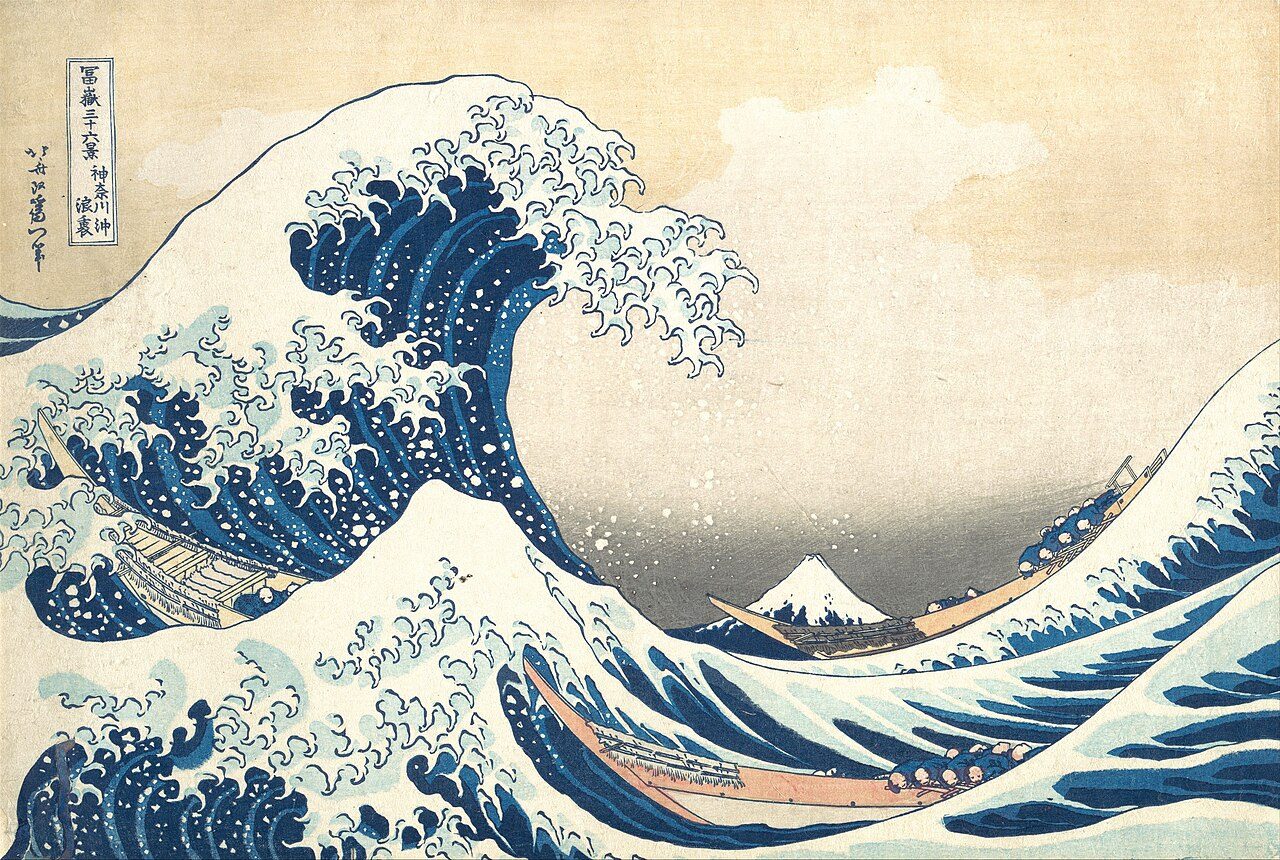
From the 17th century to the 19th century, ukiyo-e depicting secular subjects became very popular among the common people and were mass-produced. ukiyo-e is based on kabuki actors, sumo wrestlers, beautiful women, landscapes of sightseeing spots, historical tales, and so on, and Hokusai and Hiroshige are the most famous artists. In the 18th century, Suzuki Harunobu established the technique of multicolor woodblock printing called nishiki-e and greatly developed Japanese woodblock printing culture such as ukiyo-e. Ukiyo-e influenced European Japonisme and Impressionism. 1
From Meiji period onwards
After the decline of ukiyo-e and the introduction of modern printing technologies, woodblock printing continued as a method for printing texts as well as for producing art, both within traditional modes such as ukiyo-e and in a variety of more radical or Western forms that might be construed as modern art. In the early 20th century, shin-hanga that fused the tradition of ukiyo-e with the techniques of Western paintings became popular, and the works of Hasui Kawase and Hiroshi Yoshida gained international popularity. Institutes such as the "Adachi Institute of Woodblock Prints" and "Takezasado" continue to produce ukiyo-e prints with the same materials and methods as used in the past. With the entry into modernity, in Japan, there was a renewal of woodblock printmaking, the hanga. After the death of Hiroshige in 1858, the ukiyo-e practically disappeared. Its last manifestations correspond to Goyō Hashiguchi, who already shows a clear Western influence in the realism and plastic treatment of his images. With the entry into the 20th century, the artists who practiced engraving evolved to a style more in line with modern Japanese taste. One of its first exponents was Hiroshi Yoshida, author of landscapes influenced by nineteenth-century English watercolor. 1
Technique
The technique for printing texts and images was generally similar. 1
The text above is adapted from the Wikipedia article “Woodblock printing in Japan”, available under the Creative Commons Attribution-ShareAlike 4.0 licence. 1
woodblock printing in Japan is ancient technique for reproducing images or text, according to the structured record cited below. This entry was generated automatically from that record and has not yet been reviewed by a person familiar with the tradition. 2
The source record links this tradition to 9 external registers, which can be verified through the citation. 2