The tradition & historical record
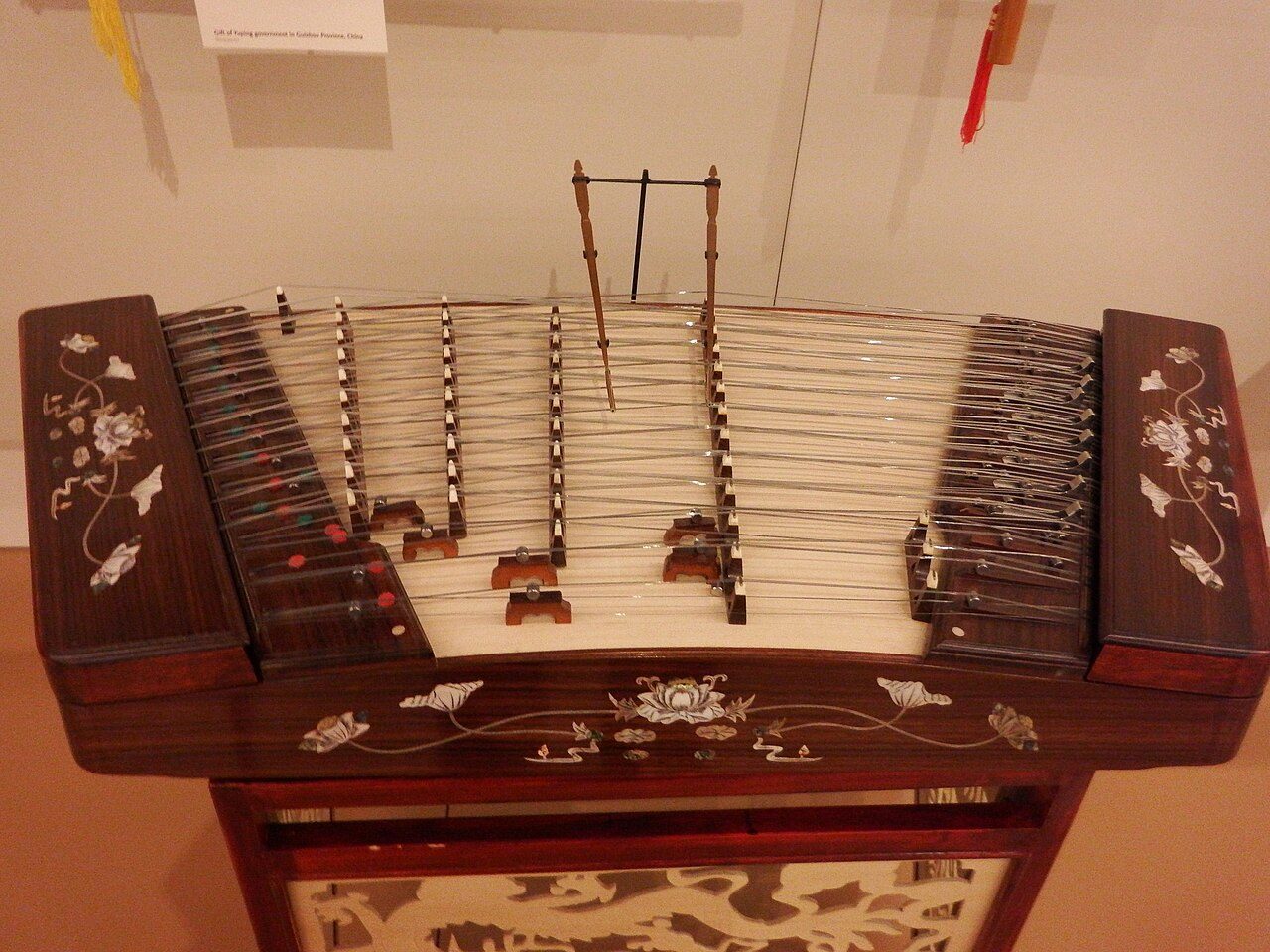
4 min read · 2 sourcesThe trapezoidal yangqin (simplified Chinese: 扬琴; traditional Chinese: 揚琴; pinyin: yángqín; Jyutping: joeng4 kam4) is a Chinese hammered dulcimer, likely derived from the Iranian santur or the European dulcimer. It used to be written with the characters 洋琴 (lit. "foreign zither"), but the first character was changed in the early 20th century to 揚 (also pronounced yáng), meaning "acclaimed". It is also spelled yang ch'in. Hammered dulcimers of various types are now very popular not only in China, but also Eastern Europe, the Middle East, India, Iran, and Pakistan. The instruments are also sometimes known by the names "santoor" and "cymbalom". This instrument had an influence on the Thai classical instrument, known as Khim (ขิม). The yangqin was traditionally fitted with bronze strings, which gave the instrument a soft timbre. This form of instrument is still occasionally heard today in the hudie qin (蝴蝶琴; 'butterfly zither') played in the traditional silk and bamboo genre from the Shanghai region known as Jiangnan sizhu (江南絲竹), as well as in some Cantonese music and Chaozhou (Teochew) music groups. The Thai and Cambodian khim are nearly identical in their construction, having been introduced to those nations by southern Chinese musicians. Since the 1950s, however, steel alloy strings (in conjunction with copper-wound steel strings for the bass notes) have been used, in order to give the instrument a brighter, and louder tone. 1
Origins
Historians offer several theories to explain how the instrument was introduced to China: 1
that the instrument may have been introduced by land, through the Silk Road; that it was introduced by sea, through the port of Guangzhou (Canton); or that it was invented without foreign influence by the Chinese themselves. The word "yangqin" has historically been written in two different ways, using different Chinese characters for "yang". The "yang" in the earlier version was written with the character 洋, meaning "foreign". It was later changed, in 1910, to the character "yang" (揚), meaning "acclaimed". 1
Theory of introduction by land
Another theory of how the yangqin came into contact with the Chinese is through the Silk Road from Mongolia. The Silk Route stretched almost 5,000 miles reaching from China to the Middle East, including Iran (Persia). The Iranian santur, a dulcimer, has existed since ancient times. If any dulcimer was to influence China by land, it is likely to be this instrument. The technical structure of the santur is different in the way the tuning pegs are placed, the bridges and the mallets. The yangqin's tuning pins are set in parallel instead of a 90-degree angle down at the side. The mallets of the santur also differ from those of the yangqin – they are made of wood with finger grip, designed to let the players perform by gripping the two mallets between their fore and middle fingers. Both modern and earlier yangqin mallets did not include finger grips. The bridge of the yangqin consist of long, single pieces of wood with many protruding "stubs" supporting the strings unlike the santur, which uses a number of small, individual chesspiece-like bridges. 1
Theory of introduction by sea
The port at Canton/Guangzhou attracts traders from all over Asia: from Japan, India, Southeast Asia, and the Middle East. The ships from this region bought back precious stones, slaves, exotic wares, fruits, spices, etc. Along with trade, businesses, ideas, philosophies and scientific knowledge were exchanged, including religion (principally Buddhism). During the 16th century, the Age of Exploration in Europe reached its climax and soon trade was established between China and Europe. Historians state that Portuguese, and later, English and Dutch ships, had brisk trade with China. Portuguese trading in Chinese waters began in the 16th century according to historians. Music historians report that the salterio, a hammered dulcimer, was played in Portugal, Spain, and Italy during this period. Historians say it is possible that the yangqin originated when the Portuguese, the English or the Dutch brought a dulcimer player to China who performed for locals. 1
Construction
As the yangqin is a type of hammered dulcimer, it shares many elements of construction with other instruments in the hammered dulcimer family: 1
Strings
Modern yangqin usually have 144 strings in total, with each pitch running in courses, with up to 5 strings per course, in order to boost the volume. The strings come in various thicknesses, and are tied at one end by screws, and at the other with tuning pegs. The pegs and screws are covered during playing by a hinged panel/board. This panel is opened up during tuning to access the tuning pegs. 1
The text above is adapted from the Wikipedia article “Yangqin”, available under the Creative Commons Attribution-ShareAlike 4.0 licence. 1
yangqin is Chinese musical instrument, a kind of hammered zither, according to the structured record cited below. This entry was generated automatically from that record and has not yet been reviewed by a person familiar with the tradition. 2
The source record links this tradition to 9 external registers, which can be verified through the citation. 2