The tradition & historical record
6 min read · 2 sourcesThe Zeytun Gospels of 1256 AD (Matenadaran, MS. 10450) is an Armenian illuminated manuscript in the Armenian language by artist and ordained priest T'oros Roslin. The Zeytun Gospels consists of four tabernacles, four evangelists, four namesakes, ornaments and decorations. The manuscript's patron was Catholicos Constantine I of Bardzrberd (1221–1267) and was commissioned for his godson Levon (b. 1236). It was transcribed in a scriptorium at the fortress Hromklay, "the God protected castle", in Cilician Armenia. Hromklay was also known as The School of Miniature Painting at the Catholicosate. The Hromklan (Roman-Kar, Klein Roman) scriptorium was at its peak while Roslin worked there on the Zeytun Gospels. The manuscript was later reintroduced as the Zeytun Gospels named after the mountain village of Zeytun (modern day Süleymanli) during the late Ottoman Empire. Most of the manuscript, excluding the canon tables which are kept at the J. Paul Getty Museum, are at the Matenadaran (Mesrop Mashtots Institute of Ancient Manuscripts) in Yerevan, the capital of Armenia. 1
Origin
By the early fourth and fifth centuries, Armenians adopted Christianity and chose Armenian as their liturgical language, not Greek or Syriac. St. Gregory the Illuminator was the one who Christianized Armenia, which served as Armenia's link to the West. Almost a thousand years later, the artist T'oros Roslin illustrated liturgical texts from the fifth century, paying homage to earlier Cilician illuminators while adapting Armenian manuscripts to the thirteenth century position of Eastern Christianity. The Zeytun Gospels was Roslin's first signed manuscript. Roslin studied under Yovhannes, a priest at Hromklay. While there, Roslin transcribed portraits and texts from Yovhannes's work into the Zeytun Gospels. The manuscript was created for Catholicos Constantine I, a prominent patron of the arts, who contributed to the development of sacred painting and manuscript production in Armenia. Roslin worked under him in Constantinople, as well as for the royal family. Roslin was considered the best artist at the Hromklan scriptorium. 1
Sixteenth and seventeenth centuries
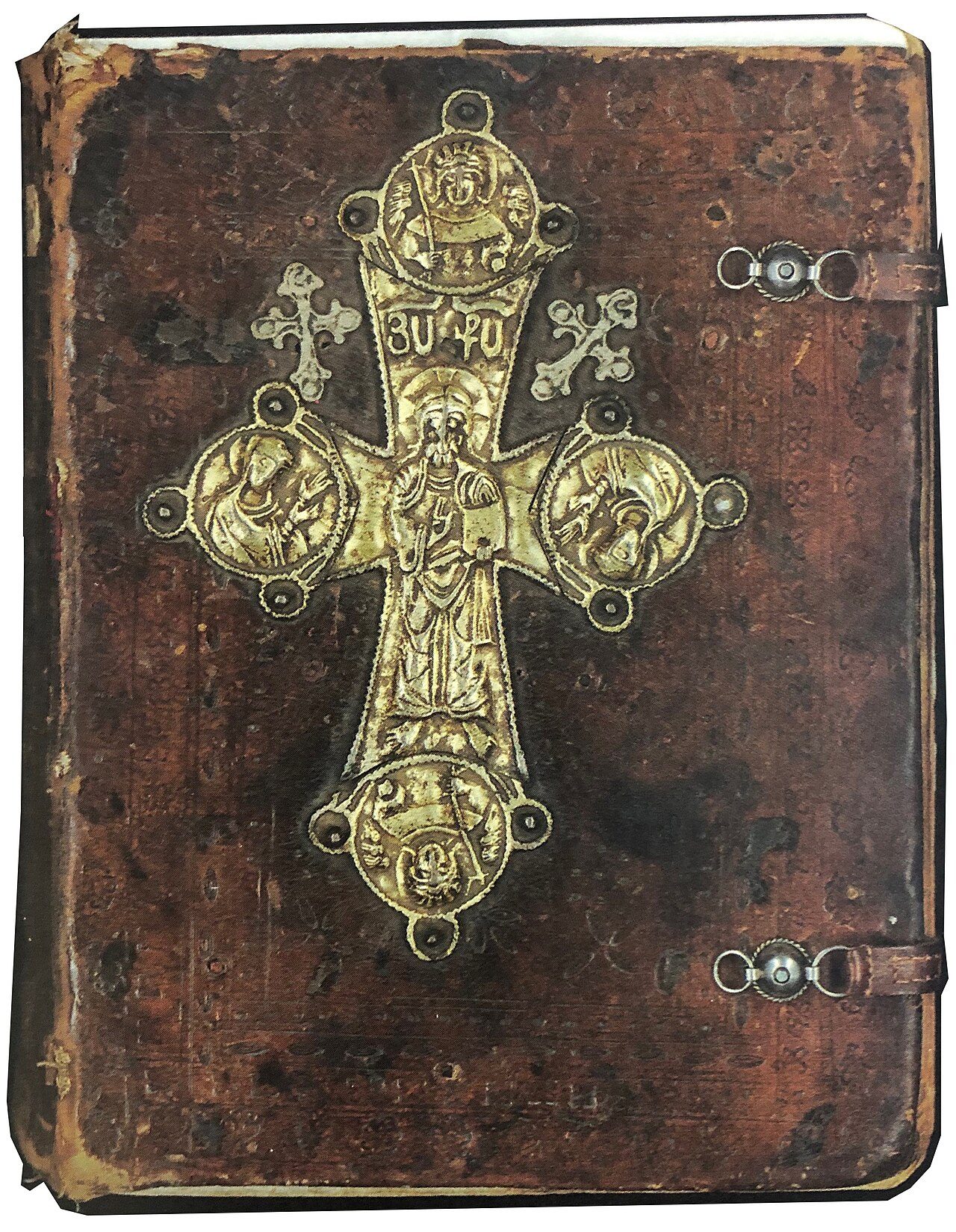
Sometime between the sixteenth and seventeenth centuries, the manuscript went from the village of Furnus to Zeytun, a town cradled by the Taurus Mountains, due to Furnus being destroyed. The use of the name Zeytun was first documented in 1536 from a copied manuscript titled the "Zeytun Citadel" and in 1545 was first inscribed in the town of Zeytun itself. The manuscript was rebound during the seventeenth century, keeping the original gold crucifix and medallions. Armenian bookbinding changed very little between the fourteenth through the eighteenth centuries. The Armenian language dictated which side manuscripts were bound. The language is read from left to right, so the manuscripts were bound on the left. 1
Modern history
Zeytun priests added notes of significant events and various messages into the colophons of the Zeytun Gospels. They essentially noted Zeytun's more recent history and turned the gospel into a living repository. Specifically in the nineteenth century, three colophons were written with deteriorating articulation and heavy vernacular, two of which were dated 1852 and 1859 and pertained to the Ottoman army. During the 1880s, the Monsignor of the Catholic Armenians of Marash attempted to sell the manuscript for its weight in gold (which is just over 7 pounds). The Zeytun people rejected the sale of the manuscript. In 1887 at the Church of the Holy Mother of God, the gospel escaped a fire, guarded by Surenian ishkhans. The ishkhan and the church council kept the gospel safe after 1908 in a secret compartment in the northern wall of the church's baptism chamber in an iron box with two keys. 1
Armenian genocide
At the beginning of the Armenian genocide, in the spring of 1915, the village of Zeytun was the first to be invaded by the Turks. During the invasion, the people of Zeytun were either exiled or killed and, in the process, the Zeytun Gospels was taken from its repository. Sometime during the following years, the canon tables were taken out of the manuscript. Nearly five years after the start of the Armenian genocide, after the Battle of Marash in 1920, the manuscript was then given to James Lyman, an American missionary, by Father Khachadur Der Ghazarian for safe keeping. After the end of the Armenian genocide, the manuscript (excluding the canon tables) meandered through many hands for decades until it finally found its way to the Matenadaran (the translation of Matenadaran is "repository of manuscripts" and holds over 23,000 manuscripts, including the national collection of Armenia). In 1994, the canon tables were sold to the J. Paul Getty Museum for $950,000 after being exhibited at the Pierpont Morgan Library in New York. Previously owned by the Atamian Family in Watertown, Massachusetts, it would be the first and last time a Roslin was on the art market. In 2015, an agreement was signed between the Getty and the Western Prelacy of the Armenian Apostolic Church of America, which acknowledged that the Armenian Church was the rightful owner of the canon tables, but that the manuscript pages would remain in the Getty "in order to ensure their preservation and widespread exhibition." 1
Stylistic elements
The Zeytun Gospels set an artistic standard for later Armenian artists. Roslin is thought to have had a yearning for realism, painting from real life, which is reflected in the manuscript. It was also written in a round slanted text with pointed corners called bolorgir. Even though he modeled this manuscript after other scribes, he tended to intensify his narratives and added exquisite illuminations into the margins, which were unrivaled for the time in Armenian art. He also introduced Western motifs into this manuscript, which could have been a visual nod towards pro-union Armenian forces (which echoed earlier connections with Rome created by Nerses of Lambron). In the Zeytun Gospels, Roslin combined Byzantine elements with Cilician designs and Western motifs creating a new distinctive style. The Western motifs were late in Roslin's career and were not numerous. It is unclear as to why a principal illuminator under the catholicos of the Armenian Church would be allowed to insert Western elements. 1
The text above is adapted from the Wikipedia article “Zeytun Gospels”, available under the Creative Commons Attribution-ShareAlike 4.0 licence. 1
Zeytun Gospels is 1256 Armenian illuminated manuscript by T'oros Roslin, according to the structured record cited below. This entry was generated automatically from that record and has not yet been reviewed by a person familiar with the tradition. 2
The source record links this tradition to 1 external register, which can be verified through the citation. 2