The tradition & historical record
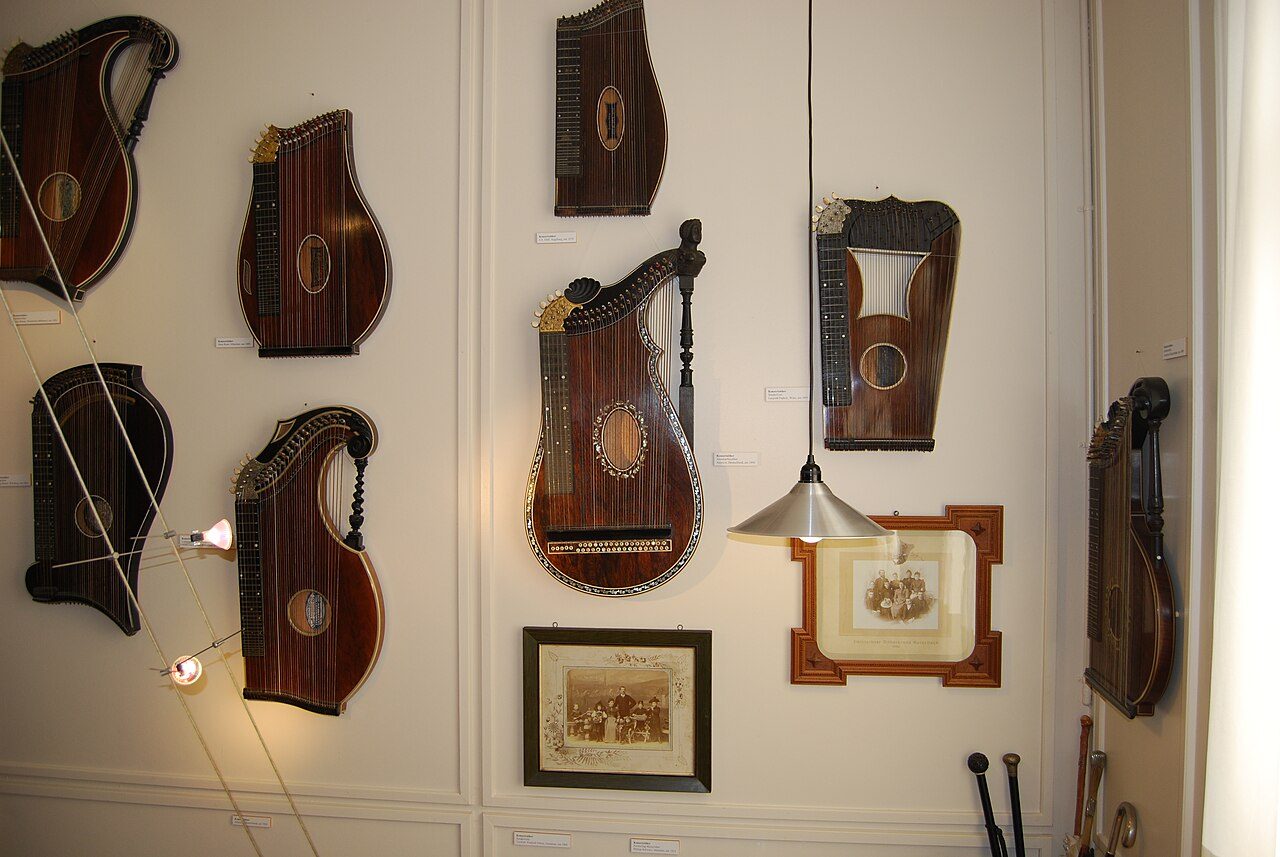
6 min read · 2 sourcesZither (; German: [ˈtsɪtɐ], from the Greek κιθάρα, cithara) is a class of stringed instruments, and the term also refers to a specific subset of instruments of the zither class, most usually the concert or Alpine zithers. The modern instrument has many strings stretched across a thin, flat body. Zithers are typically played by strumming or plucking the strings with the fingers or a plectrum. In the Hornbostel–Sachs classification system, the term refers to a larger family of similarly shaped instruments that also includes the hammered dulcimer family and piano and a few rare bowed instruments like the bowed psaltery, bowed dulcimer, and streichmelodion. Like an acoustic guitar or lute, a zither's body serves as a resonating chamber (sound box), but, unlike guitars and lutes, a zither lacks a distinctly separate neck assembly. The number of strings varies, from one to more than fifty. In modern usage, the term "zither" usually refers to three specific instruments: the concert zither (German: Konzertzither), its variant the Alpine zither (each of which uses a fretted fingerboard), and the chord zither (more recently described as a fretless zither or "guitar zither"). Concert and Alpine zithers are traditionally found in Slovenia, Austria, Hungary, France, north-western Croatia, the southern regions of Germany, Alpine Europe, Poland, the Czech Republic, Slovakia, Russia, Ukraine and Belarus. 1
Etymology
The word "zither" is derived from Latin cythara, which was used in this form for the title covers on many 16th- and 17th-century German-printed manuscript books originally for the 'cittern' – from the Greek word kithara, an instrument used in Ancient Greece. The German scholar Michael Praetorius mentions an Englishman who came to Germany with a small cittern, einem kleinen Citterlein, in his treatise Syntagma Musicum, published during the early 17th century. It is not fully understood how "zitter" or "zither" came to be applied to the instruments in this article as well as German varieties of the cittern. Other types of zither also existed in Germany, mostly drone zithers like the scheitholt (which was mentioned by Praetorius) or hummel, but these generally have their own individual regional names and may have been in use before the introduction into the lexicon of 'cythara' and its German derivative cognate. 1
Organology
The Hornbostel–Sachs system, an academic instrument classification method, also uses the term zither to classify all stringed instruments in which the strings do not extend beyond the sounding box. Categories include Bar zithers (made up of musical bows and stick zithers), tube zithers, raft zithers, board zithers (includes box zithers, ground zithers and harp zithers), trough zithers and frame zithers. According to Sachs: 1
Board-zithers form the most important category from an occidental point of view because they include our stringed keyboard instruments. The strings are stretched out over a board, which is rectangular or trapezoidal or in some other shape, and which is glued onto a shallow box. The strings may be open or stopped, it may be a psaltery or a dulcimer. This includes such diverse instruments as the hammered dulcimer, psaltery, Appalachian dulcimer, guqin, guzheng, tromba marina, koto, gusli, kanun, kanklės, kantele, kannel, kokles, valiha, gayageum, geomungo, ajaeng, đàn tranh, autoharp, santoor, yangqin, santur, swarmandal, and others. Pedal steel guitars, lap guitars (where the neck serves no separate function other than to extend the string length), and keyboard instruments like the clavichord, harpsichord and piano also fall within this broad categorical use. The word has also been used in conjunction with brand varieties of other string instruments, for example, the zither banjo. 1
History and development
The earliest known surviving instrument of the zither family is a Chinese guqin, a fretless instrument, found in the tomb of Marquis Yi of Zeng, dating from 433 BC. Similar instruments along this design were developed over the following centuries, for example, the Japanese silk-strung koto; the siter of Indonesian gamelans; the qānūn (or kanun) of Greece and the Middle East; the valiha, a tube zither of Madagascar; and many others. Increasing interest in "world music" has brought wider recognition to these other zither family members, both ancient and modern. Many of these instruments have been sampled electronically and are available in instrument banks for music synthesizers. 1
In Europe and other more northern and western regions, early zithers were more similar to the modern mountain dulcimer, having long, usually rectangular, sound boxes, with one or more melody strings and several unfretted drone strings. Some of these employed movable bridges similar to the Japanese koto, used for retuning the drone strings. The Alpine Scheitholt furnishes an example of this older type of European zither. By the late 18th century, two principal varieties of European concert zither had developed, known as the Salzburg zither (with a rounded side away from the player), and the Mittenwald zither (with both sides rounded). 1
Concert and Alpine zithers
A concert zither may have from 29 to 38 strings, with 34 or 35 being most typical. These are arranged as follows: four or five fretted melody strings, placed above a guitar-like fretboard; 12 unfretted "accompaniment" strings; followed by 12 unfretted "bass" strings; followed by a varying number of "contrabass" strings, with five or six being the most common number. On some older zithers, one may find "half-frets" above the 12th fret, which extend only under the first two or three strings. This results in the lower fretted strings having no pitches (or no chromatic pitches) available above the 12th fret, while the higher fretted strings still have higher chromatic pitches available at these half-frets. Nearly all instruments made after 1960, however, have full-length frets all the way up the fretboard. Anton Karas and Ruth Welcome used instruments of similar design to the one illustrated. After World War II, Karas (according to zither scholar Günter Wittenstein, who was acquainted with him) performed on an instrument of larger dimensions than normal – with a 43 cm standard scale length for the fingerboard strings. He used Viennese tuning (see below), but with an altered chromatic sequence for the fingerboard and open strings. The accompaniment strings G and F♯ were tuned an octave higher, while contrabass strings tuned E♭, F, D, E, C♯ replaced the regular cycle of fifths bass strings. This brought the contrabasses closer to the fingerboard where the player could reach them more easily. For The Third Man, Karas tuned the zither a semi-tone lower, giving a particularly distinctive tone to the contrabass strings. The resulting lower string tension also enabled Karas to perform an expressive vibrato on the fingerboard melody strings. 1
Tuning
Tuning chart for concert and Alpine zithers: 1
The C#, F, & A strings of the unfretted string section on the fretted zither are colored red; like the red C stri… 1
The text above is adapted from the Wikipedia article “Zither”, available under the Creative Commons Attribution-ShareAlike 4.0 licence. 1
zither is class of musical stringed instruments, according to the structured record cited below. This entry was generated automatically from that record and has not yet been reviewed by a person familiar with the tradition. 2
The source record links this tradition to 39 external registers, which can be verified through the citation. 2