Opening room…
Skip to content
Head-to-Head Archival Dossier · Music
African tradition vs Gnawa: Side-by-Side Archival Comparison
Side-by-side comparison of African tradition (Documented region, Global Archive) and Gnawa (Essaouira & Marrakech, Morocco) across cultural family, chronology, materials, instruments, and living vitality.
12-Point Archival Comparison Table: African tradition vs Gnawa
Study & Syllabus Export Tools · CC BY-SA 4.0
| Dimension | 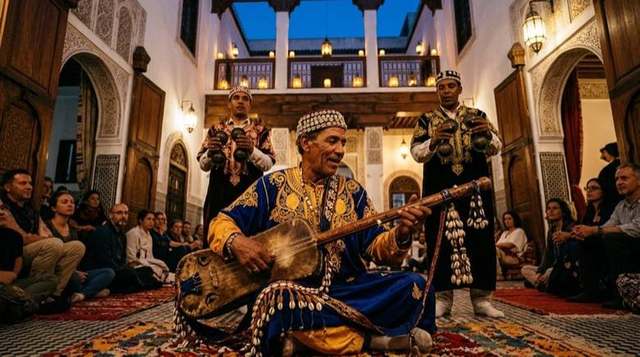 Gnawa | |
|---|---|---|
| Tradition Name | African tradition | Gnawa |
| Native Script / Endonym | African tradition | كناوة |
| Cultural Family |
Key Differences Between African tradition and Gnawa
- Geography & Origin: African tradition is rooted in Documented region, Global Archive (attested Historical oral & textual attestation), whereas Gnawa originates in Essaouira & Marrakech, Morocco (attested 16th century).
- Classification & Form: African tradition belongs to the Music family (La Tradition africaine est un ensemble varié des coutumes et pratiques des pays de toutes l'Afrique souvent influencé par l'impact de l'Afrique subsaharienne transmise de génération en génération pour des siècles et des siècles.), while Gnawa is documented under Music (Moroccan brotherhood music and all-night Lila therapeutic ceremony led by a Maâlem on the three-stringed guembri lute and iron qraqeb.).
- Instruments & Materials: African tradition is transmitted through regional performance and craft media; by contrast, Gnawa uses Guembri (Sintir), Qraqeb iron castanets, Tbel drum, Carved walnut body, Camel-neck hide, Cowrie shells.
- Heritage Recognition & Vitality: African tradition is assessed as UNKNOWN (Documented in public ethnographic & archival sources), while Gnawa is assessed as THRIVING (Representative List (2019)).
Shared Cultural & Historical Parallels
- Both African tradition and Gnawa belong to the Music domain and transmit repertoire across generations through master-disciple lineage rather than commercial mass production.
- Across Global Archive and Morocco, both traditions demonstrate how local communities safeguard ancestral craft and performance knowledge through guild, temple, or village stewardship.
Frequently Asked Questions
What is the main difference between African tradition and Gnawa?
African tradition is a music tradition from Documented region, Global Archive (La Tradition africaine est un ensemble varié des coutumes et pratiques des pays de toutes l'Afrique souvent influencé par l'impact de l'Afrique subsaharienne transmise de génération en génération pour des siècles et des siècles.), whereas Gnawa is a music tradition from Essaouira & Marrakech, Morocco (Moroccan brotherhood music and all-night Lila therapeutic ceremony led by a Maâlem on the three-stringed guembri lute and iron qraqeb.).
Where did African tradition and Gnawa originate?
African tradition originated in Documented region, Global Archive (Historical oral & textual attestation). Gnawa originated in Essaouira & Marrakech, Morocco (16th century).
What instruments or materials are used in African tradition vs Gnawa?
African tradition uses traditional regional instruments and media. Gnawa uses Guembri (Sintir), Qraqeb iron castanets, Tbel drum, Carved walnut body, Camel-neck hide, Cowrie shells.
Are African tradition and Gnawa recognized by UNESCO?
African tradition heritage status: Documented in public ethnographic & archival sources. Gnawa heritage status: Representative List (2019).