Side-by-side comparison of Arabic calligraphy (Documented region, Global Archive) and Warli Ritual Rice-Paste Wall Painting (Dahanu, Talasari & Jawhar, Palghar, Maharashtra, India) across cultural family, chronology, materials, instruments, and living vitality.
| Dimension | Warli Ritual Rice-Paste Wall Painting | |
|---|---|---|
| Tradition Name | Arabic calligraphy | Warli Ritual Rice-Paste Wall Painting |
| Native Script / Endonym | Arabic calligraphy | वारली चित्रकला |
| Cultural Family | Painting | Painting |
| Primary Geography & Origin | Documented region, Global Archive | Dahanu, Talasari & Jawhar, Palghar, Maharashtra, India |
| World Region | Global | Asia |
| First Attested / Era | Historical oral & textual attestation | 10th century tradition / 1970s paper transition |
| UNESCO & Inventory Status | Documented in public ethnographic & archival sources | National Inventory |
| Vitality Assessment | ▢▢▢▢ Not yet sourced | ■■■■ Thriving |
| Instruments & Accompaniment | Traditional regional accompaniment | Chewed bamboo-stick brush (kathi), Tarpa wind horn (depicted & played at harvests) |
| Materials & Medium | Regional performance / craft media | Pounded white rice paste & water, Red ochre (geru) & cow-dung wall wash |
| Practitioner Lineages | Regional bearer community | Savasini Ritual Painters & Mashe Lineage of Dahanu and Ganjad |
| Cited Archival Sources | 1 verified sources | 10 verified sources |
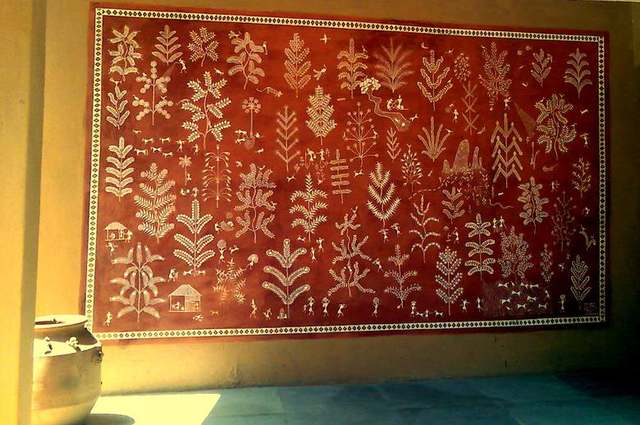
Arabic calligraphy is a painting tradition from Documented region, Global Archive (Arabic calligraphy is the artistic practice of handwriting and calligraphy based on the Arabic alphabet. It is known in Arabic as khatt (Arabic: خَطّ), derived from the words 'line', 'design', or 'construction'.), whereas Warli Ritual Rice-Paste Wall Painting is a painting tradition from Dahanu, Talasari & Jawhar, Palghar, Maharashtra, India (Adivasi geometric wall-painting tradition of the North Sahyadri range executed with chewed bamboo sticks in white rice paste over terracotta-and-cow-dung plaster.).
Arabic calligraphy originated in Documented region, Global Archive (Historical oral & textual attestation). Warli Ritual Rice-Paste Wall Painting originated in Dahanu, Talasari & Jawhar, Palghar, Maharashtra, India (10th century tradition / 1970s paper transition).
Arabic calligraphy uses traditional regional instruments and media. Warli Ritual Rice-Paste Wall Painting uses Chewed bamboo-stick brush (kathi), Tarpa wind horn (depicted & played at harvests), Pounded white rice paste & water, Red ochre (geru) & cow-dung wall wash.
Arabic calligraphy heritage status: Documented in public ethnographic & archival sources. Warli Ritual Rice-Paste Wall Painting heritage status: National Inventory.
A free public archive of the world’s living and endangered cultural traditions — documented with primary sources, geographic coordinates, and open-licensed photography. Two rooms, one wall. The door is open.
folkroom — Archive of Living Traditions · Text CC BY-SA 4.0 · Images credited & licensed individually
Open commons: Wikimedia Commons · UNESCO ICH · Openverse · Flickr CC · Wikidata · No trackers · No ads