Opening room…
Skip to content
Head-to-Head Archival Dossier · Living Tradition × Dance
Badminton bei den Gay Games vs Kathakali: Side-by-Side Archival Comparison
Side-by-side comparison of Badminton bei den Gay Games (Documented region, Global Archive) and Kathakali (Thrissur, Kerala, India) across cultural family, chronology, materials, instruments, and living vitality.
12-Point Archival Comparison Table: Badminton bei den Gay Games vs Kathakali
Study & Syllabus Export Tools · CC BY-SA 4.0
| Dimension |  Kathakali | |
|---|---|---|
| Tradition Name | Badminton bei den Gay Games | Kathakali |
| Native Script / Endonym | Badminton bei den Gay Games | കഥകളി |
Key Differences Between Badminton bei den Gay Games and Kathakali
- Geography & Origin: Badminton bei den Gay Games is rooted in Documented region, Global Archive (attested Historical oral & textual attestation), whereas Kathakali originates in Thrissur, Kerala, India (attested 17th century).
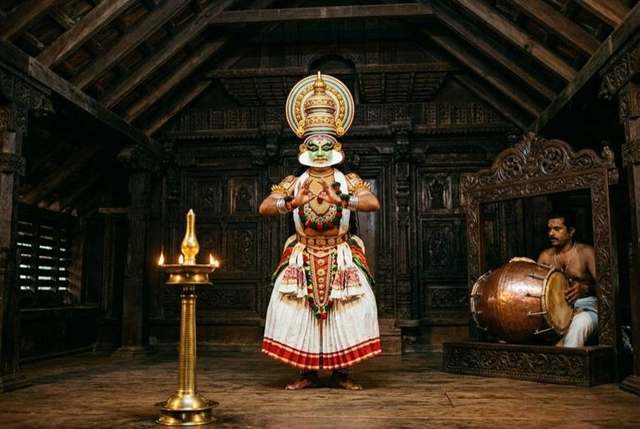
- Classification & Form: Badminton bei den Gay Games belongs to the Living Tradition family (Badminton gehört bei den Gay Games zu den Sportarten, die nicht ständig im Programm der Spiele standen. Erst bei der fünften Austragung 1998 in Amsterdam gelangte der Sport in das Programm der Spiele.), while Kathakali is documented under Dance (Classical dance-drama of Kerala told entirely through mudra hand-gestures, facial expression, and percussion, without a single word spoken by the actor.).
- Instruments & Materials: Badminton bei den Gay Games is transmitted through regional performance and craft media; by contrast, Kathakali uses Chenda, Maddalam, Chengila, Ilathalam, Chutti rice paste, Natural mineral pigments, Carved wood crown.
- Heritage Recognition & Vitality: Badminton bei den Gay Games is assessed as UNKNOWN (Documented in public ethnographic & archival sources), while Kathakali is assessed as STABLE (National Inventory).
Shared Cultural & Historical Parallels
- Although Badminton bei den Gay Games (Living Tradition) and Kathakali (Dance) use different artistic media, both encode community cosmology, seasonal calendars, and regional identity.
- Across Global Archive and India, both traditions demonstrate how local communities safeguard ancestral craft and performance knowledge through guild, temple, or village stewardship.
Frequently Asked Questions
What is the main difference between Badminton bei den Gay Games and Kathakali?
Badminton bei den Gay Games is a living tradition tradition from Documented region, Global Archive (Badminton gehört bei den Gay Games zu den Sportarten, die nicht ständig im Programm der Spiele standen. Erst bei der fünften Austragung 1998 in Amsterdam gelangte der Sport in das Programm der Spiele.), whereas Kathakali is a dance tradition from Thrissur, Kerala, India (Classical dance-drama of Kerala told entirely through mudra hand-gestures, facial expression, and percussion, without a single word spoken by the actor.).
Where did Badminton bei den Gay Games and Kathakali originate?
Badminton bei den Gay Games originated in Documented region, Global Archive (Historical oral & textual attestation). Kathakali originated in Thrissur, Kerala, India (17th century).
What instruments or materials are used in Badminton bei den Gay Games vs Kathakali?
Badminton bei den Gay Games uses traditional regional instruments and media. Kathakali uses Chenda, Maddalam, Chengila, Ilathalam, Chutti rice paste, Natural mineral pigments, Carved wood crown.
Are Badminton bei den Gay Games and Kathakali recognized by UNESCO?
Badminton bei den Gay Games heritage status: Documented in public ethnographic & archival sources. Kathakali heritage status: National Inventory.