Opening room…
Skip to content
Head-to-Head Archival Dossier · Dance
Gurdjieff movements vs Danza de los Voladores: Side-by-Side Archival Comparison
Side-by-side comparison of Gurdjieff movements (Documented region, Global Archive) and Danza de los Voladores (Papantla, Veracruz, Mexico) across cultural family, chronology, materials, instruments, and living vitality.
12-Point Archival Comparison Table: Gurdjieff movements vs Danza de los Voladores
Study & Syllabus Export Tools · CC BY-SA 4.0
| Dimension | 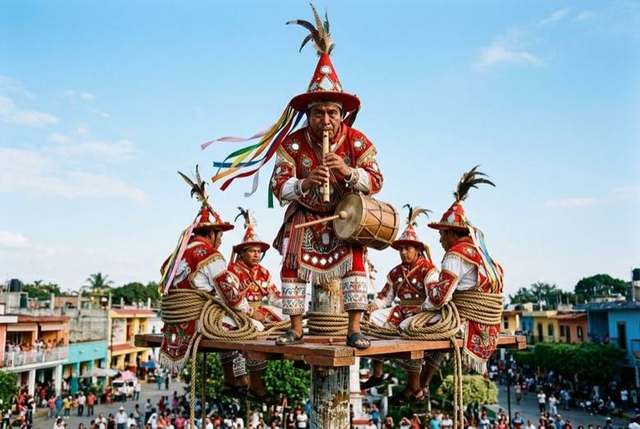 Danza de los Voladores | |
|---|---|---|
| Tradition Name | Gurdjieff movements | Danza de los Voladores |
| Native Script / Endonym | Gurdjieff movements |
Key Differences Between Gurdjieff movements and Danza de los Voladores
- Geography & Origin: Gurdjieff movements is rooted in Documented region, Global Archive (attested Historical oral & textual attestation), whereas Danza de los Voladores originates in Papantla, Veracruz, Mexico (attested Pre-Columbian).
- Classification & Form: Gurdjieff movements belongs to the Dance family (The Gurdjieff movements are a series of sacred dances that were created by G. I. Gurdjieff. He taught them to his pupils as part of his teaching to facilitate self observation and self study.), while Danza de los Voladores is documented under Dance (Totonac ritual ceremony in which four flyers descend headfirst by ropes from a thirty-metre rotating pole while the caporal plays flute and drum atop the mast.).
- Instruments & Materials: Gurdjieff movements is transmitted through regional performance and craft media; by contrast, Danza de los Voladores uses Reed three-hole flute, Tabor hand drum, Forest timber mast, Hemp waist ropes, Embroidered ceremonial regalia.
- Heritage Recognition & Vitality: Gurdjieff movements is assessed as UNKNOWN (Documented in public ethnographic & archival sources), while Danza de los Voladores is assessed as STABLE (Representative List (2009)).
Shared Cultural & Historical Parallels
- Both Gurdjieff movements and Danza de los Voladores belong to the Dance domain and transmit repertoire across generations through master-disciple lineage rather than commercial mass production.
- Across Global Archive and Mexico, both traditions demonstrate how local communities safeguard ancestral craft and performance knowledge through guild, temple, or village stewardship.
Frequently Asked Questions
What is the main difference between Gurdjieff movements and Danza de los Voladores?
Gurdjieff movements is a dance tradition from Documented region, Global Archive (The Gurdjieff movements are a series of sacred dances that were created by G. I. Gurdjieff. He taught them to his pupils as part of his teaching to facilitate self observation and self study.), whereas Danza de los Voladores is a dance tradition from Papantla, Veracruz, Mexico (Totonac ritual ceremony in which four flyers descend headfirst by ropes from a thirty-metre rotating pole while the caporal plays flute and drum atop the mast.).
Where did Gurdjieff movements and Danza de los Voladores originate?
Gurdjieff movements originated in Documented region, Global Archive (Historical oral & textual attestation). Danza de los Voladores originated in Papantla, Veracruz, Mexico (Pre-Columbian).
What instruments or materials are used in Gurdjieff movements vs Danza de los Voladores?
Gurdjieff movements uses traditional regional instruments and media. Danza de los Voladores uses Reed three-hole flute, Tabor hand drum, Forest timber mast, Hemp waist ropes, Embroidered ceremonial regalia.
Are Gurdjieff movements and Danza de los Voladores recognized by UNESCO?
Gurdjieff movements heritage status: Documented in public ethnographic & archival sources. Danza de los Voladores heritage status: Representative List (2009).