Opening room…
Skip to content
Head-to-Head Archival Dossier · Living Tradition × Dance
munchū vs Capoeira: Side-by-Side Archival Comparison
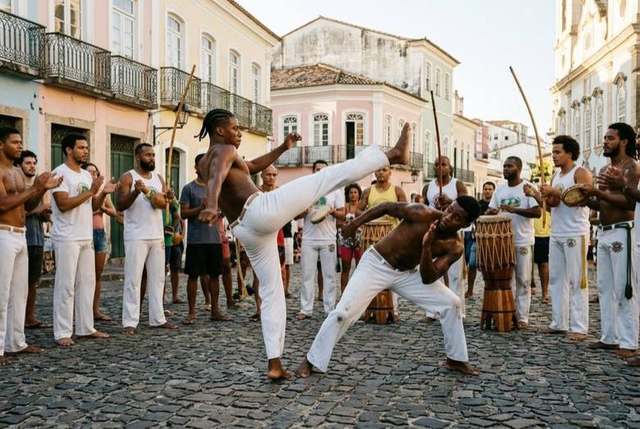
Side-by-side comparison of munchū (Japan, Japan) and Capoeira (Salvador da Bahia, Brazil) across cultural family, chronology, materials, instruments, and living vitality.
12-Point Archival Comparison Table: munchū vs Capoeira
Study & Syllabus Export Tools · CC BY-SA 4.0
Key Differences Between munchū and Capoeira
- Geography & Origin: munchū is rooted in Japan, Japan (attested Historical oral & textual attestation), whereas Capoeira originates in Salvador da Bahia, Brazil (attested 16th century).
- Classification & Form: munchū belongs to the Living Tradition family (門中(もんちゅう、沖縄語:むんちゅう)は、沖縄県における、始祖を同じくする父系の血縁集団のことである。門中は、17世紀後半以降、士族の家譜編纂を機に沖縄本島中南部を中心に発達し、のちには本島北部や離島にも拡がった。その活動形態や組織結合の度合いは、地域によって大きく異なる。門中に似た血縁集団の概念は、日本の同族、中国の宗族、朝鮮半島の本貫、ベトナムのゾンボ等、東アジアの漢字文化圏にも見られる。), while Capoeira is documented under Dance (Afro-Brazilian circle of fight, dance, acrobatics, and call-and-response song governed by the single-string berimbau bow.).
- Instruments & Materials: munchū is transmitted through regional performance and craft media; by contrast, Capoeira uses Berimbau, Atabaque, Pandeiro, Agogô, Reco-reco, Biriba wood bow, Cabaça gourd resonator, Steel wire.
- Heritage Recognition & Vitality: munchū is assessed as UNKNOWN (Documented in public ethnographic & archival sources), while Capoeira is assessed as THRIVING (Representative List (2014)).
Shared Cultural & Historical Parallels
- Although munchū (Living Tradition) and Capoeira (Dance) use different artistic media, both encode community cosmology, seasonal calendars, and regional identity.
- Across Japan and Brazil, both traditions demonstrate how local communities safeguard ancestral craft and performance knowledge through guild, temple, or village stewardship.
Frequently Asked Questions
What is the main difference between munchū and Capoeira?
munchū is a living tradition tradition from Japan, Japan (門中(もんちゅう、沖縄語:むんちゅう)は、沖縄県における、始祖を同じくする父系の血縁集団のことである。門中は、17世紀後半以降、士族の家譜編纂を機に沖縄本島中南部を中心に発達し、のちには本島北部や離島にも拡がった。その活動形態や組織結合の度合いは、地域によって大きく異なる。門中に似た血縁集団の概念は、日本の同族、中国の宗族、朝鮮半島の本貫、ベトナムのゾンボ等、東アジアの漢字文化圏にも見られる。), whereas Capoeira is a dance tradition from Salvador da Bahia, Brazil (Afro-Brazilian circle of fight, dance, acrobatics, and call-and-response song governed by the single-string berimbau bow.).
Where did munchū and Capoeira originate?
munchū originated in Japan, Japan (Historical oral & textual attestation). Capoeira originated in Salvador da Bahia, Brazil (16th century).
What instruments or materials are used in munchū vs Capoeira?
munchū uses traditional regional instruments and media. Capoeira uses Berimbau, Atabaque, Pandeiro, Agogô, Reco-reco, Biriba wood bow, Cabaça gourd resonator, Steel wire.
Are munchū and Capoeira recognized by UNESCO?
munchū heritage status: Documented in public ethnographic & archival sources. Capoeira heritage status: Representative List (2014).