Opening room…
Skip to content
Head-to-Head Archival Dossier · Painting
Raghurajpur Pattachitra vs Warli Ritual Rice-Paste Wall Painting: Side-by-Side Archival Comparison
Comparing two painting traditions of India — Raghurajpur Pattachitra (Raghurajpur & Puri, Odisha) and Warli Ritual Rice-Paste Wall Painting (Dahanu, Talasari & Jawhar, Palghar, Maharashtra) — across origin, technique, instruments, materials, and UNESCO heritage status.
12-Point Archival Comparison Table: Raghurajpur Pattachitra vs Warli Ritual Rice-Paste Wall Painting
Study & Syllabus Export Tools · CC BY-SA 4.0
| Dimension | 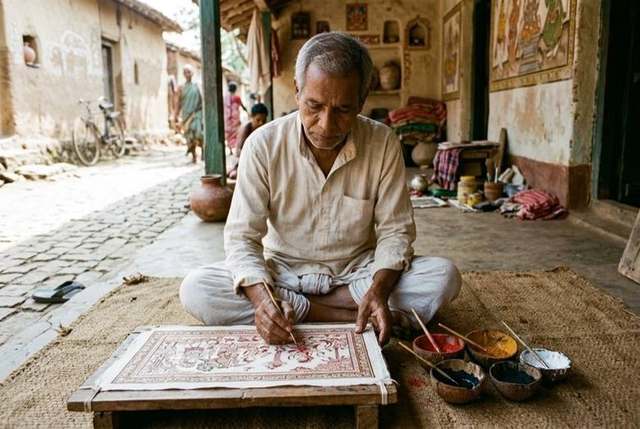 Raghurajpur Pattachitra | 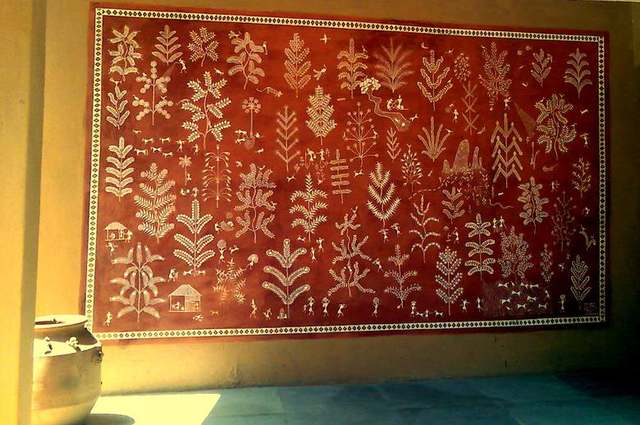 Warli Ritual Rice-Paste Wall Painting |
|---|---|---|
| Tradition Name | Raghurajpur Pattachitra | Warli Ritual Rice-Paste Wall Painting |
| Native Script / Endonym | ପଟ୍ଟଚିତ୍ର | वारली चित्रकला |
| Cultural Family | Painting | Painting |
| Primary Geography & Origin | Raghurajpur & Puri, Odisha, India | Dahanu, Talasari & Jawhar, Palghar, Maharashtra, India |
| World Region | Asia | Asia |
| First Attested / Era | 12th century | 10th century tradition / 1970s paper transition |
| UNESCO & Inventory Status | National Inventory | National Inventory |
| Vitality Assessment | ▢▢▢▢ Not yet sourced | ■■■■ Thriving |
| Instruments & Accompaniment | Traditional regional accompaniment | Chewed bamboo-stick brush (kathi), Tarpa wind horn (depicted & played at harvests) |
| Materials & Medium | Tamarind-seed gum canvas (patta), Conch-shell white, Hingula cinnabar red | Pounded white rice paste & water, Red ochre (geru) & cow-dung wall wash |
| Practitioner Lineages | Chitrakar Guilds of Raghurajpur & Paralakhemundi | Savasini Ritual Painters & Mashe Lineage of Dahanu and Ganjad |
| Cited Archival Sources | 5 verified sources | 10 verified sources |
Key Differences Between Raghurajpur Pattachitra and Warli Ritual Rice-Paste Wall Painting
- Geography & Origin: Raghurajpur Pattachitra is rooted in Raghurajpur & Puri, Odisha, India (attested 12th century), whereas Warli Ritual Rice-Paste Wall Painting originates in Dahanu, Talasari & Jawhar, Palghar, Maharashtra, India (attested 10th century tradition / 1970s paper transition).
- Classification & Form: Raghurajpur Pattachitra belongs to the Painting family (Cloth-scroll and etched palm-leaf (tala pattachitra) narrative painting prepared with tamarind-seed paste, chalk gesso, and conch-shell white.), while Warli Ritual Rice-Paste Wall Painting is documented under Painting (Adivasi geometric wall-painting tradition of the North Sahyadri range executed with chewed bamboo sticks in white rice paste over terracotta-and-cow-dung plaster.).
- Instruments & Materials: Raghurajpur Pattachitra relies on Tamarind-seed gum canvas (patta), Conch-shell white, Hingula cinnabar red; by contrast, Warli Ritual Rice-Paste Wall Painting uses Chewed bamboo-stick brush (kathi), Tarpa wind horn (depicted & played at harvests), Pounded white rice paste & water, Red ochre (geru) & cow-dung wall wash.
- Heritage Recognition & Vitality: Raghurajpur Pattachitra is assessed as UNKNOWN (National Inventory), while Warli Ritual Rice-Paste Wall Painting is assessed as THRIVING (National Inventory).
Shared Cultural & Historical Parallels
- Both Raghurajpur Pattachitra and Warli Ritual Rice-Paste Wall Painting belong to the Painting domain and transmit repertoire across generations through master-disciple lineage rather than commercial mass production.
- Both traditions are living pillars of India's intangible cultural heritage and appear frequently in cultural history curricula, museum collections, and safeguarding inventories.
Frequently Asked Questions
What is the main difference between Raghurajpur Pattachitra and Warli Ritual Rice-Paste Wall Painting?
Raghurajpur Pattachitra is a painting tradition from Raghurajpur & Puri, Odisha, India (Cloth-scroll and etched palm-leaf (tala pattachitra) narrative painting prepared with tamarind-seed paste, chalk gesso, and conch-shell white.), whereas Warli Ritual Rice-Paste Wall Painting is a painting tradition from Dahanu, Talasari & Jawhar, Palghar, Maharashtra, India (Adivasi geometric wall-painting tradition of the North Sahyadri range executed with chewed bamboo sticks in white rice paste over terracotta-and-cow-dung plaster.).
Where did Raghurajpur Pattachitra and Warli Ritual Rice-Paste Wall Painting originate?
Raghurajpur Pattachitra originated in Raghurajpur & Puri, Odisha, India (12th century). Warli Ritual Rice-Paste Wall Painting originated in Dahanu, Talasari & Jawhar, Palghar, Maharashtra, India (10th century tradition / 1970s paper transition).
What instruments or materials are used in Raghurajpur Pattachitra vs Warli Ritual Rice-Paste Wall Painting?
Raghurajpur Pattachitra uses Tamarind-seed gum canvas (patta), Conch-shell white, Hingula cinnabar red. Warli Ritual Rice-Paste Wall Painting uses Chewed bamboo-stick brush (kathi), Tarpa wind horn (depicted & played at harvests), Pounded white rice paste & water, Red ochre (geru) & cow-dung wall wash.
Are Raghurajpur Pattachitra and Warli Ritual Rice-Paste Wall Painting recognized by UNESCO?
Raghurajpur Pattachitra heritage status: National Inventory. Warli Ritual Rice-Paste Wall Painting heritage status: National Inventory.