Opening room…
Skip to content
Head-to-Head Archival Dossier · Living Tradition × Dance
髮繡 vs Capoeira: Side-by-Side Archival Comparison
Side-by-side comparison of 髮繡 (Documented region, Global Archive) and Capoeira (Salvador da Bahia, Brazil) across cultural family, chronology, materials, instruments, and living vitality.
12-Point Archival Comparison Table: 髮繡 vs Capoeira
Study & Syllabus Export Tools · CC BY-SA 4.0
Key Differences Between 髮繡 and Capoeira
- Geography & Origin: 髮繡 is rooted in Documented region, Global Archive (attested Historical oral & textual attestation), whereas Capoeira originates in Salvador da Bahia, Brazil (attested 16th century).
- Classification & Form: 髮繡 belongs to the Living Tradition family (髮绣是运用头发绣製的绣品。髮绣以頭髮代替毛線或絲線,利用头发黑、白,灰、黄和棕的自然色泽,以及细、柔、光、滑的特性,用接针、切针、缠针和滚针等不同针法刺绣。髮绣白地黑线,适宜绣製摹线(白描)人物,山水和建筑物等,人物一般背景较少。髮绣以质朴素净取胜,绣品针迹细密,色彩柔和,风格独特。因为头发具有特殊性能,所以髮绣坚韧光滑,色泽经久不褪。), while Capoeira is documented under Dance (Afro-Brazilian circle of fight, dance, acrobatics, and call-and-response song governed by the single-string berimbau bow.).
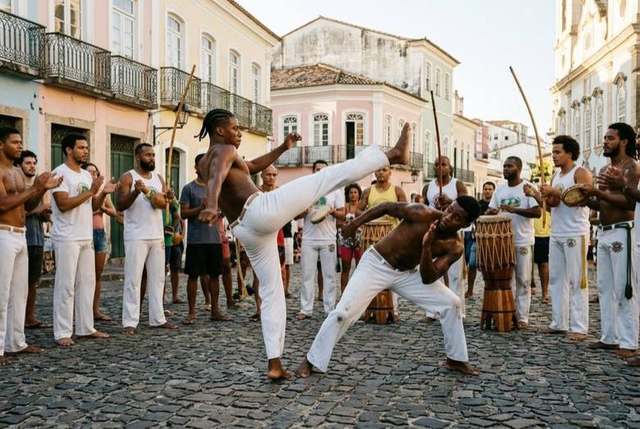
- Instruments & Materials: 髮繡 is transmitted through regional performance and craft media; by contrast, Capoeira uses Berimbau, Atabaque, Pandeiro, Agogô, Reco-reco, Biriba wood bow, Cabaça gourd resonator, Steel wire.
- Heritage Recognition & Vitality: 髮繡 is assessed as UNKNOWN (Documented in public ethnographic & archival sources), while Capoeira is assessed as THRIVING (Representative List (2014)).
Shared Cultural & Historical Parallels
- Although 髮繡 (Living Tradition) and Capoeira (Dance) use different artistic media, both encode community cosmology, seasonal calendars, and regional identity.
- Across Global Archive and Brazil, both traditions demonstrate how local communities safeguard ancestral craft and performance knowledge through guild, temple, or village stewardship.
Frequently Asked Questions
What is the main difference between 髮繡 and Capoeira?
髮繡 is a living tradition tradition from Documented region, Global Archive (髮绣是运用头发绣製的绣品。髮绣以頭髮代替毛線或絲線,利用头发黑、白,灰、黄和棕的自然色泽,以及细、柔、光、滑的特性,用接针、切针、缠针和滚针等不同针法刺绣。髮绣白地黑线,适宜绣製摹线(白描)人物,山水和建筑物等,人物一般背景较少。髮绣以质朴素净取胜,绣品针迹细密,色彩柔和,风格独特。因为头发具有特殊性能,所以髮绣坚韧光滑,色泽经久不褪。), whereas Capoeira is a dance tradition from Salvador da Bahia, Brazil (Afro-Brazilian circle of fight, dance, acrobatics, and call-and-response song governed by the single-string berimbau bow.).
Where did 髮繡 and Capoeira originate?
髮繡 originated in Documented region, Global Archive (Historical oral & textual attestation). Capoeira originated in Salvador da Bahia, Brazil (16th century).
What instruments or materials are used in 髮繡 vs Capoeira?
髮繡 uses traditional regional instruments and media. Capoeira uses Berimbau, Atabaque, Pandeiro, Agogô, Reco-reco, Biriba wood bow, Cabaça gourd resonator, Steel wire.
Are 髮繡 and Capoeira recognized by UNESCO?
髮繡 heritage status: Documented in public ethnographic & archival sources. Capoeira heritage status: Representative List (2014).