Opening room…
Skip to content
Head-to-Head Archival Dossier · Food
Sioux Empire Fair vs Bhuta Kola: Side-by-Side Archival Comparison
Side-by-side comparison of Sioux Empire Fair (United States of America, United States of America) and Bhuta Kola (Tulu Nadu, Coastal Karnataka, India) across cultural family, chronology, materials, instruments, and living vitality.
12-Point Archival Comparison Table: Sioux Empire Fair vs Bhuta Kola
Study & Syllabus Export Tools · CC BY-SA 4.0
| Dimension | 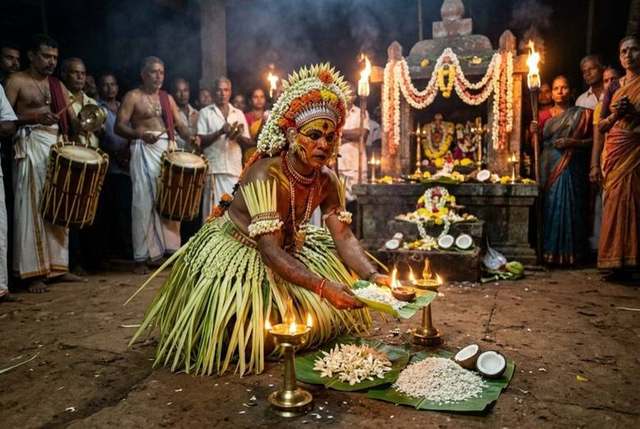 Bhuta Kola | |
|---|---|---|
| Tradition Name | Sioux Empire Fair | Bhuta Kola |
| Native Script / Endonym | Sioux Empire Fair | ಭೂತ ಕೋಲ |
Key Differences Between Sioux Empire Fair and Bhuta Kola
- Geography & Origin: Sioux Empire Fair is rooted in United States of America, United States of America (attested Historical oral & textual attestation), whereas Bhuta Kola originates in Tulu Nadu, Coastal Karnataka, India (attested Medieval).
- Classification & Form: Sioux Empire Fair belongs to the Food family (The Sioux Empire Fair is a fair held annually each summer in Sioux Falls, South Dakota, at the W. H. Lyon Fairgrounds. The Sioux Empire Fair includes carnival rides, fair food, livestock shows, horse shows, and art competitions daily.), while Bhuta Kola is documented under Food (All-night Tulu spirit-worship ritual and communal harvest offering of coastal Karnataka in which the medium wears a palm-leaf ani halo and recites paddana epics.).
- Instruments & Materials: Sioux Empire Fair is transmitted through regional performance and craft media; by contrast, Bhuta Kola uses Tempe drum, Nadaswaram, Gaggara bronze anklets, Tender coconut fronds (siri), Brass & silver mukha masks.
- Heritage Recognition & Vitality: Sioux Empire Fair is assessed as UNKNOWN (Documented in public ethnographic & archival sources), while Bhuta Kola is assessed as STABLE (National Inventory).
Shared Cultural & Historical Parallels
- Both Sioux Empire Fair and Bhuta Kola belong to the Food domain and transmit repertoire across generations through master-disciple lineage rather than commercial mass production.
- Across United States of America and India, both traditions demonstrate how local communities safeguard ancestral craft and performance knowledge through guild, temple, or village stewardship.
Frequently Asked Questions
What is the main difference between Sioux Empire Fair and Bhuta Kola?
Sioux Empire Fair is a food tradition from United States of America, United States of America (The Sioux Empire Fair is a fair held annually each summer in Sioux Falls, South Dakota, at the W. H. Lyon Fairgrounds. The Sioux Empire Fair includes carnival rides, fair food, livestock shows, horse shows, and art competitions daily.), whereas Bhuta Kola is a food tradition from Tulu Nadu, Coastal Karnataka, India (All-night Tulu spirit-worship ritual and communal harvest offering of coastal Karnataka in which the medium wears a palm-leaf ani halo and recites paddana epics.).
Where did Sioux Empire Fair and Bhuta Kola originate?
Sioux Empire Fair originated in United States of America, United States of America (Historical oral & textual attestation). Bhuta Kola originated in Tulu Nadu, Coastal Karnataka, India (Medieval).
What instruments or materials are used in Sioux Empire Fair vs Bhuta Kola?
Sioux Empire Fair uses traditional regional instruments and media. Bhuta Kola uses Tempe drum, Nadaswaram, Gaggara bronze anklets, Tender coconut fronds (siri), Brass & silver mukha masks.
Are Sioux Empire Fair and Bhuta Kola recognized by UNESCO?
Sioux Empire Fair heritage status: Documented in public ethnographic & archival sources. Bhuta Kola heritage status: National Inventory.