Opening room…
Head-to-Head Archival Dossier · Craft
water basketball vs Channapatna Wood & Lac Turning: Side-by-Side Archival Comparison
Side-by-side comparison of water basketball (Documented region, Global Archive) and Channapatna Wood & Lac Turning (Channapatna, Ramanagara, Karnataka, India) across cultural family, chronology, materials, instruments, and living vitality.
12-Point Archival Comparison Table: water basketball vs Channapatna Wood & Lac Turning
Study & Syllabus Export Tools · CC BY-SA 4.0
| Dimension | 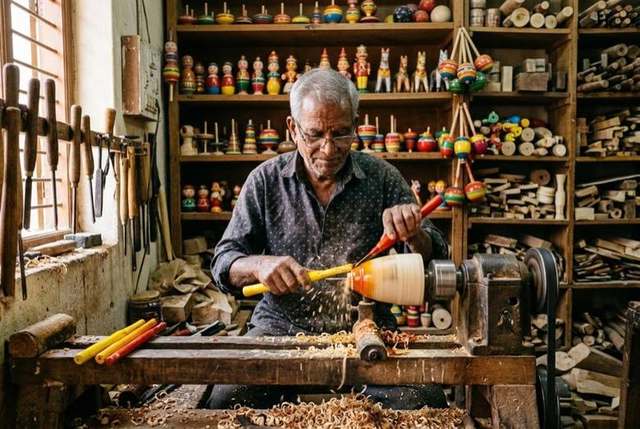 Channapatna Wood & Lac Turning | |
|---|---|---|
| Tradition Name | water basketball | Channapatna Wood & Lac Turning |
| Native Script / Endonym |
Key Differences Between water basketball and Channapatna Wood & Lac Turning
- Geography & Origin: water basketball is rooted in Documented region, Global Archive (attested Historical oral & textual attestation), whereas Channapatna Wood & Lac Turning originates in Channapatna, Ramanagara, Karnataka, India (attested 18th century).
- Classification & Form: water basketball belongs to the Craft family (Water basketball is a water sport, which mixes the rules of basketball and water polo, played in a swimming pool. Teams of five players each must shoot at the goal with a ball within a certain time after gaining possession.), while Channapatna Wood & Lac Turning is documented under Craft (Lathe-turned ivory-wood (Wrightia tinctoria) craft coated on the spinning mandrel with sticks of shellac compounded with turmeric, indigo, and kumkum.).
- Instruments & Materials: water basketball is transmitted through regional performance and craft media; by contrast, Channapatna Wood & Lac Turning uses Hand bow-lathe (patti), Gouge & skew chisels, Aale mara ivory-wood (Wrightia tinctoria), Natural shellac, Screw-pine leaf.
- Heritage Recognition & Vitality: water basketball is assessed as UNKNOWN (Documented in public ethnographic & archival sources), while Channapatna Wood & Lac Turning is assessed as UNKNOWN (National Inventory).
Shared Cultural & Historical Parallels
- Both water basketball and Channapatna Wood & Lac Turning belong to the Craft domain and transmit repertoire across generations through master-disciple lineage rather than commercial mass production.
- Across Global Archive and India, both traditions demonstrate how local communities safeguard ancestral craft and performance knowledge through guild, temple, or village stewardship.
Frequently Asked Questions
What is the main difference between water basketball and Channapatna Wood & Lac Turning?
water basketball is a craft tradition from Documented region, Global Archive (Water basketball is a water sport, which mixes the rules of basketball and water polo, played in a swimming pool. Teams of five players each must shoot at the goal with a ball within a certain time after gaining possession.), whereas Channapatna Wood & Lac Turning is a craft tradition from Channapatna, Ramanagara, Karnataka, India (Lathe-turned ivory-wood (Wrightia tinctoria) craft coated on the spinning mandrel with sticks of shellac compounded with turmeric, indigo, and kumkum.).
Where did water basketball and Channapatna Wood & Lac Turning originate?
water basketball originated in Documented region, Global Archive (Historical oral & textual attestation). Channapatna Wood & Lac Turning originated in Channapatna, Ramanagara, Karnataka, India (18th century).
What instruments or materials are used in water basketball vs Channapatna Wood & Lac Turning?
water basketball uses traditional regional instruments and media. Channapatna Wood & Lac Turning uses Hand bow-lathe (patti), Gouge & skew chisels, Aale mara ivory-wood (Wrightia tinctoria), Natural shellac, Screw-pine leaf.
Are water basketball and Channapatna Wood & Lac Turning recognized by UNESCO?
water basketball heritage status: Documented in public ethnographic & archival sources. Channapatna Wood & Lac Turning heritage status: National Inventory.