Explore Spain's UNESCO-inscribed living traditions — Andalusian Flamenco (cante, baile, toque), Catalan Castells human towers, Silbo Gomero whistled language, and Valencia Fallas.
| Tradition | Region / Place | Family | Attested | Recognition | Instruments / Materials | Vitality |
|---|---|---|---|---|---|---|
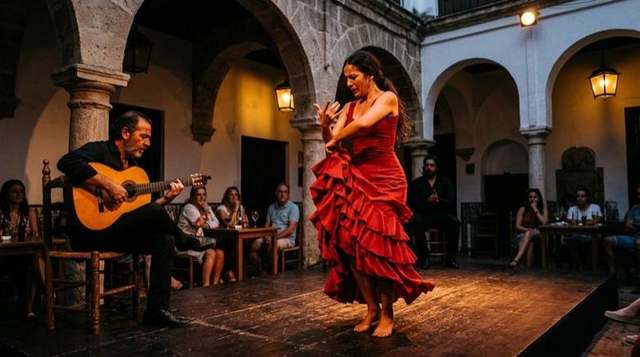
![]() Flamenco Cante, Baile y Toque | Seville, Jerez & Cádiz, Spain | Dance | 18th century | Representative List (2010) | Flamenco guitar, Cajón, Castañuelas, Palmas | ■■■■ Thriving |
![]() 42: Festival de gèneres fantàstics | Spain | Living Tradition | Historical attestation | Archival Record | See cited room dossier | ▢▢▢▢ Not yet sourced |
![]() Actual (festival) | Spain | Living Tradition | Historical attestation | Archival Record | See cited room dossier | ▢▢▢▢ Not yet sourced |
![]() aizkolaritza | Spain | Living Tradition | Historical attestation | Archival Record | See cited room dossier | ▢▢▢▢ Not yet sourced |
![]() Albacete Fair | Spain | Living Tradition | Historical attestation | Archival Record | See cited room dossier | ▢▢▢▢ Not yet sourced |
![]() Alcalá City Awards | Spain | Living Tradition | Historical attestation | Archival Record | See cited room dossier | ▢▢▢▢ Not yet sourced |
Andalusian triad of cante song, baile dance, and toque guitar rooted in Gitano, Moorish, Sephardic, and Castilian traditions.
42: Festival de gèneres fantàstics documented in Spain, Spain.
This guide documents 6 living traditions, including Flamenco (Seville, Jerez & Cádiz), 42: Festival de gèneres fantàstics (Spain), Actual (festival) (Spain), aizkolaritza (Spain), Albacete Fair (Spain), Alcalá City Awards (Spain). Every entry includes its place of origin, cultural family, vitality assessment, and cited sources.
Each tradition is classified under one of the seven cultural families (Dance, Music, Theatre, Painting, Craft, Textile, or Oral Tradition) and verified against UNESCO registers, national academy inventories, and ethnographic monographs under CC BY-SA 4.0.
Andalusian Flamenco (inscribed by UNESCO in 2010) synthesizes Gitano, Moorish, Sephardic, and Andalusian folk idioms across dozens of palos (rhythmic-modal forms).
A free public archive of the world’s living and endangered cultural traditions — documented with primary sources, geographic coordinates, and open-licensed photography. Two rooms, one wall. The door is open.
folkroom — Archive of Living Traditions · Text CC BY-SA 4.0 · Images credited & licensed individually
Open commons: Wikimedia Commons · UNESCO ICH · Openverse · Flickr CC · Wikidata · No trackers · No ads