Opening room…
Skip to content
Regional Heritage Guide · United States · 1 Documented Traditions
Living Traditions, Folk Music, Dance & Crafts of United States — Archival Guide
Structured archival directory of documented folk dances, musical traditions, visual arts, and material crafts of United States, with geographic origins, vitality conditions, and cited sources.
Key Archival & Syllabus Notes
- This archival guide compiles all documented living traditions associated with United States in the Folkroom cultural heritage graph.
Master Reference Table (1 Traditions)
Study & Syllabus Export Tools · CC BY-SA 4.0
| Tradition | Region / Place | Family | Attested | Recognition | Instruments / Materials | Vitality |
|---|---|---|---|---|---|---|
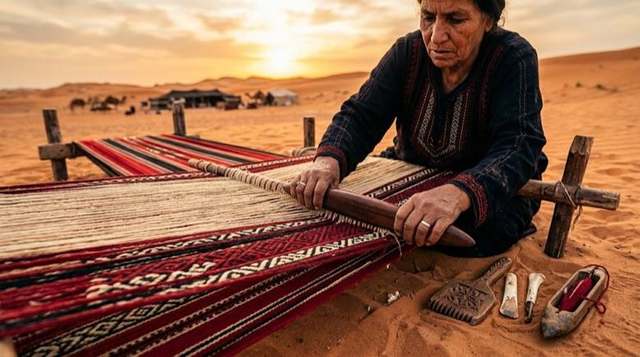 Navajo Upright-Loom Weaving (Diné Diyogí) Diyogí | Chinle, Two Grey Hills & Ganado, Navajo Nation, United States | Textile | 17th century | National Inventory | Upright timber loom, Oak weaving batten (bee nik'i'nilłlish), Wooden weaving fork, Navajo-Churro sheep wool | ■■■□ Stable |
Tradition Dossiers & Field Summaries
Textile · Chinle, Two Grey Hills & Ganado, Navajo Nation, United States
Navajo Upright-Loom Weaving (Diné Diyogí)
Diné vertical-frame loom tapestry weaving of the Colorado Plateau using hand-carded Navajo-Churro sheep wool and desert plant dyes in geometric Two Grey Hills, Ganado, and Chief Blanket patterns.
Frequently Asked Questions
Which traditions are covered in Living Traditions of United States?
This guide documents 1 living traditions, including Navajo Upright-Loom Weaving (Diné Diyogí) (Chinle, Two Grey Hills & Ganado, Navajo Nation). Every entry includes its place of origin, cultural family, vitality assessment, and cited sources.
How are traditions classified and verified in Living Traditions of United States?
Each tradition is classified under one of the seven cultural families (Dance, Music, Theatre, Painting, Craft, Textile, or Oral Tradition) and verified against UNESCO registers, national academy inventories, and ethnographic monographs under CC BY-SA 4.0.
What are the key UNESCO and historical highlights for Living Traditions of United States?
This archival guide compiles all documented living traditions associated with United States in the Folkroom cultural heritage graph.
Side-by-Side Comparisons in This Guide
Textile
Al Sadu Weaving vs Navajo Upright-Loom Weaving (Diné Diyogí)
Textile
Kanjeevaram Silk Weaving vs Navajo Upright-Loom Weaving (Diné Diyogí)
Textile
Zapotec Pedal-Loom Weaving vs Navajo Upright-Loom Weaving (Diné Diyogí)
Dance × Textile
Danza de los Voladores vs Navajo Upright-Loom Weaving (Diné Diyogí)
Dance × Textile
Danza de tijeras vs Navajo Upright-Loom Weaving (Diné Diyogí)